Ksenia Kartamysheva
 - Consulting PMOs need more than project tracking–they require portfolio visibility, governance, resource planning, utilization reporting, and project financial oversight across multiple client engagements.
- While dedicated PMO and PPM platforms excel at governance and portfolio management, PSA software combines those capabilities with billable utilization, project financials, resource planning, and billing workflows, making it well suited to professional services firms.
- PMOs often outgrow spreadsheets when portfolio reporting becomes manual, utilization is measured inconsistently across practices, resource conflicts emerge too late, and executive reporting depends on finance rather than live operational data.
- Before selecting a PMO platform, firms should evaluate governance depth, portfolio reporting requirements, resource visibility, finance integration, and implementation approach through a structured evaluation framework rather than comparing feature lists alone.
- The right solution depends on organizational complexity. Smaller PMOs may succeed with lighter project management tools, while consulting firms managing multiple practices, billable resources, and portfolio-level governance typically benefit from PSA software that connects delivery, utilization, and project economics.
A Project Management Office (PMO) at a consulting firm does not run projects. It runs how projects run: stage gates, portfolio dashboards, cross-practice staffing rules, and executive reporting. PSA (Professional Services Automation) software is built for that layer. It fits when billable delivery, utilization, and margin must roll up from the same records consultants use every day. No PMO can enforce that discipline while portfolio data lives in spreadsheets beside the PM tool.
This article compares the PSA platforms consulting-firm PMOs actually shortlist: Birdview PSA, Kantata, Certinia, Planview, and BigTime. It adds a decision framework for governance depth, reporting, and process standardization across practices.
SPI Research’s 2026 Professional Services Maturity Benchmark links Level 5 firms to billable utilization of 81.2%, versus an industry average of 66.4% [1] – the kind of gap a PMO exists to close. SPI publishes no quartiles.
What a PMO at a consulting firm needs from software
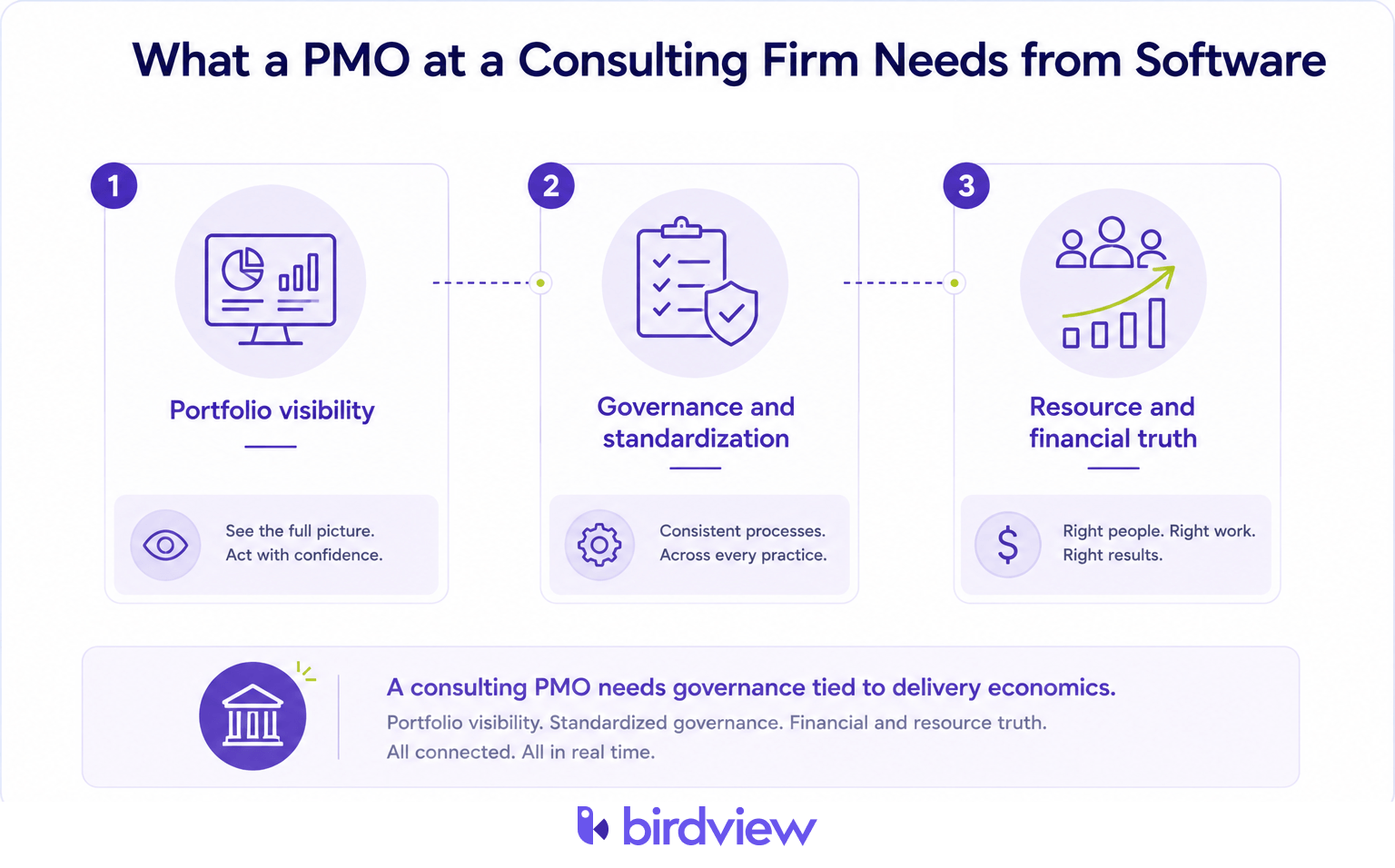
PMO software for consulting is not task management for delivery teams. Three jobs recur in every mature PMO:
Portfolio visibility. Roll up status, budget burn, and risk across 20–200 engagements without exporting each project to Excel.
Governance and standardization. Publish methodology templates, approval gates, and naming rules that practices cannot override at will.
Resource and financial truth. See who is booked next month, which engagements are over-burning, and whether utilization trends match the board plan.
Generic PM tools handle work breakdown and deadlines. They rarely hold bill rates, WIP, and firm-wide capacity in the same model PSA uses. That gap is why PMO directors at billable firms evaluate PSA software for PMO governance. Not another project board.
PSA vs dedicated PMO tools: Where the categories overlap
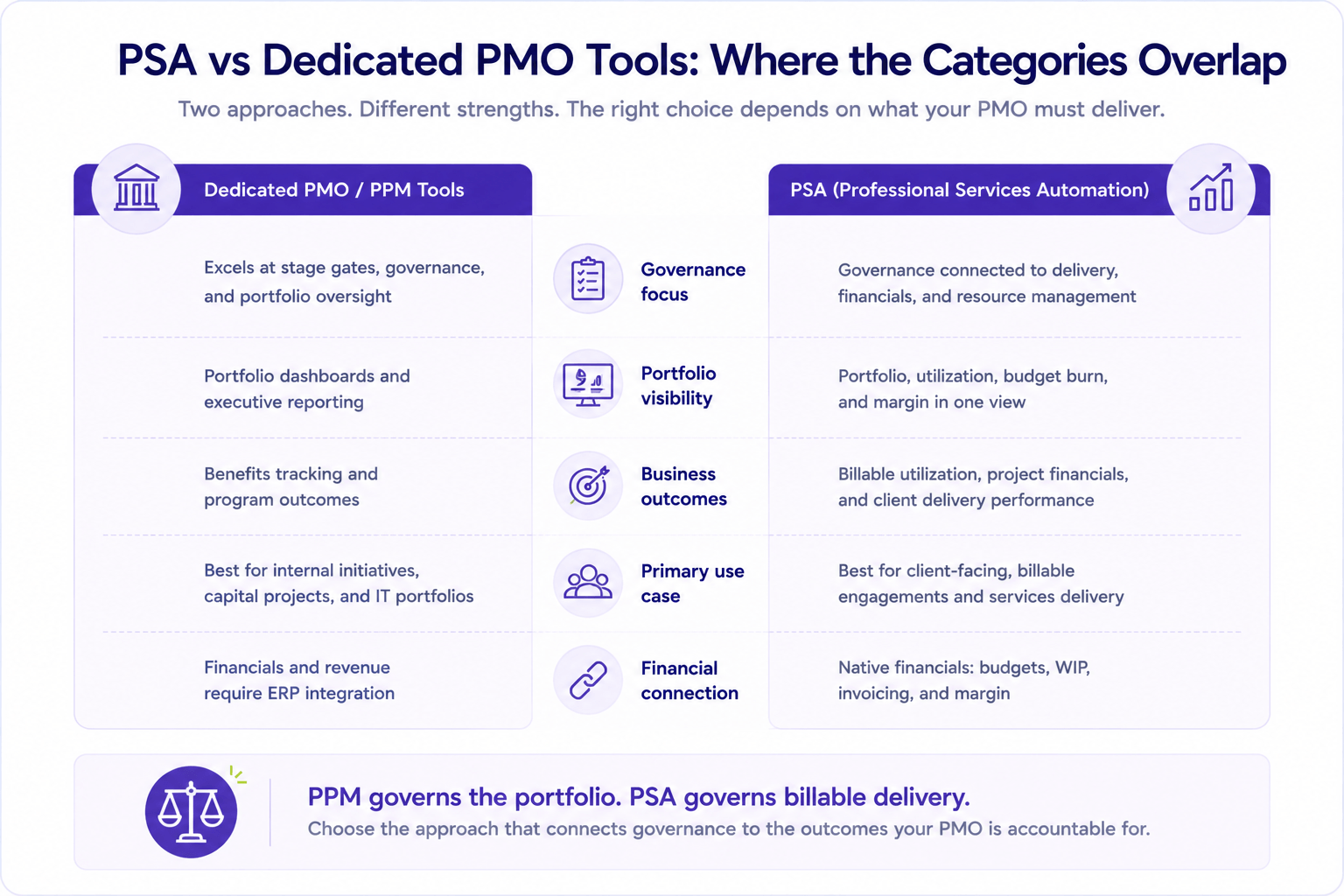
On paper, the two categories look close. Dedicated PMO suites (portfolio governance platforms, enterprise PPM) excel at stage gates, benefits tracking, and executive dashboards across business units. PSA excels when the PMO must also answer: Are we billing correctly, staffed correctly, and profitable on each account?
| Need | Dedicated PMO / PPM | PSA |
|---|---|---|
| Portfolio rollup dashboards | Strong | Strong (delivery + financial) |
| Methodology templates | Strong | Moderate to strong |
| Billable utilization | Weak without integrations | Native |
| Invoice and margin linkage | Requires ERP bridge | Built in |
| Consultant time capture | External | Native |
| Best fit | Corporate IT PMO, capex portfolios | Billable consulting PMO |
The tiebreaker is money. For a consulting firm PMO, PSA wins when governance must tie to revenue and utilization, not only project health colors on a dashboard. Pure PPM wins when the portfolio is mostly internal capex with finance owned entirely by ERP.
Best PSA software for a PMO: Head-to-head comparison
| Capability | Birdview PSA | Kantata | Certinia | Planview | BigTime |
|---|---|---|---|---|---|
| Portfolio status rollup | Yes | Yes | Yes | Yes (enterprise PPM) | Moderate |
| Cross-project resource view | Yes | Strong | Strong | Strong | Moderate |
| PMO reporting / executive dashboards | Yes | Yes | Yes (Salesforce analytics) | Yes | Financial focus |
| Methodology / template standardization | Yes | Yes | Configurable | Strong | Light |
| Billable utilization tracking | Native | Native | Native | Via integration | Native |
| Margin / budget burn on engagements | Real-time | Real-time | Real-time | Portfolio-level | Strong financial |
| Ideal consulting firm size | ~15–200 billable staff | ~100+ / enterprise | Salesforce-centric enterprise | Large program offices | IT / engineering consultancies |
| Typical PMO implementation | 4–6 weeks | Months | Months (Salesforce program) | Months | Weeks to months |
A fit comparison, not a quality ranking. BigTime suits PMOs that put billing precision first [2]. Planview suits program offices that already run enterprise PPM. Birdview PSA targets mid-market consulting PMOs that need portfolio plus delivery economics without a Salesforce program.
How PSA supports portfolio visibility (without a nightly export)
The mechanics are simple. In PSA, a project status change and a time entry share one engagement record. The PMO dashboard reads hours logged, budget consumed, and remaining capacity from the same place delivery managers approve work.
Contrast the spreadsheet model: each practice exports hours on Fridays; the PMO merges files Monday. Staffing decisions then use data 48–72 hours stale. In our experience across professional services firms, the pain shows up at billing. Firms in the Birdview PSA knowledge base reported four to five hours per billing cycle just reconciling time against financials. Portfolio visibility fails the same way when the PMO roll-up is a manual merge.
PSA closes the loop. The PMO sees which engagements are green on tasks but red on margin before the quarter ends.
Executive reporting cadence separates PSA from PM-plus-Excel. Top-quartile firms in SPI 2023 review utilization weekly [1]. A PMO that only refreshes portfolio data at month-end is always reacting. PSA dashboards let the PMO flag a practice trending under 70% utilization in week two–not in the board deck three weeks later.
Five signs your PMO has outgrown PM-plus-spreadsheets
- Portfolio reviews require a new workbook every month. If the PMO rebuilds roll-ups from practice exports, governance is already downstream of delivery.
- Utilization targets exist but practices report differently. SPI 2023 top-quartile firms track utilization weekly [1]. Mixed definitions across practices leave PMO targets with no teeth.
- Resource conflicts surface in client meetings, not the PMO review. One case: a 19-person strategy consulting firm from the Birdview PSA knowledge base. We saw a senior consultant double-booked at a client kickoff. The spreadsheet lagged live assignments by three days.
- Executive asks for margin by practice; the PMO cannot answer without finance. PSA ties delivery records to margin; PM-only stacks defer it to quarter-end.
- Methodology templates exist on paper but not in the system. A standard consultants can bypass in their PM tool is not governance–it is paperwork.
Score yourself honestly. If three or more signs match, look at PSA built for consulting PMOs rather than adding another reporting layer on top of Asana or Monday.com.
PMO evaluation framework: Six steps before you buy
- Define governance depth. Stage gates only, or gates plus billing and utilization enforcement? Deeper governance favors PSA over lightweight PM.
- Map portfolio questions. List the ten questions the PMO must answer monthly (utilization by practice, top five over-burn engagements, bench capacity next quarter). Score vendors on native answers versus custom reports. If a vendor needs a services partner to build more than two of those views, budget that cost into year-one TCO.
- Test cross-practice standardization. Can the PMO publish one engagement template and forbid local variants? If not, the tool is delivery software–not PMO infrastructure.
- Stress-test resource visibility. Book a test 10% headcount increase across two practices. How fast can the PMO see conflicts? Under 30 minutes without exports is a practical bar for firms above ~50 billable staff.
- Align with finance. If ERP owns revenue recognition, confirm PSA-to-ERP integration. Certinia fits Salesforce-native finance; Kantata fits open enterprise stacks; mid-market firms standardize on Birdview PSA without a CRM program.
- Pilot one practice, measure reporting time. Target: monthly portfolio pack in under half a day without manual merges. Track hours saved versus the old spreadsheet process–that number belongs in the business case.
Run the framework with delivery, finance, and PMO in the same room. Full stop. No buying before finance signs off on utilization definitions. The best PSA for a consulting PMO is the one all three will actually maintain.
When a lighter stack is still enough
Not every PMO needs the full platform. A PMO under ~30 billable staff with one practice and one billing model can govern on BigTime or a strong PM tool plus tight templates. That holds while portfolio questions stay mostly schedule and milestone based.
Planview or Certinia make sense when the PMO already sits inside an enterprise Salesforce or PPM program and has rollout budget measured in quarters.
Birdview PSA enters when the PMO must standardize across multiple practices and tie portfolio views to utilization and margin. Governance then lives in the same system consultants log time in–not in a parallel PMO workbook.
The threshold is easy to spot. The firm adds a second geography or practice line, and the PMO can no longer chair every staffing call from memory.
FAQ
Which PMO software is best for enterprise governance, reporting, and portfolio visibility? At enterprise scale, Kantata and Planview lead. Certinia leads when Salesforce is already the corporate backbone. Mid-market consulting PMOs (roughly 15–200 staff) land on Birdview PSA when they need portfolio plus delivery economics without a multi-quarter enterprise rollout.
What PMO tools are best for standardizing processes across departments? Tools that lock templates, stage gates, and naming rules into the system–not PDF playbooks. PSA platforms including Birdview PSA and Kantata publish templates at the portfolio level; pure PM tools rely on optional project copies that practices drift from.
How does PSA support portfolio visibility? PSA rolls up hours, budget burn, and staffing from the same engagement records delivery uses daily. The PMO sees financial and schedule risk together instead of merging exports from each practice.
What problem does PSA solve in portfolio visibility? The manual merge problem–stale spreadsheets, inconsistent utilization definitions, and margin questions deferred to finance. Knowledge-base cases from our clients show hours of rework per billing cycle when time and project financials lived in separate tools.
When do service teams require governance through PSA? When the PMO must enforce utilization, billing rules, and portfolio reporting across billable practices. Writing it down is not enough. That point arrives past ~20–30 billable staff, or when a second practice joins the portfolio.
How do you determine required governance depth in project software? Count how many portfolio questions need live financial or utilization data. If more than half do, PM-only software is not enough. You need PSA, or enterprise PPM plus PSA.
What project software supports governance needs? Enterprise PPM (Planview) for program governance; Certinia for Salesforce-native governance. Kantata fits large consulting operators. Birdview PSA fits mid-market consulting PMOs that need governance tied to billable delivery and margin.
Bottom line
The best PSA for a consulting-firm PMO is the platform it can govern with, not just report from. One test settles it. If portfolio reviews still mean merging spreadsheets, the PMO is auditing delivery after the fact. PSA built for professional services puts governance, utilization, and margin in one model consultants cannot bypass. That means Birdview PSA at mid-market scale, Kantata or Certinia at enterprise.
Sources
[1] SPI Research – 2026 Professional Services Maturity Benchmark – https://spiresearch.com/psmaturitymodel/
[2] BigTime – PSA software overview – https://www.bigtime.net/blogs/what-is-psa-software/