Ksenia Kartamysheva
 - A project portfolio review is a governance meeting that evaluates all active engagements together, helping delivery leaders balance utilization, project margins, resource capacity, and risk across the entire portfolio rather than reviewing projects individually.
- Successful portfolio reviews depend on preparation. A concise review pack, clearly defined attendees, and a structured 90-minute agenda allow leadership teams to focus on decisions instead of gathering or validating data during the meeting.
- The most valuable portfolio metrics include practice utilization, project margin, budget burn versus schedule, and outstanding change orders. Reviewing these indicators together helps identify staffing issues, profitability risks, and delivery problems before they affect clients.
- Common portfolio review failures include discussing every project instead of prioritizing high-risk engagements, relying on outdated spreadsheet data, failing to assign action owners, and excluding finance from governance decisions.
- As project portfolios become more complex, manual spreadsheets make governance slower and less reliable. Professional Services Automation (PSA) software connects project delivery, resource planning, financials, and reporting into a single operational view, reducing preparation time and improving portfolio visibility.
A project portfolio review is a recurring governance meeting. Delivery leadership checks every active engagement at once: utilization, margin, burn, and risk, not just the projects already in trouble. COOs and PMO leaders use it to redeploy capacity, catch margin erosion early, and align priorities before client impact. Without a monthly roll-up, each practice tunes its own numbers while the firm drifts on staffing and margin.
This guide is for COOs, PMO leads, and delivery executives at consulting and professional services firms. It lays out a repeatable monthly cadence, not a status parade.
SPI Research’s 2026 Professional Services Maturity Benchmark (509 organizations) reports median billable utilization at 66.4%, with Level 3 maturity firms at 72.5% and Level 4–5 firms at 80–81% [1], a portfolio-level gap no single project view will surface. SPI publishes no quartiles.
What a project portfolio review is (and is not)
A portfolio review is governance, not a project status meeting. Status meetings answer how one engagement is tracking. A portfolio review answers: given everything running in parallel, are we deploying capacity, margin, and risk tolerance in the right places?
The output is a decision log and action register, not a slide deck that disappears until next month. Decisions made here carry portfolio authority: reorder a practice’s backlog, shift senior architects, or push a change order before burn crosses a threshold.
Who attends and how to prepare the review pack
Core attendees: COO or Head of Delivery (chair), PMO lead (process owner), practice leads, resource management, finance. Client-facing partners join only when a named engagement needs an escalation decision. Keep the room under ten people. Larger groups turn the review into a broadcast.
Prep pack (due 48 hours before the meeting):
| Pack item | Owner | Purpose |
|---|---|---|
| One-page portfolio dashboard | PMO | Utilization, margin, burn, risk flags |
| Project summary sheet | PMO | RAG status, milestone variance, forecast vs actuals |
| Prior action log | PMO | Owner, due date, completion status |
| Escalation queue | Practice leads | Items needing portfolio-level decision |
If pack assembly takes more than three hours, the bottleneck is data infrastructure, not PMO discipline. Birdview PSA knowledge-base cases show what that costs. Firms lost four to five hours per billing cycle when time, assignments, and financial roll-ups lived in separate tools. Portfolio reviews fail the same way when the dashboard is a Friday export ritual.
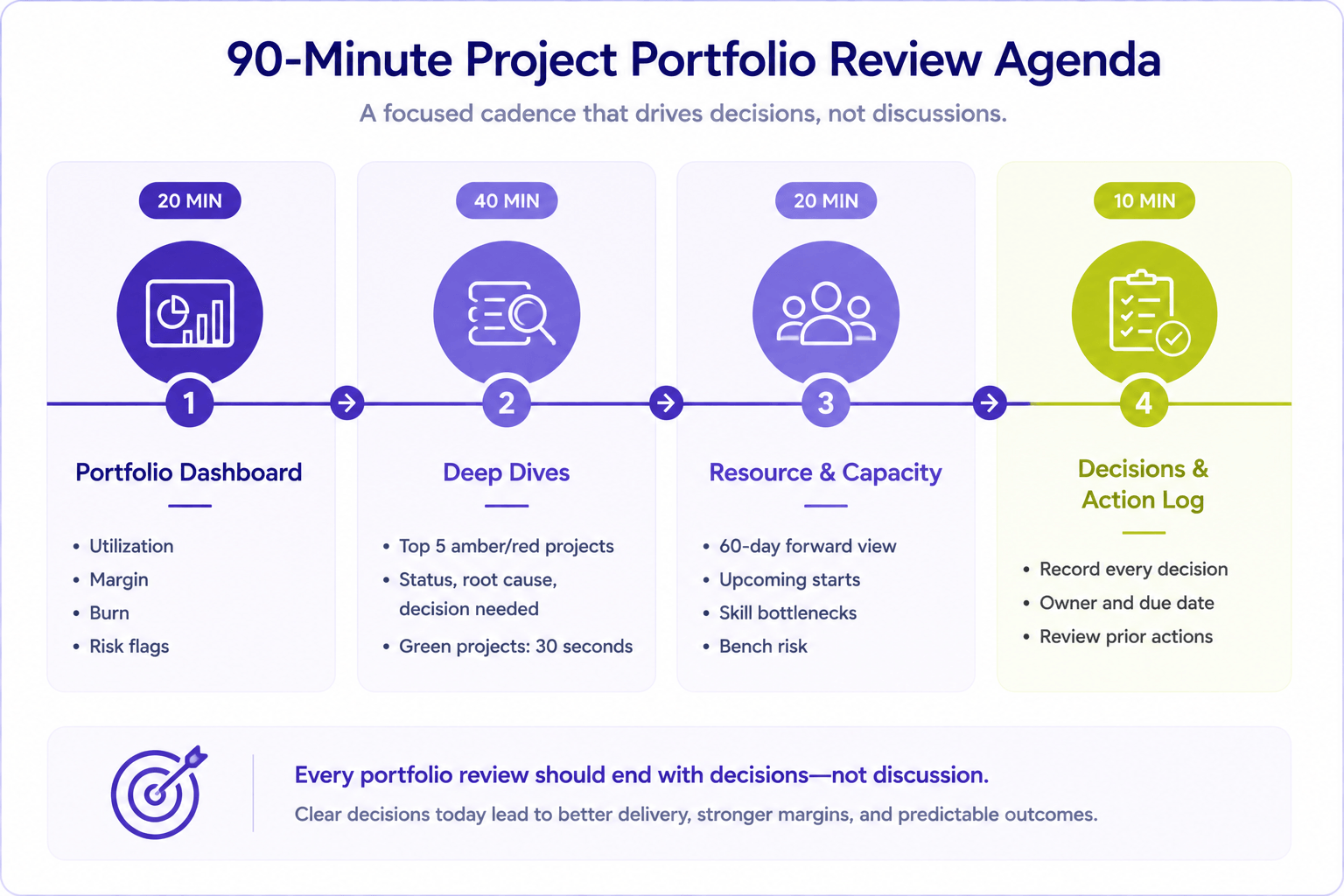
Agenda blocks with time boxes (90 minutes)
Block 1 – Portfolio dashboard (20 min)
Open with numbers: firm and practice utilization, blended margin, projects flagged for burn risk. Pattern recognition comes first. Which practices are over-allocated? Which engagements are under target margin?
Block 2 – Deep dives (40 min)
Amber and red projects only, five max, eight minutes each: status, root cause, decision needed. Green projects get 30 seconds. This rule separates governance from status theater.
Block 3 – Resource and capacity (20 min)
Resource management leads with a 60-day forward view: upcoming starts, skill bottlenecks, bench risk. SPI 2026 ties higher maturity levels to weekly utilization discipline [1]; portfolio reviews that only refresh monthly are always reacting.
Block 4 – Decisions and action log (10 min)
Log every decision in the room: what, named owner, due date. Review prior actions for completion. No deferral to email after the meeting ends.
The metrics dashboard: Utilization, margin, and burn
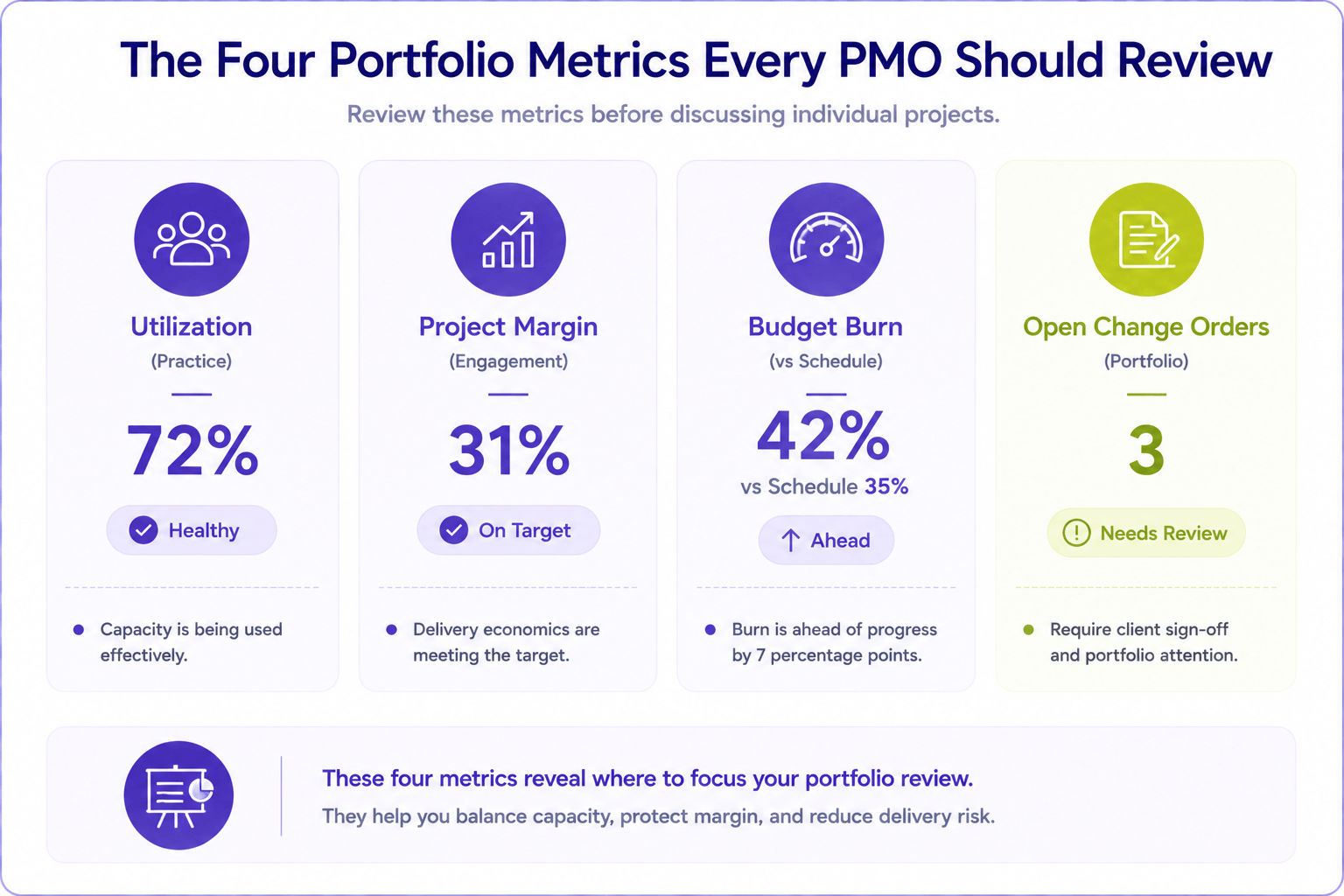
Utilization. Billable hours ÷ available hours, tracked at portfolio and practice level, not only by individual. Most well-run consulting firms target 70–75% billable utilization on delivery staff; SPI 2026 reports Level 4–5 firms at 80–81% and the median at 66.4% [1].
Margin by project and practice. Gross margin per engagement exposes scope creep without change orders and seniority drift on fixed-fee work. Flag any project under target margin with more than 30% budget consumed.
Burn vs schedule. Budget or hours consumed compared to milestone progress. If burn exceeds schedule progress by more than 10 percentage points, the engagement belongs on the deep-dive list. Firms without integrated PSA consistently report higher overrun rates than those where delivery and financials share a platform [2]. Half that gap is visibility and reaction time.
| Metric | What it tells the portfolio | Typical review trigger |
|---|---|---|
| Utilization (practice) | Capacity vs demand | Practice below 70% for two consecutive weeks |
| Gross margin (engagement) | Delivery economics vs sold rate | Margin under target with >30% burn |
| Burn vs schedule | Early overrun signal | Burn ahead of milestones by >10 points |
| Open change orders | Scope control on fixed fee | CO pending client sign-off past 14 days |
Review these four rows before deep dives. If the dashboard cannot produce them from one data path, the meeting will debate spreadsheet versions, not the portfolio.
A 90-minute portfolio review in practice
Picture a 40-person consulting firm with 22 active engagements across two practices. The PMO circulates the pack Tuesday for a Thursday review. Block 1 shows utilization at 71% in the digital practice while strategy sits at 78%. Not a crisis. It is a leading indicator before Q4 pipeline converts to staffed work. Block 2 spends eight minutes on a fixed-fee transformation program. Margin slipped from 32% to 19% with 45% of budget consumed. The decision: a priced change order before the next sprint, not a post-mortem in six weeks. Block 3 flags that two upcoming wins both need the same delivery architect in September. The portfolio call: defer one kickoff by two weeks rather than double-book. Block 4 logs three owners with dates. Total elapsed time: 88 minutes. That is the difference between governance and narration.
Where portfolio reviews go wrong
Four failure modes show up before firms admit they need better systems:
Status parade. Every project gets a story; no time-boxed decisions. Fix: green projects get 30 seconds; chair cuts narrative at eight minutes.
Stale data. The dashboard reflects last week’s export; weekend hours and a rate change are missing. A Birdview PSA knowledge-base case caught a senior consultant double-booked at kickoff because spreadsheet assignments lagged live work by three days.
No action log. Everyone agrees something should happen; nothing has an owner. Two weeks later, accounts disagree on what was decided.
Finance absent. Utilization looks fine; margin does not match the ledger. Invite finance to Block 1 so portfolio numbers match what invoicing will show.
Monthly preparation checklist
Use this before every review:
- Refresh portfolio dashboard from live PSA or controlled export (same cut-off time each month).
- RAG all active engagements; pre-select no more than five amber/red deep dives.
- Circulate prep pack 48 hours ahead; chair confirms attendees read it.
- Open with prior action log: complete or re-own incomplete items.
- Close with new decisions logged before anyone leaves the room.
Decisions and the action log
Each log row: decision or action, owner by name, due date, status. The PMO maintains the log between cycles and opens the next review with a completion report. For board or investor reporting, the same log feeds quarterly portfolio summaries without a separate rewrite pass.
Name the owner, not the role. “Finance” is not an owner; “Alex Chen, CFO” is. Vague ownership is how portfolio decisions evaporate between meetings.
Escalations unresolved in the meeting get an owner and a hard deadline, not “we’ll follow up.”
When spreadsheets fail and PSA becomes necessary
Spreadsheets work until roughly 15–20 concurrent engagements or a second delivery practice with its own resource pool. The failure modes repeat. Utilization does not match finance actuals. Allocation lives in one file, status in another. The PMO spends the days before review merging exports instead of analyzing variance.
PSA (Professional Services Automation) connects time, assignments, rate cards, budget burn, and invoicing on one engagement record. The morning-of dashboard then reflects yesterday’s hours, not last week’s manual pull. Mid-market firms often adopt Birdview PSA when portfolio reviews still mean merging timer exports with a master budget sheet. Enterprise stacks (Kantata, Certinia on Salesforce) address the same problem at larger program scale.
Pilot one practice for two monthly cycles. Measure three things: prep-pack hours saved, time from staffing change to dashboard update, and whether finance agrees roll-up margin matches the ledger. If all three improve, the tooling is the constraint, not meeting discipline.
Portfolio visibility without a nightly export is the operational test. PSA platforms including Birdview PSA (mid-market), Kantata, and Certinia answer the same question at different scale. Can the PMO open a Monday-morning roll-up that matches what consultants logged Friday afternoon? If the answer is no, the firm is running governance on lagging evidence. That is exactly where the overrun gap widens [2].
FAQ
What is the difference between a project portfolio review and a project status meeting? A status meeting covers one engagement’s timeline and milestones. A portfolio review examines the full active portfolio and authorizes cross-project resource and priority decisions. Outputs differ: status notes vs a portfolio decision log.
How often should a professional services firm run a portfolio review? Monthly is standard. High-volume firms with short engagements may add a lighter bi-weekly pulse, but the full governance review should stay monthly. Quarterly-only reviews let margin and staffing conflicts compound too long.
Who should own the portfolio review process? The PMO lead owns prep, agenda, and action-log maintenance. The COO or Head of Delivery chairs and holds decision authority. Split ownership without both roles produces informal check-ins, not governance.
What metrics matter most in a PMO portfolio review? Core four: billable utilization, gross margin by project and practice, budget burn versus schedule progress, and project RAG status. SPI 2026 links higher maturity levels to weekly utilization discipline on top of monthly portfolio roll-ups [1].
How do you keep a portfolio review from becoming a two-hour status meeting? Time-box every agenda block. Limit deep dives to five amber/red projects, circulate the prep pack 48 hours early, and give green projects 30 seconds. Attendees who read the pack debate decisions, not data entry.
When does a firm need PSA software for portfolio management? Past roughly 15–20 concurrent projects, or when prep-pack assembly exceeds the value the meeting produces. PSA is required when time, resources, and project financials do not live in one system. Portfolio visibility then becomes a manual merge instead of a live view.
Bottom line
A monthly project portfolio review is one of the highest-leverage governance habits a services firm can build. The recipe is simple. The right room, a disciplined agenda, live metrics, and a decision log that closes the loop. Firms that run the cadence monthly catch staffing conflicts and margin slips while they are still reversible, not after the client escalation email.
Start with the 90-minute structure and prep checklist. Measure prep-pack hours for two cycles. The spreadsheet-vs-PSA question answers itself once data lag shows up in Block 1 twice in a row.
Sources
- SPI Research – 2026 Professional Services Maturity Benchmark (509 organizations; 2025 billable utilization: median 66.4%, L1 54.7%, L2 62.7%, L3 72.5%, L4 80.0%, L5 81.2%; PSA users 66.4% vs non-users 63.5%) – https://spiresearch.com/ps-maturity-model/
- Project Management Institute (PMI) – Pulse of the Profession 2024 (integrated project management practices and overrun reduction) – https://www.pmi.org/learning/thought-leadership/pulse