Ksenia Kartamysheva
 - Revenue leakage occurs across the entire service delivery lifecycle–not just during time tracking. Most leakage happens when work moves between people, projects, and finance through disconnected approvals, billing processes, and collections.
- A structured quarterly audit of time capture, scope management, billing operations, and collections helps firms identify operational gaps before investing in new software. Organizations should measure controls consistently and review results across all three operational domains.
- The six highest-impact controls include shortening the approval-to-invoice cycle, establishing realization targets, enforcing priced change orders, billing more frequently, monitoring WIP aging, and implementing a consistent collections process. Together, these practices reduce write-downs, billing delays, and lost revenue.
- Key performance indicators such as realization rate, WIP days, net collection rate, write-down rate, and time-to-approval provide early warning signs of revenue leakage long before year-end financial reports reveal the problem.
- As firms grow, disconnected spreadsheets and manual handoffs make revenue leakage harder to control. Professional Services Automation (PSA) software helps connect time tracking, project budgets, WIP, billing, and accounting into a single workflow, reducing manual reconciliation and improving financial visibility.
Revenue leakage is billable value your firm earned in delivery but never collected. It is lost in the gap between work performed, hours approved, invoice issued, and cash received. It is not the same as low utilization on the bench. Leakage happens while people are busy. Unlogged hours, unpriced scope, write-downs, billing delays, and collection gaps each look small. Stacked across a portfolio, they are not.
Realization rate – invoiced hours divided by logged billable hours – is not a metric SPI Research publishes in its 2026 benchmark; the word ‘realization’ does not appear in the report. Closing even part of the spread between logged and invoiced hours recovers fees that were always there–just never invoiced or collected.
This playbook is for CFOs, heads of delivery, and billing operations leaders. It is a cross-firm audit–not another memo blaming “time tracking culture.”
Where leakage hides: People, projects, and finance
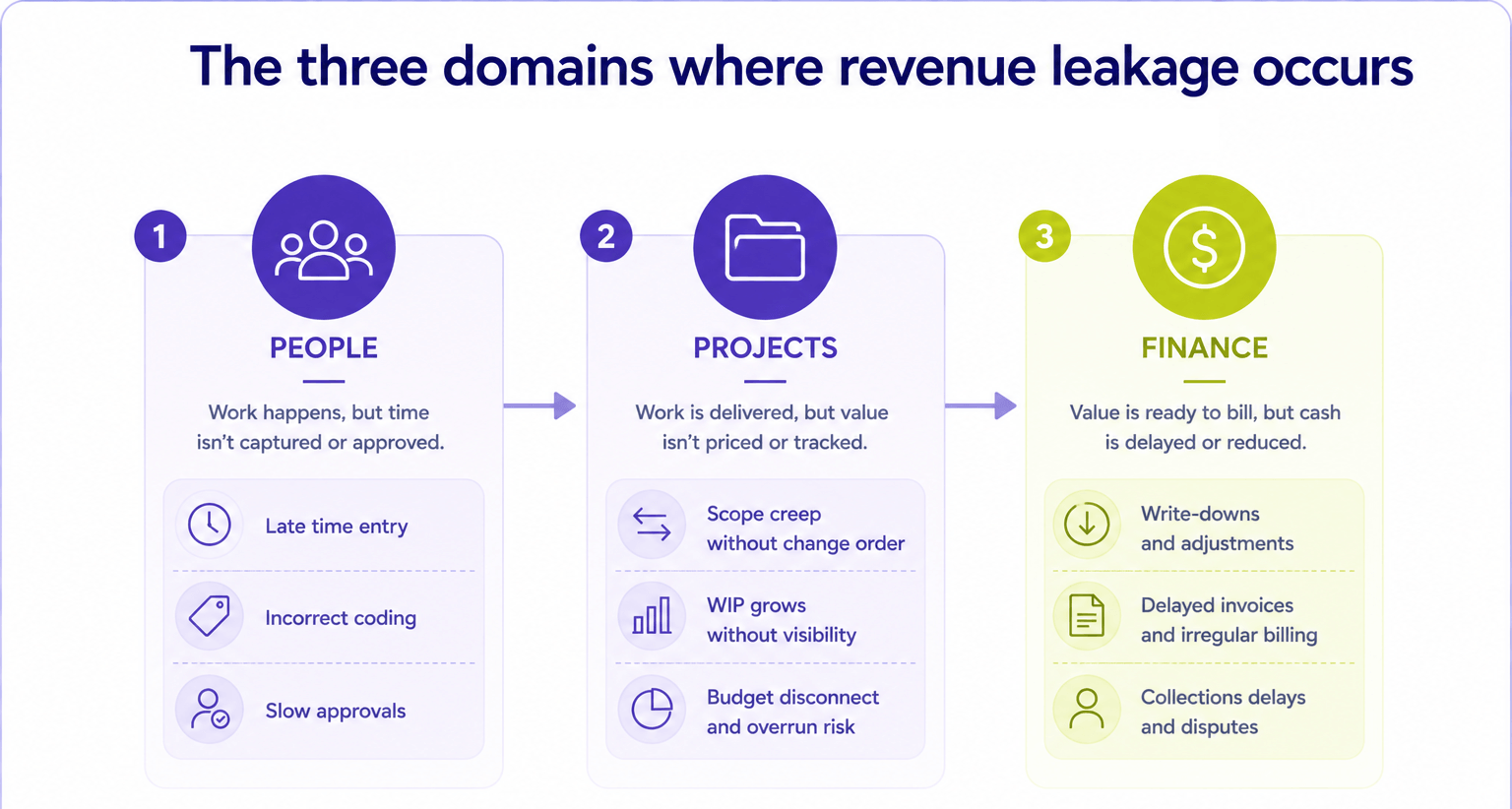
Most leakage is a handoff problem. A late timesheet (People) becomes an unbilled hour (Projects) becomes a delayed invoice (Finance). Fixing one domain in isolation does not close the gap. The leak lives in the seam.
| Domain | Typical leak | Early signal |
|---|---|---|
| People | Forgotten hours, wrong codes, slow approvals | Friday bulk entry; managers approving from memory |
| Projects | Scope absorbed without change order; WIP not tied to budget burn | Engagements finish “on budget” with zero COs |
| Finance | Write-downs without reason codes; quarterly billing; stale AR follow-up | Realization drifts down quarter over quarter |
Deltek’s 2022 Clarity report linked automated time-to-billing workflows to realization rates 8–12 points higher than manual shops [2]. That gap is not pricing genius. Fewer hours die between approval and invoice.
Birdview PSA knowledge-base cases from professional services firms report four to five hours lost per billing cycle. The common thread: time, project budgets, and invoicing lived in separate tools. Multiply that across monthly closes and you are funding reconciliation labor instead of collection.
Revenue leakage audit: Score your firm in 90 minutes
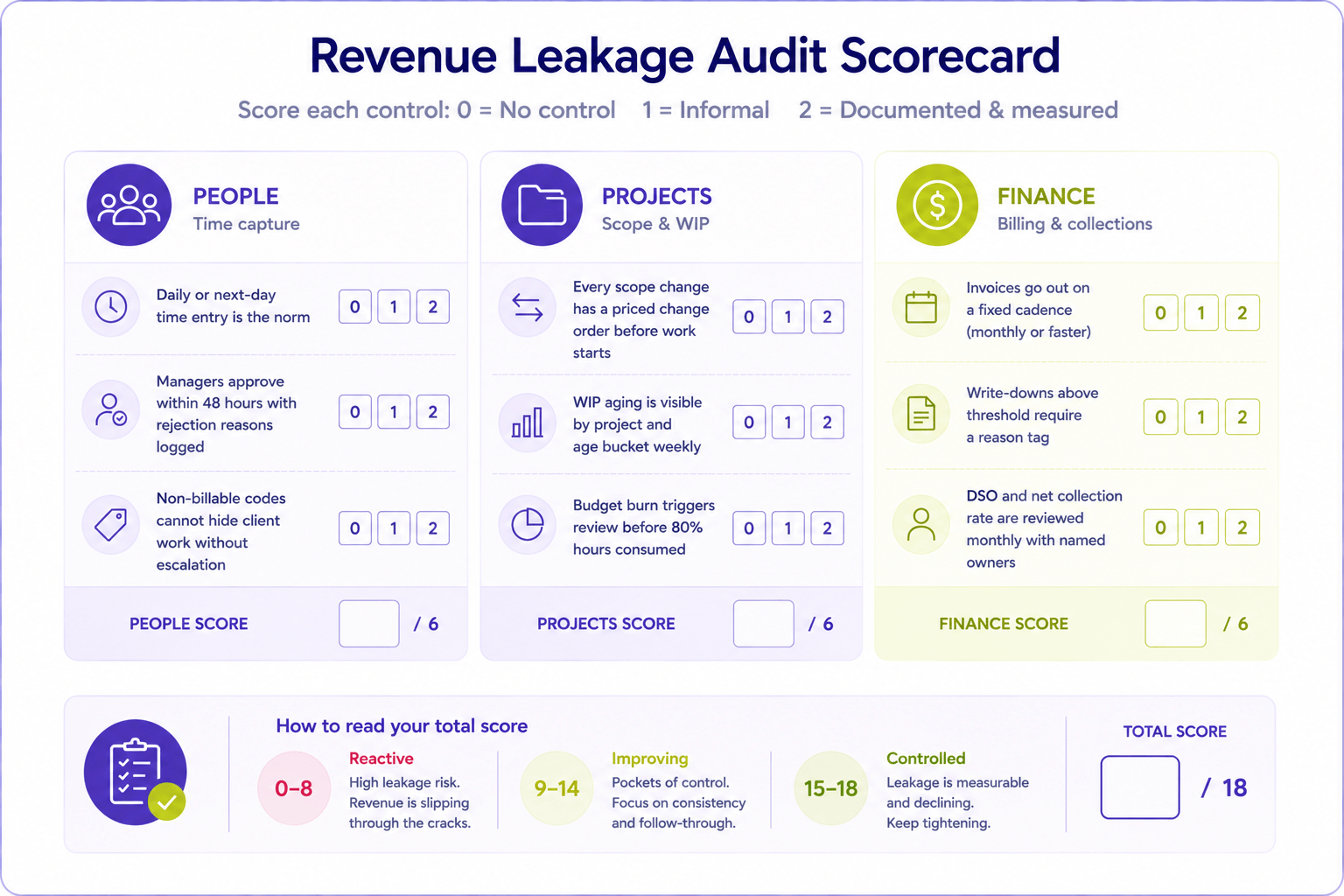
Run this once per quarter before you buy new software. Score each row 0 (no control), 1 (informal), 2 (documented + measured).
People / time capture
- Daily or next-day time entry is the norm–not end-of-week catch-up
- Managers approve within 48 hours with rejection reasons logged
- Non-billable codes cannot hide client work without escalation
Projects / scope and WIP
- Every scope change has a priced change order before work starts
- WIP aging is visible by project and age bucket weekly
- Budget burn triggers review before 80% hours consumed
Finance / billing and collection
- Invoices go out on a fixed cadence (monthly or faster)–not “when someone has time”
- Write-downs above threshold require a reason tag (scope, estimate, dispute, courtesy)
- DSO and net collection rate are reviewed monthly with named owners
How to read the score: 0–8 means reactive billing. 9–14 means pockets of control. 15–18 means leakage is measurable and declining. If Projects and Finance both score below 4, realization will keep slipping no matter how hard consultants log hours. Share the score with partners quarterly. Visibility without accountability changes nothing.
Six controls that reduce leakage (in priority order)
Not every control needs PSA on day one. All six need an owner and a number on the dashboard.
- Shorten the approval-to-invoice path. Target: approved hours become invoice lines within five business days. Longer cycles inflate WIP and invite write-downs at month-end when finance is rushing to close.
- Set a realization floor. Publish a firm minimum: for example, no engagement invoices below 85% of logged billable value without a partner reason code. Treat 85% as an internal policy threshold and adjust it based on your firm’s pricing, billing model, and historical performance.
- Gate scope before work. Template: client sign-off, budget line update, then delivery. Informal Slack requests do not count. Fixed-fee work leaks here first; T&M leaks when extra hours never reach the invoice.
- Bill monthly (or faster). Quarterly billing increases WIP, write-downs, and client surprise. Monthly cycles pull DSO down and shrink pre-invoice discounts–cash arrives closer to effort. Retainers with quarterly true-ups hide overage until reconciliation. Monthly metering closes that gap.
- Run WIP aging weekly. Flag engagements where WIP grows faster than milestone completion. Ten days of approval-to-invoice delay on $600,000 monthly billings can leave roughly $200,000 in idle WIP at any moment. That is cash you earned on paper but have not collected.
- Collections cadence, not heroics. Day 7 reminder, day 21 escalation, day 45 partner call–documented. Leakage after invoice (disputes, slow pay) is still leakage; net collection rate belongs on the same deck as utilization.
Stop buying tools until controls 1 and 3 have owners. Process first. Software second.
Metrics that expose leakage before year-end
Track these monthly at firm and engagement level.
| Metric | Formula (simplified) | Why it matters |
|---|---|---|
| Realization rate | Billed value ÷ logged billable value | Catches write-downs and reclassification |
| WIP days | Average days from work to invoice | Surfaces approval and billing bottlenecks |
| Net collection rate | Cash collected ÷ invoiced amount | Finds post-invoice leakage |
| Write-down rate | Invoice adjustments ÷ gross billings | Shows discount culture vs. one-offs |
| Time-to-approve | Hours from entry to manager approval | Stale hours rarely survive to invoice intact |
If realization drifts 3+ points over two quarters while utilization is flat, the problem is billing and scope–not sales pipeline.
Billing model guardrails: Fixed price, time and materials, and retainer
Leakage patterns differ by contract type. One policy does not fit all.
| Model | Primary leak | Control |
|---|---|---|
| Time and materials | Unlogged hours; realization erosion | Daily entry; cap notifications; weekly billing where contracts allow |
| Fixed fee | Scope creep without CO | Phase thresholds; mandatory change orders |
| Retainer | Overage buried in “included” hours | Meter included hours monthly; invoice overage automatically |
What billing models should PSA support? At minimum: T&M with rate cards, fixed-fee milestones, and retainer buckets with overage rules. That way finance does not re-key approved hours into a separate ledger. Accounting integration matters because duplicate entry is where approved hours disappear between delivery and invoice.
Weekly leakage review: A 30-minute cadence
Billing ops + delivery lead, every Monday:
| Block | Time | Output |
|---|---|---|
| Realization outliers | 10 min | Top five engagements below firm floor |
| WIP aging | 10 min | Any project >14 days approval-to-invoice |
| Write-down log | 10 min | Adjustments >threshold with missing reason codes |
Close with one action per outlier: chase approval, issue change order, or escalate collection. If the meeting produces no named owner and date, it was reporting–not leakage reduction.
When integrated PSA stops the seams
Spreadsheets work for a single engagement post-mortem. They fail as a firm-wide leakage system past roughly 20–30 billable staff or when T&M and fixed-fee run in parallel.
PSA (Professional Services Automation) ties time entry, rate cards, budget burn, WIP, and invoicing to one engagement record. Control 1 then stops depending on a Friday export ritual.
Mid-market firms adopt Birdview PSA when billing still means merging Harvest or Toggl exports with a master budget sheet. Enterprise stacks (Kantata, Certinia on Salesforce) address the same seam at larger program scale.
What changes when PSA integrates with accounting? Approved project hours post to the general ledger without re-entry. Invoice lines match the project budget. Realization and WIP reconcile to cash without a multi-hour month-end bridge. Pilot one live engagement for two billing cycles. Measure billing lag, realization, and finance’s reconciliation hours before portfolio rollout.
That is infrastructure. The six controls above are operating discipline–and they work before the RFP.
FAQ
What is revenue leakage and how do services firms stop it? Revenue leakage is earned billable value that never becomes collected cash. It is lost across time capture, scope, billing, and collections. Firms stop it by auditing the People/Projects/Finance seams and enforcing priced change orders. They shorten the billing path and track realization and WIP weekly.
How to reduce revenue leakage in professional services? Prioritize daily time entry with fast approval and realization floors with reason codes on write-downs. Add a monthly billing cadence, WIP aging reviews, and a documented collections path. Measure realization and net collection monthly–not only utilization.
What is realization rate in professional services? Realization rate is billed revenue divided by logged billable value–expressed as a percentage. SPI 2023 cites median firms near 72–75% and top quartile above 85% [1]. It exposes write-downs, reclassification, and billing caps that utilization alone hides.
What is work in progress (WIP) in professional services? WIP is the value of work performed but not yet invoiced. Growing WIP with slow billing cycles ties up cash and increases end-of-period write-downs. Weekly WIP aging by project catches approval and billing bottlenecks before month-end.
How do firms that sell billable hours lose revenue when time tracking is inconsistent? Unlogged hours never reach the client invoice. Neither do hours stuck in slow manager approval or reclassified during invoice review. The loss is often one hour per person per week–small per consultant, material at firm scale. Inconsistent capture is one leakage channel; billing and scope controls address the rest.
What billing models (time-and-materials, fixed-fee, retainer) should a PSA platform support for a services firm? Support all three natively. T&M needs role-based rate cards. Fixed fee needs milestones or phase billing. Retainers need included-hour meters and overage rules. Mixed portfolios cannot rely on exports–handing hours to accounting is where leakage returns.
What changes in a services firm’s project billing when its PSA platform is integrated with its accounting system? Duplicate entry disappears. Approved hours flow straight to invoicing and GL. WIP and realization reconcile to cash. Manual bridges between project delivery and finance shrink. Birdview PSA knowledge-base cases cite multi-hour monthly reconciliation cycles eliminated when time and billing share one record.
Bottom line
Reducing revenue leakage in professional services is an operating system–not a one-time billing cleanup. Audit the three domains, install the six controls in order, and measure realization and WIP before you blame utilization. Firms that only chase new logos while leaking on delivery are filling a bucket with the tap running.
Start with control 1 and control 3 this month: tighten approval-to-invoice and gate scope before work. Add metrics and collections discipline next. PSA earns its place when manual handoffs still lose hours after process owners exist.
Sources
[1] SPI Research – 2026 Professional Services Maturity Benchmark – https://spiresearch.com/psmaturitymodel/
[2] Deltek – 2022 Clarity Professional Services Industry Report (automated time-to-billing vs manual realization rates) – https://info.deltek.com/Clarity