Ksenia Kartamysheva
 - Missed project deadlines often result from poor visibility into resource capacity, utilization, dependencies, and project financials rather than poor execution.
- A common failure chain begins with limited operational visibility, leading to scheduling errors that eventually become client-facing delivery delays.
- Disconnected project management, resource planning, and financial systems make it difficult to identify overloaded consultants, budget overruns, and dependency risks before they affect project schedules.
- Monitoring early warning indicators such as resource utilization, dependency changes, milestone health, and project burn rates enables consulting firms to resolve issues before deadlines are missed.
- Professional Services Automation (PSA) software connects project planning, resource management, time tracking, financial data, and portfolio visibility into a single system, helping delivery teams identify risks earlier and improve on-time project delivery.
Resource visibility means seeing who is staffed on what, at what utilization, against which budget. One place, while dates are still movable. The missed deadlines consulting teams keep hitting share a mechanism, not a work-ethic problem. SPI Research’s 2026 benchmark reports industry on-time delivery of 73.8% in 2025 – meaning roughly 26% of projects miss their original deadline. By maturity level: L1 31.3%, L2 70.4%, L3 75.4%, L4 82.5%, L5 89.6%. PSA users 73.8% vs non-users 75.2% – PSA is behind on this line [1]. Delivery leads are busy. They are also blind until a milestone slips. The chain runs in three stages: visibility gap → scheduling error → missed deadline. We built Birdview PSA to break that chain at Stage 1.
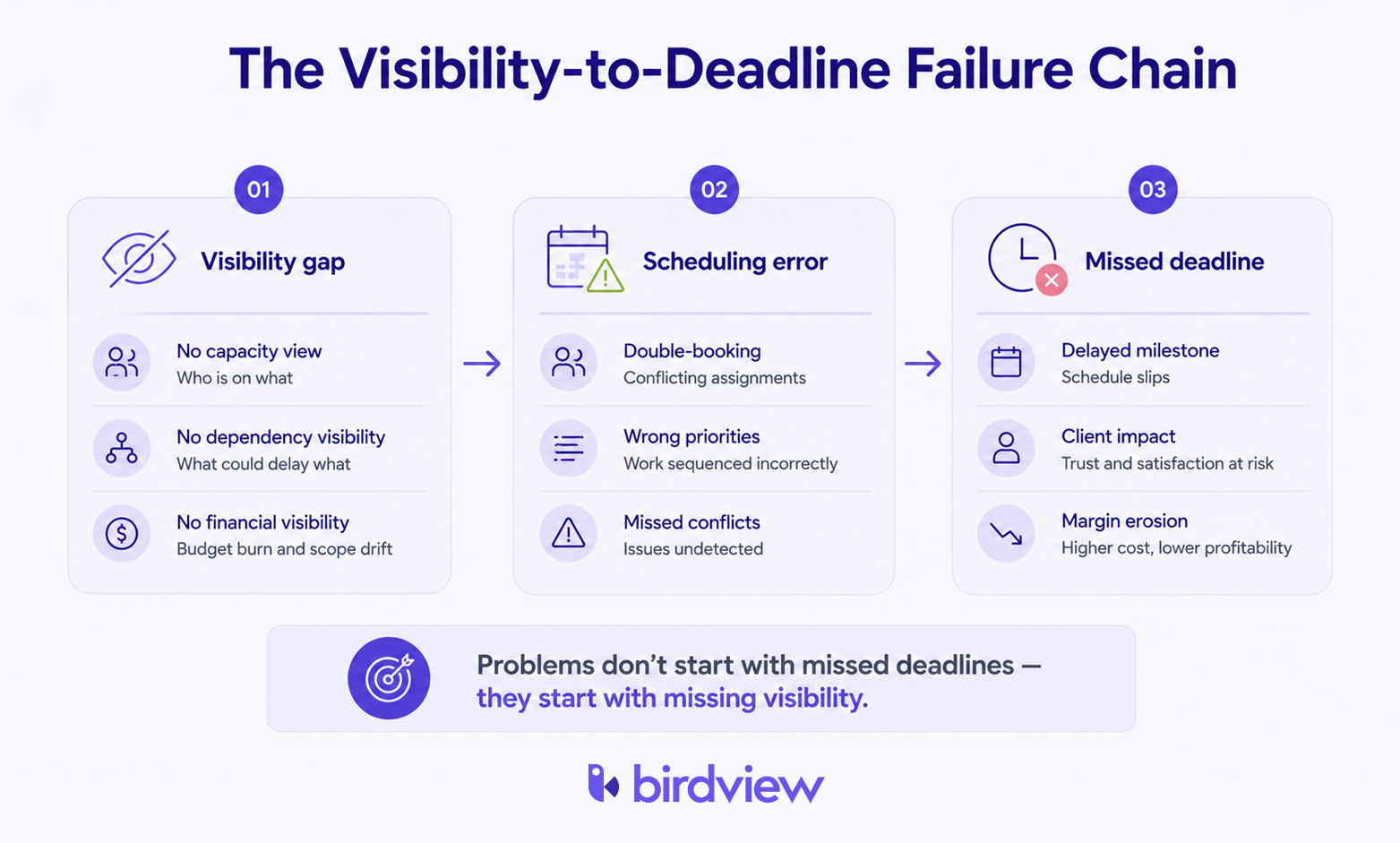
The 3-step causal chain: From visibility gap to missed deadline
- Stage 1 – Visibility gap: No consolidated view of who is on what, at what utilization, against which budget.
- Stage 2 – Scheduling error: Plans are built on partial data – double-booking, ignored dependencies, assignments without load checks.
- Stage 3 – Missed deadline: The error surfaces at a milestone; downstream work is already committed, so rescheduling cost multiplies.
Timeline math: a 10-person team spends two hours per person per week reconciling status across disconnected tools. That is 1,040 hours/year of lost scheduling intelligence. Enough time to catch Stage 1 signals before they become Stage 3 crises.
This article maps the causal mechanism. Tool-fragmentation costs and profitability blind spots are separate topics. The question here: how missing data becomes a missed deadline.
Stage 1: Visibility gaps: What managers cannot see
Four blind spots recur every planning cycle:
- No consolidated capacity view across concurrent projects
- No real-time financial burn rate per engagement – scope creep moves the schedule before finance flags it
- No dependency map – a three-day slip on a predecessor stays hidden until the successor is due
- No utilization alert for load above ~85%
Blind spots compound. Fast.
Birdview PSA’s delivery research documents what we saw across delivery teams: managers rely on partial data, overbook some teams, and leave others idle. SPI Research’s 2026 benchmark ties Level 1 (lowest maturity) firms to on-time delivery of 31.3%, against an industry average of 73.8% [2]. SPI publishes no quartiles – use maturity levels instead. At enterprise scale, multi-project resource conflicts routinely rank among the top drivers of schedule slippage. Its trigger: capacity tracked project-by-project instead of portfolio-wide. This pattern holds at 40 delivery staff or 400.
| Visibility gap | Scheduling consequence |
|---|---|
| No capacity view | Senior staff double-booked undetected |
| No burn-rate view | Scope creep shifts dates before finance sees it |
| No dependency map | Predecessor delay invisible until successor is late |
| No utilization alert | Overload shows up as a missed milestone, not a signal |
Where firms go wrong before the deadline slips
Most consulting firms we see do not ignore dates. They manage them in the wrong layer.
Mistake 1 – Capacity in a spreadsheet, tasks in a PM tool. That sheet updates weekly. Assignments change daily. Your plan is stale on contact.
Mistake 2 – Burn rate reviewed after the steering meeting. Finance learns margin is tight after delivery has already promised the next phase.
Mistake 3 – Dependencies documented once, never enforced. A predecessor moves; nobody re-baselines the successor until the client asks.
Mistake 4 – Alerts tied to missed work, not rising load. The system pings when a task is late. It stays silent when a consultant hits 110% utilization two weeks earlier.
Mistake 5 – Portfolio questions answered in meetings. “Who is free?” becomes a calendar poll instead of a capacity query.
Each mistake pushes detection from Stage 1 toward Stage 3. The fix is not more status meetings. It is shared resource and financial visibility at assignment time.
Stage 2: Scheduling errors: How blind spots become bad plans
Double-booking is the most common error – and invisible at assignment time. A lead staffs Project B without seeing the same consultant at 100% on Project A. That conflict sleeps until a date slips.
Example math: Six-week engagement, two-week dependency chain. Key resource double-booked in week 3 with no dependency view. Result → the downstream milestone shifts ~10 business days (June 14 becomes July 1). Not from bad estimates – from an undetectable conflict.
In our work with consulting and IT services firms, we saw decisions made “in the dark” – overbooked members, idle specialists, last-minute fire drills. McKinsey’s research on large-scale IT delivery found projects running 7% over schedule and 45% over budget on average [3].
Five scheduling errors tied to poor visibility:
- Double-booking across concurrent projects
- Re-sequencing without checking dependencies
- Assigning work without current utilization
- Missing budget-burn signals before scope hits the schedule
- Learning a predecessor is three days late only after the successor is due
Poor resource planning deadlines start here: the plan looks feasible in a slide deck because nobody modeled concurrent load. Finance sees burn in one export. Delivery sees tasks in another. And the resource sheet lives in a third. Each is accurate locally; none is sufficient to prevent a scheduling mistake.
Stage 3: Missed deadlines: The compounding cost of late detection
A delay caught in week 1 of a 12-week project costs 1–2 days to reschedule. The same delay caught in week 8 can cost 5–10 days. By then downstream tasks are staffed, clients expect dates, and commitments are hard to unwind.
In the same McKinsey research, 17% of large IT projects go so badly that they threaten the company’s survival [3]. Late detection is a large part of what turns an ordinary slip into a failure of that scale.
Scenario: 40-person IT services firm, 15 concurrent projects. One resource conflict in week 4, invisible across tracks, can cascade into three simultaneous deadline misses by week 8. Behind each miss: the same person, a hidden dependency.
Early-warning failure checklist (three or more = you are fixing in Stage 3, not Stage 1):
- Delays learned from clients, not dashboards
- Weekly status built from three+ separate tools
- Reallocation needs a meeting, not a capacity view
- Budget burn reviewed monthly, not weekly
- Dependencies live outside the project plan; milestone dates updated after slips, not before risk
Stage 3 limits: no early warning, no dependency enforcement, no link between financial burn and milestone health.
That is how project deadline misses consulting firms explain away as “execution issues” trace back to visibility failures detected too late. Your PMO sees green status in the PM tool while finance already knows margin is compressing. Two truths that never meet before the client asks why the date moved.
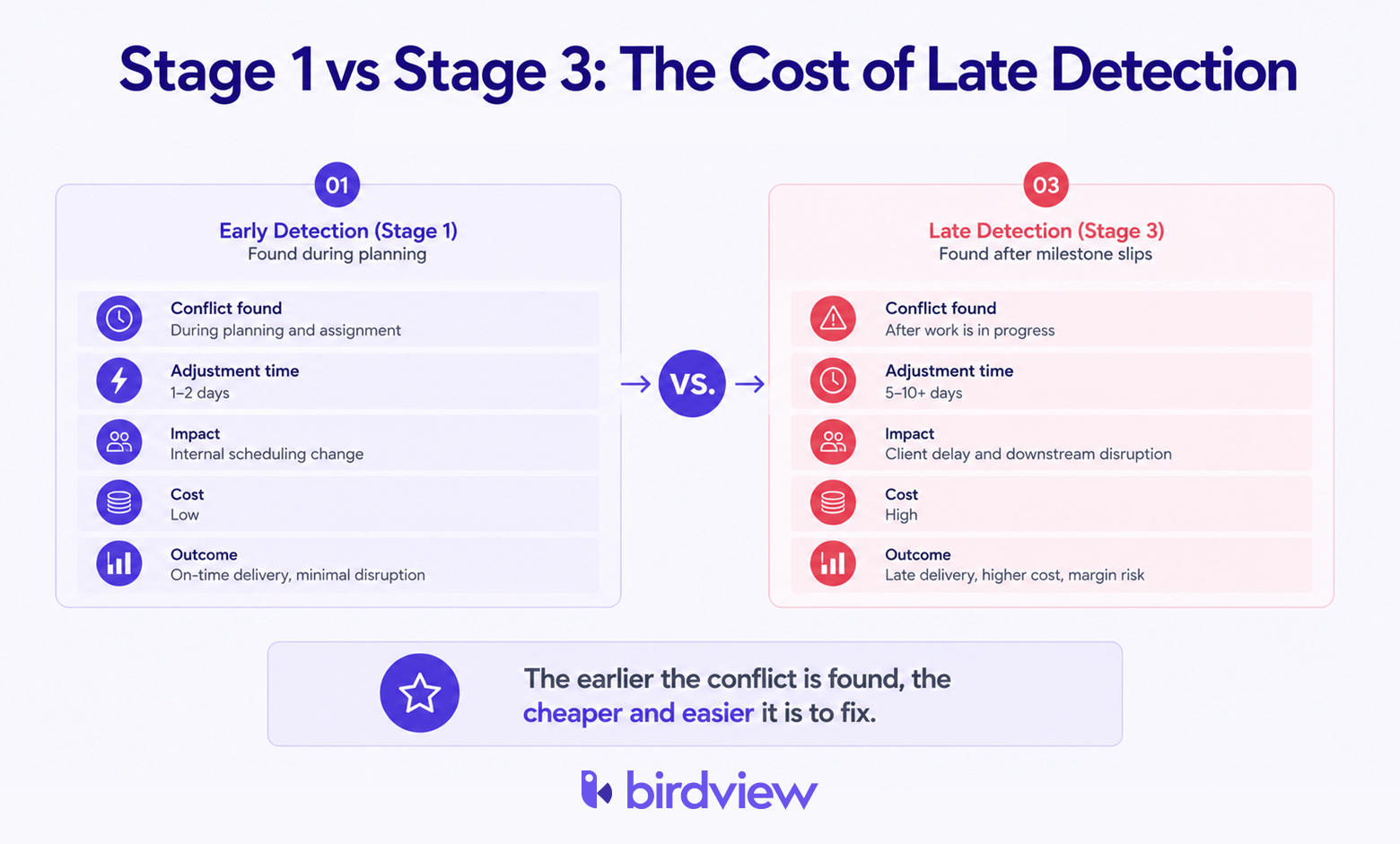
How PSA software closes each gap in the chain
PSA interrupts each stage at the source:
- Single system of record (Stage 1) – projects, resources, time, and financials linked; aggregate utilization across engagements.
- Dependency logic (Stage 1→2) – predecessor slips flag successors before owners commit to stale dates.
- Threshold alerts (Stage 2) – utilization above ~85% or burn above ~90% of plan before milestone outputs fail.
- Conflict surfacing at assignment (Stage 2→3) – dependency conflicts visible when work is staffed, not when invoices argue.
- Portfolio view (Stage 3 prevention) – milestone health across active projects. Birdview PSA’s Activity Center sequences work without reconciling CRM exports and spreadsheets.
| Stage | Without PSA | With Birdview PSA |
|---|---|---|
| 1 – Visibility | Capacity split across tools | Unified resource + financial view |
| 2 – Scheduling | Conflict found at slip | Alerts at 85% utilization; deps at assignment |
| 3 – Deadline | 5–10 day reschedule; client may know first | Catch in Stage 1; 1–2 day fix |
In our consultant-PM article, we described spotting one overbooked analyst and one with spare hours. Rebalance takes minutes once capacity is visible.
For buyers evaluating PSA resource capacity visibility, the test is practical. Can a delivery lead answer “who is free next week at 60% utilization?” without opening three tools? Can finance see which milestone is driving burn this week, not last month? If not, the firm is planning in Stage 2 while paying for Stage 3 recoveries.
Implementing real-time visibility: Checklist for delivery leaders
- Map which system holds resource, financial, and task data today
- Set one utilization alert threshold (80–85%) before overload becomes a missed milestone
- Map dependencies for all engagements over four weeks
- Review project burn weekly, not only portfolio margin monthly, and share one milestone-health view with delivery and finance
- Pilot three concurrent projects for 30 days before full rollout
| Activity | Time saved / week (20-person team) |
|---|---|
| Manual status assembly | 4 hours |
| Resource conflict firefighting | 3 hours |
| Budget reconciliation | 2 hours |
| Total | 9 hours (~468/year) |
Real-time portfolio visibility PSA dashboards should show milestone health, utilization, and burn in one pass – not three reconciled exports. Start with three live projects, measure how many scheduling conflicts surface before kickoff versus after a slip, then expand.
The chain breaks where visibility starts
Firms that catch conflicts in Stage 1 reschedule in days. Firms that catch them in Stage 3 absorb client damage and repeat the cycle on the next engagement. Financial visibility professional services leaders need is not a monthly report. It is live burn and capacity tied to milestone dates.
Every undetected conflict in a six-week engagement adds a day to the timeline. Not because the team failed – because nobody saw the clash in time.
PMO directors comparing financial visibility professional services stacks should ask one question before the next planning cycle. Does our current tooling show capacity, cost, and milestone risk together at assignment time? If the answer is no, missed deadlines are a predictable output – not an exception.
Explore Birdview PSA resource and portfolio visibility: birdviewpsa.com/professional-services
FAQ
How does poor resource visibility cause missed deadlines? Poor resource visibility hides double-booking, overload, idle capacity, and dependency conflicts until work is already late. By then, a small assignment conflict can cascade into schedule changes across several projects.
Why is financial visibility part of deadline management? Budget burn is an early signal of schedule risk. When finance sees rising cost but delivery sees only task status, the team misses the adjustment window. Scope, staffing, and milestone timing get locked in before anyone reacts.
What early-warning metrics should consulting firms monitor? Monitor utilization above 80-85%, weekly budget burn, dependency slips, milestone health, and resource conflicts before kickoff. These signals catch Stage 1 problems before they become Stage 3 client-facing misses.
Can a PM tool alone prevent resource conflicts? Not on its own. A PM tool shows tasks and dates; it lacks live capacity, financial burn, role cost, and cross-project allocation. Deadline prevention needs those views in the same workflow.
How does PSA software reduce deadline risk? PSA software connects resources, project plans, dependencies, time, and financial data. That lets managers spot overload and budget pressure at assignment time rather than after a milestone has already slipped.
What should a delivery leader pilot first? Pilot three concurrent projects with one shared view of capacity, milestone health, and burn. Measure how many conflicts surface before kickoff versus after a slip, then expand the PSA workflow if early detection improves.
Sources
[1] PMI – 2024 Pulse of the Profession: The Future of Project Work – https://www.pmi.org/learning/thought-leadership/future-of-project-work
[2] SPI Research – 2026 Professional Services Maturity Benchmark – https://spiresearch.com/ps-maturity-model/
[3] McKinsey & Company – Delivering large-scale IT projects on time, on budget, and on value – https://www.mckinsey.com/capabilities/mckinsey-digital/our-insights/delivering-large-scale-it-projects-on-time-on-budget-and-on-value