Ksenia Kartamysheva
 The losses don’t arrive as one big write-off. You see them as rounded entries, slow approvals, quiet scope creep, and last-minute invoice trims. Harmless in isolation, costly when they stack week after week. Below are five mechanisms that drain billable value when time capture is inconsistent. Each comes with arithmetic you can rerun on your own headcount and blended rate.
What is revenue leakage in professional services? (Definition + scope)
Revenue leakage means billable effort that never converts to collected fees: work your team performed, but the invoice (or the cash) came up short. That is different from utilization loss, which measures idle capacity on the bench. Leakage hits after people are already busy – through missed logs, discounted lines, or hours that never made it to billing.
Realization rate – invoiced hours divided by logged billable hours – is not a metric SPI Research publishes in its 2026 benchmark; the word ‘realization’ does not appear in the report. Closing even part of the spread between logged and invoiced hours moves real margin, not theoretical pipeline. For a firm billing $7M annually, a 10-point lift in invoiced-vs-logged hours can mean $700,000 in fees that were always there – just never collected.
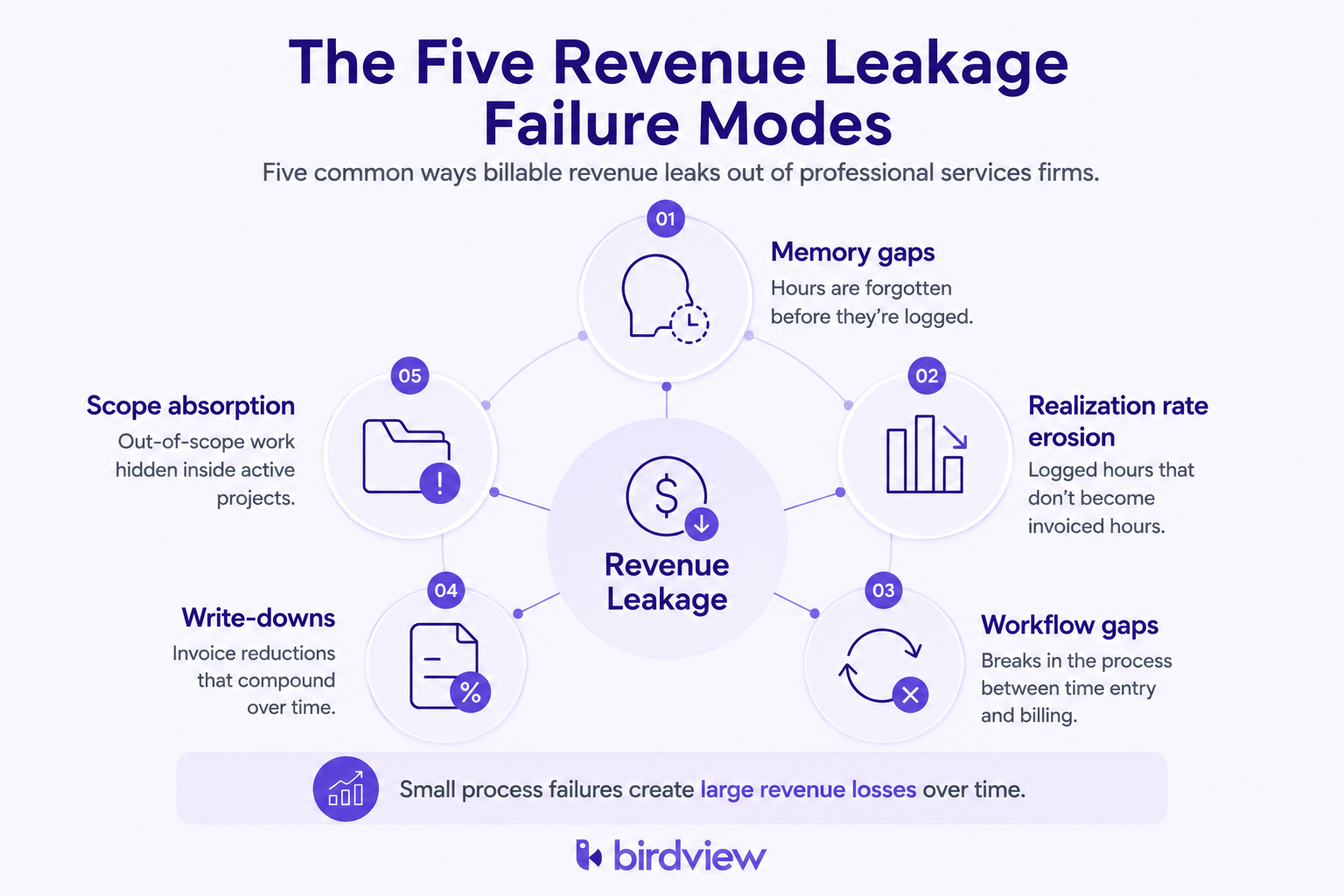
Five mechanisms show up again and again when time tracking is loose:
- Memory gaps – hours forgotten before they’re logged
- Realization rate erosion – logged hours that don’t survive to invoice
- Workflow gaps – process breaks between time entry and billing
- Write-downs – deliberate invoice reductions that compound over time
- Scope absorption – out-of-scope work buried inside active projects
Each has its own fix. Calling all five a generic “time-tracking problem” is why many improvement programs stall after the first policy memo.
Failure mode 1: Memory gaps: The $390,000 rounding error
Recall fades fast. DCAA (Defense Contract Audit Agency) mandates same-day time entry partly because accuracy falls roughly 40% once logging waits until after the workday [2]. Commercial firms face no DCAA audit – so Friday reconstruction of Monday’s work becomes normal. The pattern is predictable: consultants round down, managers guess, and finance invoices a number that is lower than the work delivered. The gap compounds quietly.
The dollar math for a 50-person firm:
| Scenario | Hours Lost/Week | Annual Hours | Revenue Lost ($150/hr) |
|---|---|---|---|
| 1.0 hr/consultant/week forgotten | 50 | 2,600 | $390,000 |
| 1.5 hr/consultant/week forgotten | 75 | 3,900 | $585,000 |
One hour per consultant per week is the Birdview PSA benchmark row we use with our clients. It is a conservative floor. Teams without daily entry rules run higher.
Watch for these habits:
- Full-week timesheets filed Friday for Monday–Thursday work
- Project managers padding “estimated” hours at invoice review
If that sounds familiar, treat $390,000 as a starting estimate, not a ceiling.
Failure mode 2: Realization rate erosion: When logged hours don’t become invoiced hours
Realization rate is invoiced hours divided by logged billable hours, times 100. Log 10,000 billable hours, invoice 7,100, and RR sits at 71% – a 29-point structural hole in the billing funnel.
RR erodes through four channels:
- Billing caps on fixed-fee work
- Discretionary discounts applied at partner level
- Reclassification from billable to non-billable during review
- Approval attrition – hours cut without a paper trail
Deltek’s Clarity 2022 report linked automated time-to-billing workflows to realization rates 8–12 points higher than manual shops [3].
What that gap looks like financially:
| Metric | Median Firm (71% RR) | Top-Quartile Firm (84% RR) |
|---|---|---|
| Logged billable hours (50 staff) | 60,000 | 60,000 |
| Invoiced hours | 42,600 | 50,400 |
| Revenue at $150/hr | $6,390,000 | $7,560,000 |
| Difference | – | +$1,170,000 |
Same roster, same clients – $1.17M apart on billing discipline alone. Live WIP (work-in-progress) visibility catches reclassifications and discounts while they are still reversible. Without that visibility, partners approve discounts in email threads that never reach the project record. The same client gets the same courtesy discount next month.
Failure mode 3: Workflow gaps between time entry and invoice
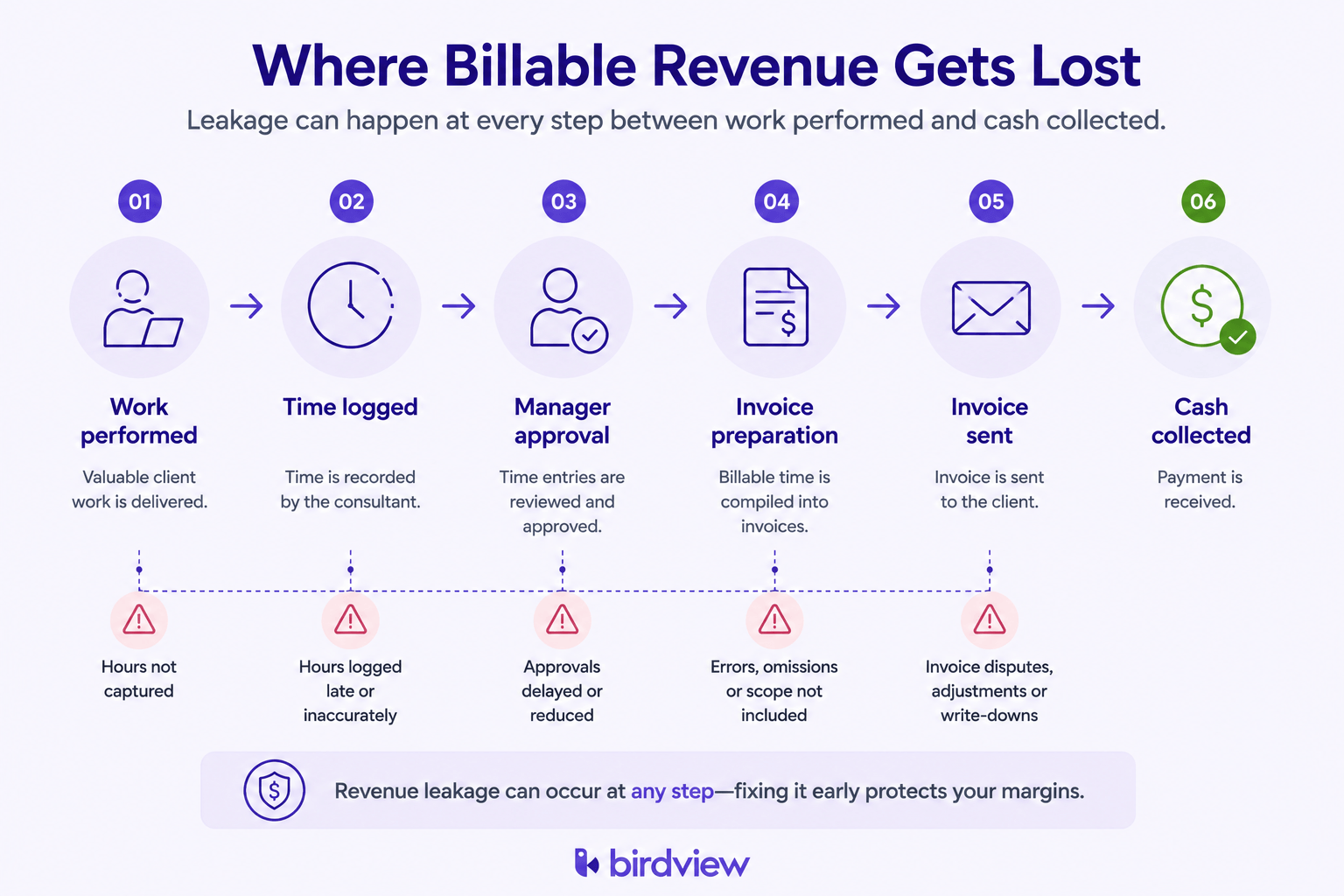
Leakage here is less about attitude than about handoffs. A typical path runs: consultant logs time → manager approves → finance builds the invoice → client pays. Split that chain across a spreadsheet, a PM tool, and an accounting system, and hours vanish in the seams. Delayed sign-offs. Double entry. Invoices that slip a week because nobody owns the queue.
In our client work, finance discovers the gap when a client disputes a line item and the supporting detail is scattered across three exports. By then, reconstructing who approved what takes longer than issuing the credit.
Birdview PSA keeps entry, project control, and billing on one dataset so approved hours do not get retyped into another system.
Approval delay math: Ten days between approval and invoice on $600,000 monthly billings leaves about $200,000 in WIP idle at any moment. Cash earned on paper, not collected.
Practical fixes:
- 48-hour approval targets for managers
- One platform from timesheet to invoice (no export/import loops)
- Automated WIP aging by project and age bucket
Failure mode 4: Write-downs: The visible tip of an invisible iceberg
A write-down lowers an invoice below logged value; a write-off removes billed amount after the fact. AICPA & CIMA practice guidance treats recurring write-offs as a signal of pricing and billing-process quality, not only relationship smoothing [4].
Pain starts when each reduction is treated as a one-time courtesy. Without reason codes, the same scoping miss or estimate error repeats every cycle. Partners know which client will push back. Operations, without those codes, has no record of how many times that pushback became a permanent discount.
Dollar math on write-downs for a 50-person firm:
| Write-Down Rate | Monthly Billings | Annual Write-Down Value |
|---|---|---|
| 5% | $600,000 | $360,000 |
In our experience, shops without formal billing review run 5–8% write-down rates. Controls that help:
- Narrative required on adjustments above your threshold (e.g., $500)
- Reason tags: scope, estimate error, dispute, courtesy
- Monthly write-down roll-up by project manager
- Firm-wide write-down budget with escalation when exceeded
Finance sees the invoice line. The missed scope conversation or stale estimate is what caused it – and stays hidden until reporting exposes the pattern.
Failure mode 5: Scope absorption: Unbilled work hidden inside active projects
Scope absorption is extra work logged to the original job code instead of a change order. It happens because the conversation feels awkward, or because nobody is watching budget burn in real time.
You discover it at project close. Delivery is done, the client has moved on, and those hours have nowhere to bill. The PM remembers the extra analysis sprint; the client will not volunteer to pay for work they assumed was included.
Portfolio snapshot (20 active projects):
| Share of Projects Absorbing Extra Work | Avg. Hours Absorbed | Revenue at $150/hr |
|---|---|---|
| 8 of 20 (40%) | 15 hours each | $18,000 |
| 12 of 20 (60%) | 15 hours each | $27,000 |
Run several portfolio cycles per year and a 60% absorption rate turns $27,000 into a recurring leak, not a one-off.
Our Hours Left view in Birdview PSA compares budgeted hours to work completed. Hitting 80% of the hour budget at 60% completion triggers a variance flag while a change order is still realistic. The goal is not to block good service. It is to surface the conversation before the extra work is delivered for free.
Warning signs:
- Projects always land within 5% of budget without live monitoring
- “General” or “admin” codes on client jobs
- Long engagements with almost no change orders
Aggregate impact: What all five failure modes cost a 50-person firm
Modes overlap – the same hour can suffer memory loss and later write-down – so totals are not a simple sum. Conservative standalone estimates for a 50-person team:
| Failure Mode | Annual Revenue Impact |
|---|---|
| Memory gaps (1 hr/consultant/week) | $390,000 |
| Realization rate erosion (71% vs. 84% RR) | $480,000 |
| Workflow gaps (billing delay + errors) | $85,000 |
| Write-downs (5% of billings) | $360,000 |
| Scope absorption (40% of projects) | $108,000 |
| Combined total | $1,423,000 |
No single catastrophe is required. The figure assumes average performance on every lever. That steady drip surfaces only when someone finally compares logged hours to bank deposits.
How to reduce revenue leakage in a services firm: A prioritized action plan
Policy memos alone will not close a systems gap. Start with the fastest-payback moves:
- Same-day entry with in-app nudges. Reminders inside the timesheet beat email digests for memory-gap recovery. DCAA’s same-day rule is a useful internal standard even without government contracts [2].
- One workflow from entry to invoice. Birdview PSA removes copy-paste between project management and billing – the main source of workflow-gap loss.
- Live budget alerts. Hours Left flags burn rate early; set thresholds at 75% and 90% of budget to force change-order talks before absorption hardens.
- Document every write-down. Reason code plus short narrative on each adjustment; review monthly by manager and client. After two cycles, you will know whether disputes, estimates, or scope gaps drive most of the loss.
- Three metrics on every ops agenda:
- Realization rate – target 82%+
- WIP aging – buckets at 0–30, 31–60, 60+ days
- Write-down rate – keep under 4% of gross billings
Monthly review beats quarter-end archaeology.
The bottom line
Missed logs, weak handoffs, silent scope, and undocumented discounts are infrastructure failures – not sales failures. For a 50-person team, the five modes above can remove more than $1.4M a year from work already delivered. Closing the gap does not require more hours sold; it requires fewer hours lost between the timesheet and the bank.
Birdview PSA ties time entry, budgets, approvals, and invoicing together so each logged hour has a path to cash. Start by measuring which of the five modes is largest in your shop. Then fix that one.
FAQ
What is revenue leakage in professional services? Revenue leakage is earned work that never turns into collected revenue. In services firms, it comes from late time entry, weak approvals, write-downs, scope absorption, and invoice handoffs that lose detail.
How much can inconsistent time tracking cost a 50-person firm? A conservative model in this article shows more than $1.4M in annual standalone impact across five leakage modes. The exact number depends on bill rates, utilization, project count, and write-down discipline.
Why is same-day time entry so important? Same-day entry reduces memory loss. Short calls, client interruptions, and follow-up work are easiest to classify correctly right after they happen, not at the end of the week.
What is the difference between a write-down and a write-off? A write-down lowers an invoice before or during billing review. A write-off removes billed value after the fact. Both can signal process issues when they repeat without reason codes.
How does PSA software reduce billing leakage? PSA software keeps time entry, approvals, budgets, WIP, and invoice preparation on one dataset. That reduces export/import loops, exposes aging work, and gives managers budget alerts before delivered work becomes unbillable.
Which leakage metric should a firm track first? Start with realization rate: billed revenue divided by logged billable value. Then add WIP aging and write-down rate so finance can see whether leakage starts before invoice, during approval, or after client review.
Sources
- SPI Research 2026 Professional Services Maturity Benchmark – https://spiresearch.com/ps-maturity-model/
- DCAA Contract Audit Manual, Time Reporting Requirements – https://www.dcaa.mil/Guidance/DCAA-Contract-Audit-Manual/
- Deltek Clarity Industry Benchmarks & Insights – https://info.deltek.com/Clarity
- AICPA & CIMA – Stop Leaving Money on the Table (write-offs and firm pricing) – https://www.aicpa-cima.com/resources/article/stop-leaving-money-on-the-table