

Fast growth in a consulting or services firm usually shows up as delivery strain before finance catches it. Pipeline looks healthy. Teams run hot. Clients still wait on staffed starts, late change orders, and status that arrives after the decision meeting. Scaling service delivery means growing throughput and margin without treating every new project as a custom rescue mission.
SPI Research’s 2026 Professional Services Maturity Benchmark, based on 509 professional services organizations, put average billable utilization at 66.4% in 2025, the lowest point in the survey’s history [1]. Separately, SPI’s Maturity Model tracking, drawn from a much larger multi-year sample of assessed firms, has found that Level 5 firms report roughly 42% more billable utilization than Level 2 peers [2]. Revenue can rise while utilization falls when delivery capacity does not scale with demand.
This guide ties PSA scalability to the delivery-specific work behind it: what breaks when headcount jumps, how to grow without burning out staff, how firms add capacity across more projects, and how the same PSA stack supports five projects or fifty as a firm moves through 50, 130, and 200 people. For the underlying five-pillar operating model this builds on, one source of truth, capacity forecasting, standardized delivery, financial visibility, and automated reporting, see how high-growth professional services firms scale operations.
How PSA software scales with business growth
One of the biggest strengths of PSA software is its ability to grow alongside the business. Small teams can start with core functions like project tracking and billing, then expand into resource forecasting, advanced reporting, and portfolio management as they take on more clients. Unlike spreadsheets or disconnected tools that quickly become unmanageable, PSA platforms are designed to handle rising complexity without forcing firms to switch systems mid-growth.
A company running five projects today may be managing fifty in just a couple of years, and the same PSA system can support both situations. This scalability matters because growth usually brings new challenges: larger teams to coordinate, profitability to track across multiple clients, and increasing demand for reliable reporting. PSA software smooths this transition by providing consistent processes and a single source of truth for all project, resource, and financial data.
Firms that adopt PSA early often find they scale faster and with less chaos. Because they already have structured planning, accurate billing, and data-driven reporting in place, growth feels like a natural step instead of a constant struggle.
In practice, PSA provides a solid foundation for sustainable expansion. It keeps projects, people, and finances aligned as the company grows, ensuring that success does not come at the cost of control.
Tool fit alone does not scale delivery. The sections below cover the delivery breakpoints leaders hit between 50 and 200 people and the ops moves that make PSA scale real on the ground.
What breaks in service delivery when a consulting firm grows fast
When a consulting firm grows fast, delivery usually breaks at the seams between functions, not inside any single team’s calendar.
Staffing seams. Sales adds another “yes” before capacity checks land in one staffing view. Kickoffs slip because the scarce skill is double-booked across three accounts. Bench and overtime coexist because nobody sees skill mix firm-wide.
Handoff seams. Scope, dates, and assumptions live in email while the PMO plans from a thinner brief. Week one becomes rework: delivery discovers missing environments, client sponsors, or rate exceptions that sales already treated as settled.
Approval seams. Change orders and access requests age without an owner. Work continues unsigned. Margin erodes while the client still expects the sold date.
Time and billing seams. Timesheets arrive late. Forecasts stay optimistic. Finance invoices from a different truth than delivery status. That pattern shows up in SPI’s utilization slide even when revenue grows [1].
Reporting seams. Leadership reviews a deck built Friday night while PSA holds fresher data nobody opened in the meeting. Each seam feels like a people problem until ops maps them on one board. For a related PM view on operational waste, see Birdview’s piece on operational inefficiencies.
How to scale delivery without burning out staff
Scaling delivery without burning out staff is not about asking the same people to work more hours. It is about removing repeat friction so each hour lands on billable, client-visible work.
Cap concurrent commitments per scarce skill. When one architect carries four critical paths, growth feels like heroics. Tag skills in the staffing plan and flag conflicts 14 days out, not at kickoff.
Protect recovery weeks. Firms that scale sustainably plan bench and training weeks into the portfolio, not only at year-end. Utilization targets above 70 percent still leave room for internal work without chronic overtime.
Stop duplicate status work. If consultants update PSA and a slide deck for the same review, burnout follows. Pick one official record and retire the shadow export.
Coach managers on escalation, not nagging. PMs who only chase timesheets burn social capital. PMs who fix approval latency and staffing conflicts remove the real overtime driver.
Measure burnout signals early. Rising shadow Excel, rising weekend hours on fixed-fee work, and rising internal transfers mid-engagement are ops metrics, not HR surprises at quarter end.
Birdview ops reviews since 2025 keep surfacing the same pattern: teams that scale delivery without hiring first fix approval aging and staffing visibility, then tune utilization targets. Hiring alone without those fixes recreates the same hot calendar with more salaries attached.
How firms scale delivery capacity across more projects
Firms scale delivery capacity across more projects when they treat capacity as a portfolio decision, not a project-by-project negotiation. PMI frames that kind of portfolio governance as end-to-end work from selection through delivery, not only oversight of live projects [3].
Portfolio lanes. Group work by practice, client tier, or delivery model. Each lane gets staffing targets and margin guardrails. Adding projects without lanes overloads the same generalists.
Repeatable kickoff packs. Scope summary, skill list, first-month staffing, risks, and client approvers in one template. Kickoff duration shrinks; fewer “surprise” weeks.
Centralized bench and contractor rules. When growth spikes, firms with a visible bench pool staff in days. Firms without one hire permanently for a three-month spike.
Forecast tied to hours consumed. Percent-complete guesses scale poorly. Hours consumed vs budget, updated weekly, catches overrun while rebalance is still cheap.
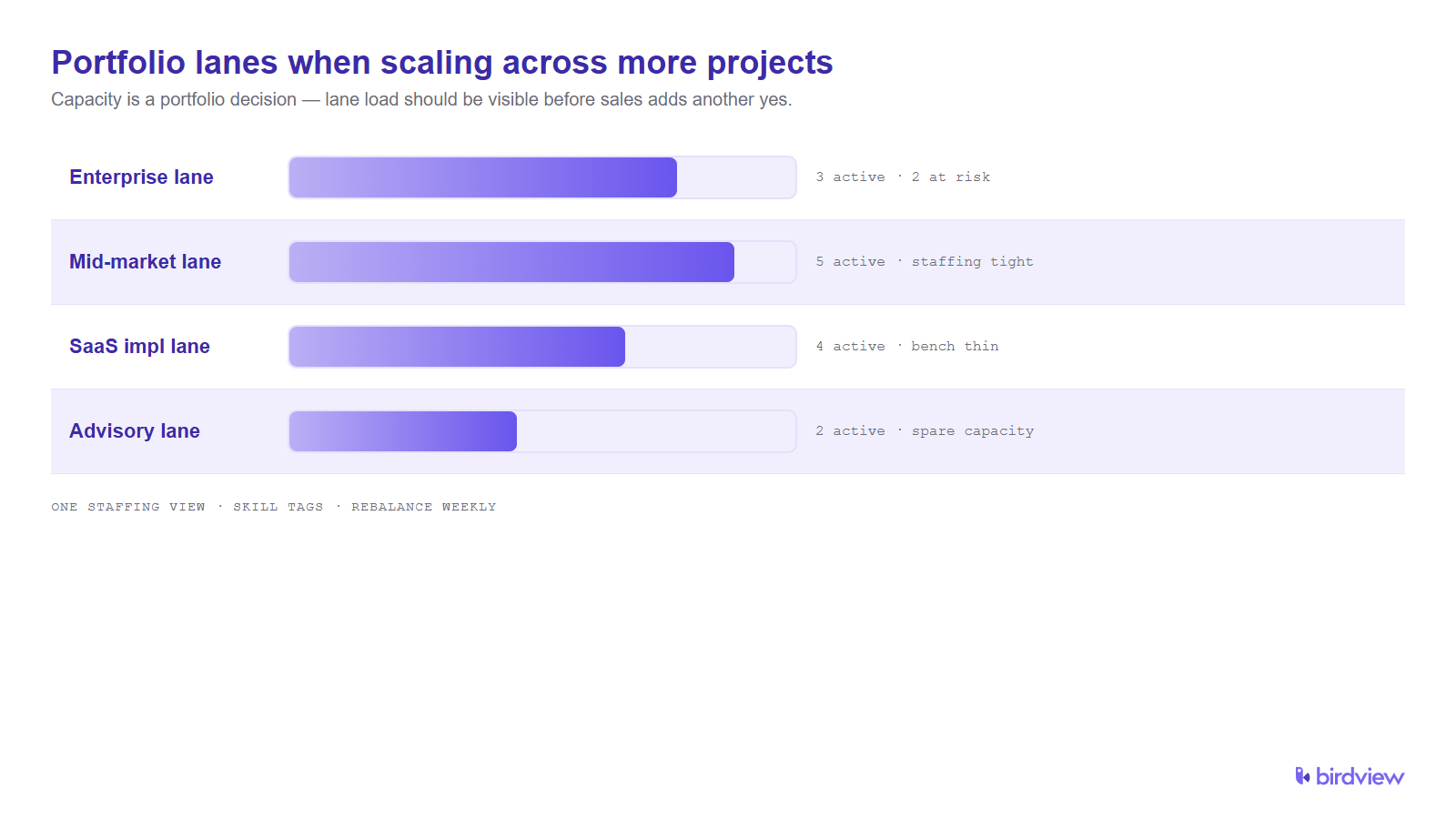
Birdview PSA customers often run five projects on the same modules they later use for fifty: the difference is portfolio views, skill-aware staffing, and financial roll-ups, not a separate “enterprise” product switch.
Does standardizing delivery playbooks help scale professional services?
Yes, standardizing delivery playbooks helps scale professional services when playbooks describe decisions and artifacts, not only document templates.
What a useful playbook contains
- Entry and exit criteria for each phase (discovery, build, transition).
- Default staffing mix and approval paths for that offer.
- Quality gates (client sign-off, security review, UAT) with owners.
- Standard metrics the PM reviews weekly.
What it should not do
- Replace client-specific design where the offer is bespoke.
- Freeze every engagement into identical tasks regardless of scope.
Playbooks scale when they shrink debate. A new PM on a familiar offer should know the next gate without reinventing the plan. They should still adapt staffing when scope diverges.
Firms at 50 people often run playbooks in wiki pages nobody opens during crunch. Firms moving toward 200 embed playbook steps in PSA workflows: required fields, approval routes, and checklist tasks tied to project type. That is when standardization shows up in utilization and margin, not only in onboarding slides.
Can you scale service delivery with better ops before hiring more people?
You can scale service delivery with better ops before hiring more people when the constraint is friction, not absolute hours in the market.
Ops-first moves that free capacity
- Retire top three shadow spreadsheets with dated cutovers.
- Cut approval aging on change orders and access requests to five business days max.
- Rebalance staffing weekly from one skill-tagged plan.
- Invoice from the same hours delivery recognizes, no Friday reconciliation marathons.
Each move returns hours without a req line. Together they often recover 5 to 15 percent effective capacity in mid-market firms we reviewed, enough to absorb another one or two projects before headcount rises.
Hiring before ops fixes buys parallel chaos: more people inherit the same broken handoffs. The right sequence is stabilize seams, standardize kickoffs, then hire into a system that can onboard someone in week one with a playbook and a staffed first assignment. Sister topic: improving service delivery without hiring more people when the bottleneck is utilization, not market demand.
What delivery visibility leaders need to scale a services firm
Leaders scaling a services firm need delivery visibility that answers three questions in one sitting: who is available, are we profitable, and what is next.
Who is available (next 14 to 30 days). Skill-level availability, not only names on a bench list. Conflicts on scarce roles should surface before sales promises a date.
Are we profitable (engagement and portfolio). Margin by project and practice, realization vs plan, and leakage from unsigned work or write-offs.
What is next (pipeline vs capacity). Weighted pipeline against staffed capacity stops the “yes” reflex that breaks delivery in growth years.
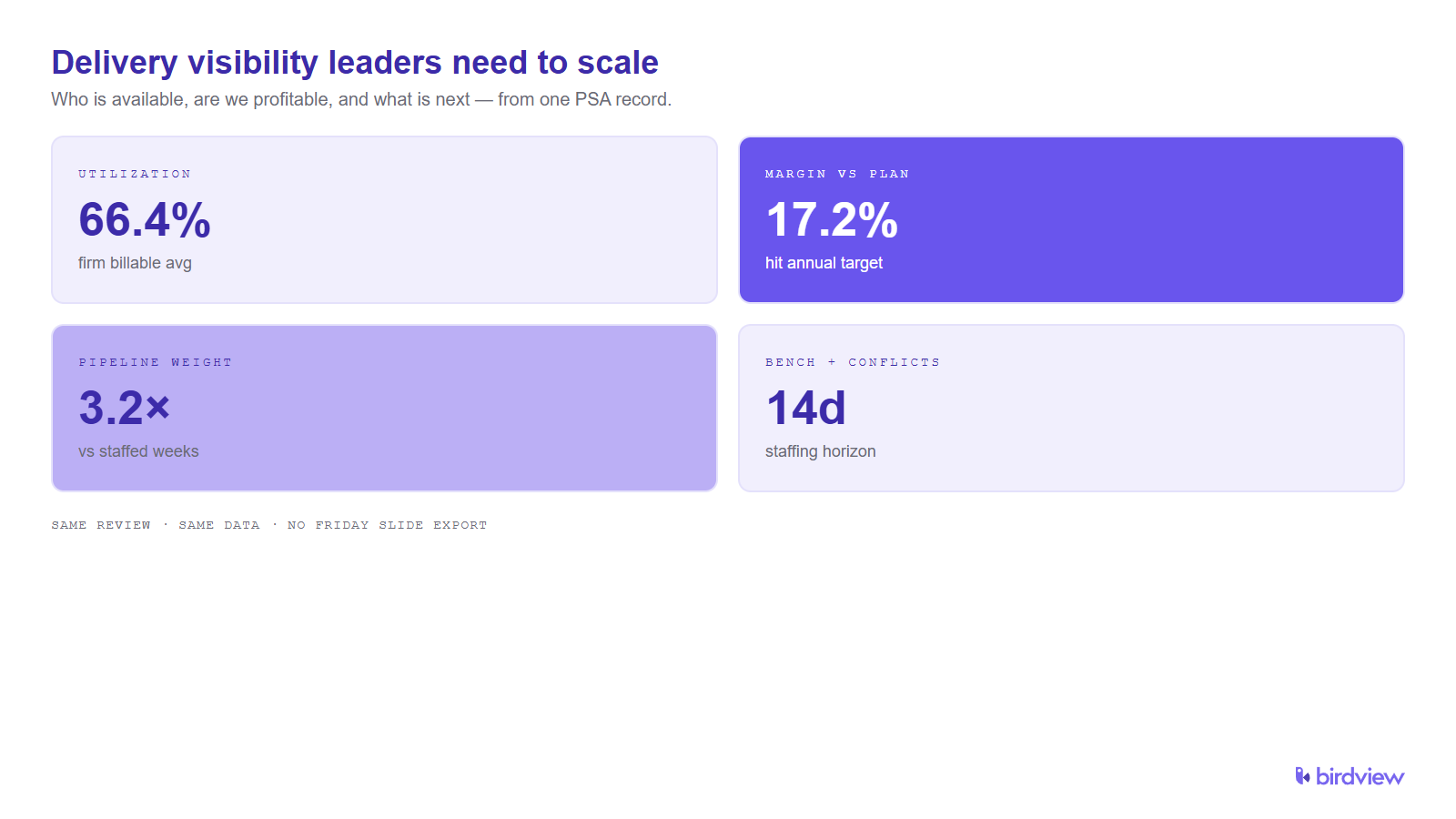
Dashboards fail when they are built for accountants alone. Delivery leaders need staffing and milestone health; CFOs need revenue and margin; both should read the same PSA record. For the full utilization and margin data behind this, and the five-pillar model it feeds into, see how high-growth professional services firms scale operations.
Stages of scaling service delivery from 50 to 200 people
Scaling service delivery from 50 to 200 people usually passes through three operational stages. PSA configuration should match the stage, not the slide deck from a larger firm.
Stage 1, roughly 50 to 80 people: coordinated delivery. Playbooks exist. Staffing is weekly. One PSA tenant holds projects and time. Leaders still know most accounts by name. Risk: hero PMs hide handoff gaps.
Stage 2, roughly 80 to 130 people: integrated portfolio. Practices run their own pipelines but share staffing pools. Portfolio reviews become mandatory. Forecast vs capacity is a standing agenda item. Risk: shadow Excel returns if approvals stay in email.
Stage 3, roughly 130 to 200 people: predictive operations. Scenario staffing, margin guardrails, and automation on repeat approvals. Champions and ops analysts maintain playbooks. Risk: tool complexity without role-based views slows adoption.
| Stage | Headcount band | Ops focus | PSA emphasis |
|---|---|---|---|
| Coordinated | 50 to 80 | Kickoff quality, time compliance | Core PSA: projects, time, billing |
| Integrated | 80 to 130 | Portfolio staffing, margin by practice | Resource forecasting, portfolio dashboards |
| Predictive | 130 to 200 | Scenarios, guardrails, playbook automation | Approvals, analytics, role-based workspaces |
Skipping a stage does not save time. Firms that jump to heavy portfolio analytics at 60 people often stall adoption because PMs still lack basic staffing discipline. Firms that stay on spreadsheets until 150 pay a migration tax when compliance and multi-entity billing finally force a platform decision.
FAQ
What breaks in service delivery when a consulting firm grows fast?
Staffing conflicts, sales-to-delivery handoff gaps, aging approvals, late timesheets, and leadership reviews built outside the system. Breaks cluster at seams between teams, not inside individual calendars.
How can firms scale delivery without burning out staff?
Cap scarce-skill overload, kill duplicate status exports, fix approval latency, and staff from one skill-aware plan. Measure shadow Excel and weekend overrun before adding headcount.
How do firms scale delivery capacity across more projects?
Portfolio lanes, repeatable kickoff packs, visible bench rules, and forecasts tied to hours consumed, not percent-complete guesses alone.
Does standardizing delivery playbooks help scale professional services?
Yes, when playbooks define gates, staffing defaults, and approvals, and when PSA workflows enforce them instead of wiki pages nobody opens in crunch weeks.
Can you scale service delivery with better ops before hiring more people?
Often yes: retire shadow sheets, cut approval aging, rebalance staffing weekly, and invoice from the same hours delivery recognizes. That recovers capacity without a req line.
What delivery visibility do leaders need to scale a services firm?
Skill availability for the next two to four weeks, margin by engagement and practice, and pipeline weight against staffed capacity, read from one PSA record in the same review meeting.
What are the stages of scaling service delivery from 50 to 200 people?
Coordinated delivery (50 to 80), integrated portfolio (80 to 130), and predictive operations (130 to 200). PSA depth should match the stage so adoption keeps pace with complexity.
Sources
- SPI Research, 2026 Professional Services Maturity Benchmark (509 organizations): https://spiresearch.com/reports/2026-ps-maturity-benchmark/
- SPI Research, Professional Services Maturity Assessment (Level 5 vs Level 2 comparative data): https://spiresearch.com/ps-maturity-assessment/
- Project Management Institute, Governance of Innovation in Portfolios, Programs, and Projects (Knapp, Killen, Stevens, Sankaran, 2019): https://www.pmi.org/learning/library/governance-innovation-projects-programs-portfolios-11796

