Ksenia Kartamysheva
 Sovereign AI means an AI system operates under a specific country’s legal, operational, and often physical control, not just that its output touches that country. When a project management vendor calls a feature “sovereign,” it can mean the AI runs on domestically owned infrastructure, or it can mean something much narrower: that your data stays in a Canadian data center while the AI model itself is run by a foreign provider. Those are different claims.
What “sovereign AI” means at the infrastructure level
Canada’s own federal AI strategy uses “sovereign” in a specific, demanding sense. The government’s Sovereign AI Compute Strategy is funding the AI Sovereign Compute Infrastructure Program (SCIP), a roughly $890 million commitment over seven years to build a large-scale, Canadian-owned AI supercomputer. That’s not a data residency arrangement. It’s ownership and operational control of the physical compute itself.
The distinction matters in practice, too. Shared Services Canada’s own sovereign AI platform, which now runs the government’s CANCHAT assistant, was built specifically so the deployment runs entirely on Canadian soil under Canadian operational and legislative control, not merely in a Canadian-located data center operated by a foreign company. At the infrastructure level, sovereignty is about who controls the system, not just where its servers physically sit.
What vendors usually mean when they say “sovereign-ready”
Most software vendors, including PM and PSA tools, aren’t building supercomputers. When a vendor markets an AI feature as “sovereign” or “sovereign-ready,” it typically means something narrower: your data stays within Canadian data residency while it’s processed by the AI feature, and the underlying model may or may not be run by a Canadian-owned company.
That’s a legitimate and useful claim, but it’s a different scale of “sovereign” than the federal infrastructure definition. A vendor can genuinely keep your data in Canada while the model doing the actual inference is licensed from a foreign AI provider. Whether that distinction matters to you depends on what you’re trying to protect against: data residency addresses where information sits, while model provider and hosting arrangement address who ultimately has access to it and under what legal exposure.
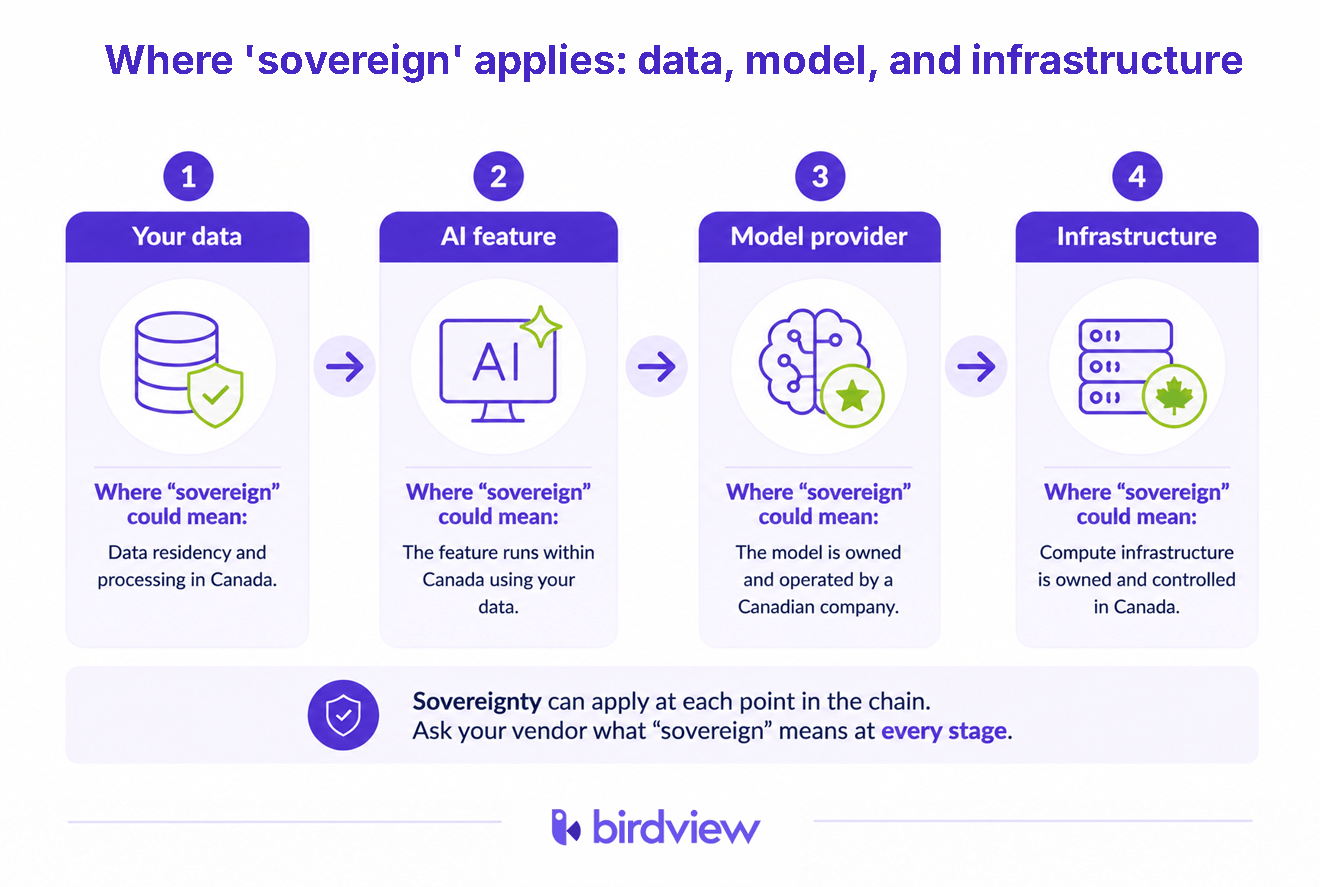
The three questions to ask when a vendor says “sovereign”
Rather than take the label at face value, ask specifically:
- Is my data processed and stored in Canada, or is “sovereign” describing something else about the feature?
- Who operates the underlying AI model? A Canadian company can still license a foreign-built model; that changes which company’s terms govern how your data is used to run the feature.
- Does “sovereign” apply to this specific AI feature, or to the vendor’s hosting in general? Some vendors describe their overall platform as Canadian-hosted while a specific AI feature routes through a separate, foreign-operated service.
None of these questions require specialized technical knowledge, they just require the vendor to be specific rather than using “sovereign” as a one-word assurance.
Why the term is spreading in vendor marketing right now
Canadian software vendors have a real incentive to use sovereignty language right now. The federal government’s own compute investments, a growing network of international sovereignty partnerships (Canada signed a joint AI declaration and launched a Sovereign Technology Alliance with Germany in February 2026), and heightened attention to foreign ownership in software procurement have all made “sovereign” a term buyers are actively searching for. BetaKit’s year-end look at the Canadian tech sector described 2025 as the year Canada broadly recognized it needs sovereign technology infrastructure, a shift reflected in how quickly the term has moved from government policy documents into product marketing.
That momentum is exactly why the term is worth scrutinizing rather than accepting at face value. A word doing a lot of policy and marketing work at once is also a word that’s easy to stretch.
Is sovereign AI the same as data residency?
No. Data residency is one component of sovereignty, not the whole thing. Canadian data residency tells you where your data is physically stored and processed. Sovereignty, in the fuller sense used by Canada’s federal AI strategy, extends to who owns and operates the infrastructure and which country’s laws ultimately govern it. A tool can have genuine Canadian data residency without meeting the infrastructure-level bar the federal government’s own sovereign AI programs are built around, and that’s fine for most buyers. The problem is only when a vendor implies the stronger claim while only delivering the narrower one.
For a closer look at how this plays out specifically in public sector project management, where sovereignty requirements are often written into procurement criteria directly, see our breakdown of sovereign AI in Canadian public sector project management.
Frequently Asked Questions
Does “sovereign AI” always mean the AI model itself was built in Canada?
Not necessarily. It can refer to infrastructure ownership, data residency, operational control, or some combination, depending on who’s using the term. Ask the vendor which specific claim they’re making.
Is data residency enough for public sector procurement requirements?
It depends on the specific procurement criteria. Some public sector requirements focus specifically on data residency, while others reference broader sovereignty or ownership criteria. Check the actual requirement language rather than assuming one term covers the other.
Why is Canada investing in sovereign AI compute infrastructure specifically?
The federal Sovereign AI Compute Strategy aims to reduce dependence on foreign-owned AI infrastructure for government and research workloads, funding both public supercomputing capacity and private sector data center investment within Canada.
Should I avoid vendors who use the term “sovereign” loosely?
Not necessarily. The term can be used accurately to describe a genuine data residency or hosting arrangement. The goal is to ask what specifically the vendor means, not to treat the word itself as a red flag.
Sources
- Innovation, Science and Economic Development Canada, “Canadian Sovereign AI Compute Strategy,” https://ised-isde.canada.ca/site/ised/en/canadian-sovereign-ai-compute-strategy
- ThinkOn, “ThinkOn Selected as Infrastructure Foundation for Canada’s Sovereign AI Platform,” https://thinkon.com/blogs/selected-to-power-canadas-sovereign-ai-platform/
- Government of Canada, “Canada and Germany sign AI joint declaration and launch Sovereign Technology Alliance,” February 14, 2026, https://www.canada.ca/en/innovation-science-economic-development/news/2026/02/canada-and-germany-sign-ai-joint-declaration-and-launch-sovereign-technology-alliance.html
- BetaKit, “2025 was the year Canada realized it needs sovereign tech,” December 28, 2025, https://betakit.com/2025-was-the-year-canada-realized-it-needs-sovereign-tech/