Ksenia Kartamysheva
 Canada is entering a new era of digital governance. Public sector organizations are under pressure to modernize. They must deliver complex projects faster while maintaining high security standards. AI is becoming a practical way to reduce administrative work and spot risks earlier. But the shift toward AI raises a basic governance question: Where does your data live, and who controls the technology?
This is where sovereign AI becomes vital. Sovereign AI refers to AI infrastructure hosted and governed in Canada. This helps keep data and AI services under Canadian jurisdiction. For Canadian public agencies, this is not just a technical preference. It is tied to national security and public trust.
This article uses Birdview PSA, a Canadian project and resource management platform, as a practical example. The Birdview team has worked with government agencies, commercial organizations, and non-profits across Canada. Birdview also includes built-in AI features that help teams draft plans, summarize updates, and flag risks earlier.
Navigating the Canadian sovereign AI compute strategy
The Canadian government has recognized the urgency of this transition. In 2024, the government launched a public consultation on AI computing infrastructure. The goal is to strengthen Canada’s ability to run AI workloads with more domestic capacity.
Read our related guide to what sovereign AI means for additional context and practical evaluation criteria. You can also explore project management software for Canadian government for additional context and practical evaluation criteria.
As stated on the official Canada.ca website: “The Government of Canada seeks to build on Canada’s leadership in AI and increase domestic access to the computing power that researchers and AI developers require for training and deployment.”
This commitment led to the development of the Canadian Sovereign AI Compute Strategy. Led by Innovation, Science and Economic Development Canada (ISED), the strategy aims to support strategic investments in public and commercial computing infrastructure to strengthen domestic capacity for Canadian AI development and deployment.
For public sector project teams, the takeaway is simple. Some “off-the-shelf” tools create cross-border dependencies through hosting, support, or AI services. If you cannot explain those dependencies during review, you are buying delivery friction.
Why sovereignty matters for public sector projects
Public sector projects often involve sensitive citizen data and critical infrastructure plans. Using AI models hosted outside Canada can expose this data to foreign laws. Sovereign AI ensures that all project data remains under Canadian jurisdiction.
This approach addresses several key challenges:
- Data residency compliance: It supports federal and provincial public sector privacy requirements and data handling obligations
- Ethical AI governance: It supports transparency and accountability expectations for automated assistance.
- Operational resilience: It reduces dependence on foreign providers and lowers the risk of disruption from cross-border policy shifts.
When project managers use sovereign-ready tools, they build trust through clarity. People support digital initiatives more readily when data handling is easy to explain.
How to choose project management software with sovereign AI
Most selection processes fail for one reason. Leaders buy features, then discover compliance gaps during implementation. You can avoid that with a short set of demo questions. Ask vendors for evidence, not just explanations:
- Where is data stored, including backups and disaster recovery?
- Who can access our data, including vendor admins?
- Is customer data used to train AI models?
- Which AI services do you rely on, and where do they process data?
- Can we disable AI features by role or workspace?
If a vendor cannot answer these clearly, you do not have innovation. You have procurement risk wearing a smart blazer.
Baseline expectations for 2026 shortlists
Here are the baseline expectations many public sector teams are moving toward in 2026. You can treat them as an early filter during the shortlist:
- Data residency in Canada, including backups
- Clear data ownership and customer-controlled access
- No customer data used for AI training by default
- Audit logs with full change history
- Accessibility compliance
- English and French support, where required
Operational requirements that matter in practice
Beyond compliance, teams also need software that supports day-to-day delivery:
- Role-based permissions and traceability
- Portfolio-level dashboards for leadership visibility
- Resource planning to prevent overload
- Governance workflows for intake and change control
- Controlled collaboration with external partners
- Reporting that produces audit-ready outputs without manual cleanup
How AI transforms project delivery
AI is no longer a futuristic concept in project management. It now acts as a practical assistant that helps teams handle complexity in everyday work. In the public sector, where budgets are closely monitored and timelines matter, this support can remove friction and improve delivery confidence.
Earlier risk detection
Sovereign-ready AI tools can surface risks before they become visible problems. By analyzing historical project data alongside current signals, AI can flag schedule delays and resourcing issues early, when corrective action is still affordable.
Smarter resource balancing
AI helps teams understand how work is distributed across departments. It can identify over-allocation, skills shortages, and conflicts between planned initiatives and operational demand. This is especially valuable when specialized skills are limited and shared across programs.
Less time spent on reporting
AI can also reduce the effort spent on status reporting. Instead of rebuilding updates each week, teams can generate draft summaries and refine them before sharing. Governance remains essential. AI should support drafting and analysis, not replace human judgment or decision-making.
Birdview PSA: Project management software with built-in AI for data sovereignty
Birdview PSA is a Canadian project and resource management platform designed for teams that manage work across multiple departments. It is commonly used by PMOs and shared-service groups that need consistency, visibility, and control.
- Portfolio-level visibility and control
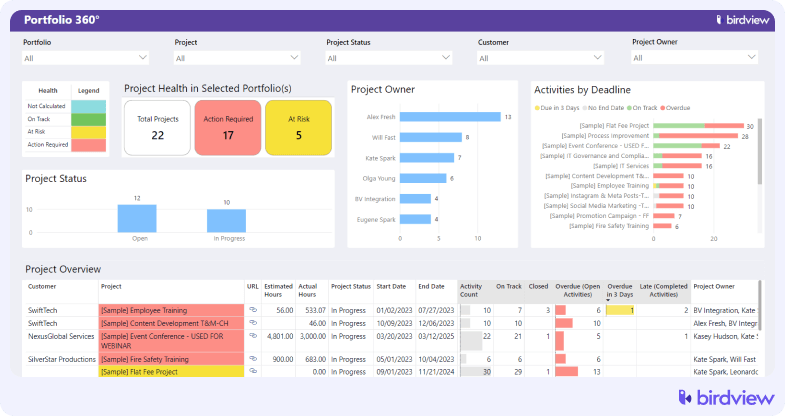
Birdview provides a portfolio view of all active projects, making it easier to see how initiatives compete for the same people. Teams can identify resource conflicts early and adjust plans before delays and dependencies begin to stack up.
- Built for structured oversight
The platform supports governance-heavy environments by capturing project status, risks, milestones, and approvals in a consistent format. This reduces manual effort in leadership reporting and helps standardize how information is shared across programs.
- Compliance and access control
From a compliance perspective, Birdview maintains audit-friendly history and documentation. Role-based permissions ensure that internal teams and external partners only see what they are meant to see, supporting controlled collaboration.
- Operational and financial visibility
Birdview helps teams track workload, utilization, and planned versus actual costs. This supports better capacity planning, clearer budget accountability, and more informed decision-making during delivery.
- AI support with governance in mind
Birdview includes AI features that reduce routine work without removing human oversight. AI can draft project updates, summarize long discussions, and rewrite messages for clarity. It can also highlight early warning signs such as schedule risk or upcoming resource bottlenecks, helping teams respond sooner.
- Canadian origin and integrations
Birdview is built by a Canadian team and headquartered in Toronto, Ontario. It integrates with financial systems such as QuickBooks, reducing duplicate data entry and improving reporting accuracy.
Building public trust through transparent technology
In government, trust comes from being able to show your work. If you use AI, you should be able to explain what it did, what data it used, and who approved the result.
Sovereign AI helps because the rules are clearer. Data stays under Canadian control, and it is easier to audit access and changes.
AI can draft status updates and highlight risks. People still review and sign off. That keeps accountability with your team and makes oversight simpler.
Next steps for Canadian public sector leaders: a practical rollout approach
Sovereign AI is not a trend to “embrace.” It is a set of constraints you plan for.
- Start with your must-haves. Focus on data location, access controls, audit logs, and export options. If a vendor cannot explain these in plain language, move on.
- Then run a controlled pilot. Pick two real projects. Choose one routine project and one high-visibility project. Define your non-negotiables before the demo starts.
- Test the tool in real conditions. Look at adoption, auditability, and whether it reduces risk and rework. If it only looks good in slides, it will fail in the field.
If you are considering Birdview PSA, keep the bar the same. Ask the same questions you ask every vendor. Confirm how its AI features work and how customer data is handled. Then decide based on fit, not hype.