Ksenia Kartamysheva
Marketing project management software helps teams plan campaigns, assign tasks, manage deadlines, and track progress. For marketing agencies, the requirements often go further: managing multiple clients, balancing team workloads, tracking billable hours, and controlling project budgets.
But not every tool is built for the same needs. Some focus on task management and campaign collaboration, while others offer resource planning, client management, and financial visibility.
In this guide, we compare six marketing project management tools, examining their key features, strengths, limitations, and best-fit use cases to help you find the right solution for your team.
How we evaluate marketing project management software
At Birdview, we work with project-driven teams managing multiple projects, shared resources, and changing priorities. Our comparison draws on this experience, supported by publicly available product documentation and vendor information.
We evaluate each tool using consistent criteria: project planning, resource and workload management, collaboration, time tracking, budget control, integrations, and suitability for marketing agencies and internal teams.
Birdview is included in this comparison, but we also highlight where competing solutions may be a better fit. Our goal is to provide a balanced assessment that helps you choose software based on your team’s actual needs.
Marketing project management software comparison
The six tools below support marketing project management, but they differ in resource planning, financial control, and client delivery capabilities.
| Software | Best for | Resource management | Time tracking & financials | Key consideration |
|---|---|---|---|---|
| Birdview PSA | Agencies managing client projects, resources, and profitability | Capacity planning, resource allocation, utilization tracking | Billable time, project budgets, invoicing, profitability reporting | More extensive than teams focused only on campaign tasks may need |
| Airtable | Marketing teams building custom campaign workflows | Configurable resource planning and tracking | Time-tracking extensions; custom budgeting and integrations | Advanced agency financial workflows require customization |
| Hive | Creative teams managing production and approvals | Resource planning, workload visibility, and placeholder assignments (available as an add-on) | Time tracking, timesheets, budget visibility | Creative workflows are a stronger focus than end-to-end PSA billing |
| Scoro | Agencies needing end-to-end business management | Resource scheduling, capacity and utilization planning | Time tracking, quotes, budgets, invoicing, profitability | Modular setup requires choosing the right capabilities |
| Teamwork | Agencies managing multiple client projects | Workload planning and resource scheduling | Billable time, project budgets, invoicing, profitability | Focused on client delivery rather than marketing asset management |
| ClickUp | Teams needing flexible campaign and task management | Workload views, time estimates, capacity tracking | Native time tracking; configurable budgets and billing integrations | Financial workflows require additional configuration |
Feature availability varies by plan, configuration, and integrations. Teams should confirm the capabilities included in their selected plan.
What is marketing project management software?
Marketing project management software provides a shared workspace for coordinating campaigns from initial planning through execution and delivery. It connects project plans, task assignments, timelines, approvals, and progress updates so teams can coordinate work and identify delays.
Depending on the platform, additional capabilities may include resource capacity planning, time tracking, client collaboration, and project financial management.
Essential features of marketing project management tools
The right features depend on your team’s workflows and the complexity of its projects. Internal marketing teams may prioritize campaign coordination and approvals, while agencies often need more advanced resource planning, time tracking, and financial reporting.
Here are the key capabilities to consider when comparing marketing project management tools.
Task management
Efficient task management is at the heart of any good project management tool. Features like task assignments, deadlines, priorities, and progress tracking help keep everyone on the same page. Gantt charts are also an excellent tool for a marketing department.
Collaboration tools
Marketing projects often require input from various team members and stakeholders. Tools that support real-time collaboration, comments, file sharing, and notifications can significantly enhance team communication.
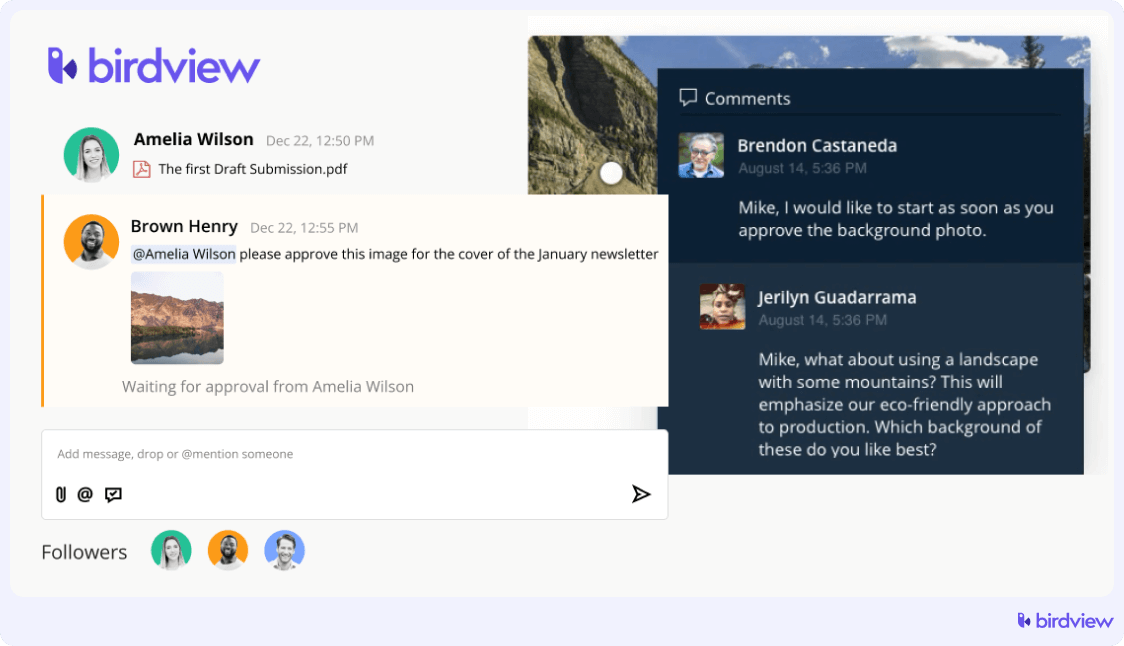
Reporting and analytics
Data-driven decisions are crucial in project management software for marketing. Software with robust reporting and analytics capabilities allows you to track performance metrics, monitor project progress, and identify areas for improvement.
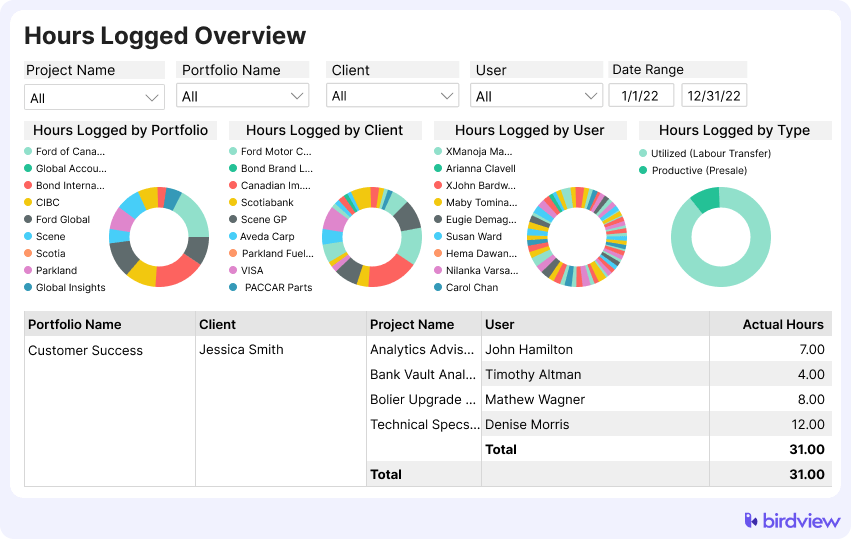
Integration with other tools
Your marketing project tracking software should seamlessly integrate with other tools you use, such as email marketing platforms, CRM systems, social media tools, and more. This integration minimizes disruptions and improves efficiency.
User-friendly interface
A clean, intuitive interface makes it easier for your team to adopt and use the software effectively. Look for tools that offer a pleasant user experience without a steep learning curve.
Scalability
As your team and projects grow, your project management software for marketing should be able to scale with you. Choose a solution that can accommodate increasing users, projects, and complexity without compromising performance.
6 best project management tools for marketing
1. Birdview PSA

Birdview PSA is professional services automation software that brings client projects, resource planning, time tracking, and financial management together. Built for service delivery, it helps advertising agencies manage campaigns, balance team capacity, track billable hours, and protect project margins.
The platform combines visual project planning, resource capacity management, automated workflows, and BI reporting. Customizable dashboards give managers visibility across multiple client projects, while built-in AI assists with project planning and team communication. Billing and invoicing capabilities help agencies connect delivered work with client payments.
Best for: Advertising agencies managing multiple client projects, resource capacity, billable hours, and project profitability.
Features: Project planning and scheduling, resource and capacity planning, time tracking, budget and cost management, billing and invoicing, BI dashboards, client collaboration, workflow automation, AI assistants.
Pricing: Starts at $37 per user/month, billed annually (PSA Team promotional pricing). Custom Enterprise pricing is available.
Trial: 14-day free trial. No credit card required.
What users say
Users appreciate Birdview’s straightforward project setup, intuitive interface, and collaboration features. Reviews highlight easier file sharing, clearer project visibility, and better communication across departments. Teams also value the ability to organize multiple projects, track progress, and reduce reliance on lengthy email exchanges.
2. Airtable
Airtable blends the functionality of a spreadsheet with a powerful database, providing marketing teams with a flexible and visual way to manage their projects. Its ability to handle large datasets and customizable templates makes it perfect for tracking detailed marketing activities, such as content calendars and campaign metrics.
Features: Customizable templates, Real-time collaboration, Database management, Kanban boards.
Pricing: Project management functionality is available in the Team plan for $20 per user per month.
Trial: A free 14-day trial is available.
What users say
Users appreciate Airtable’s marketing project management software for its various presentation formats and the extensive support and instructional guidance available, which are particularly useful for project management and team support. Users also highlight Airtable’s extreme customizability, allowing them to build databases, product roadmaps, and employee portals, and automate marketing communications. The software’s similarity to Google Sheets or Excel, combined with additional features, provides an easy learning curve.
However, some users have noted that Airtable’s automation does not cover all use cases and can require scripting for more complex functions, which can be challenging without programming knowledge. Additionally, the initial setup can be tricky, and understanding advanced features like calculated fields and automation may take time.
3. Hive
Hive offers a robust platform designed to support complex marketing projects with its advanced analytics and resource management tools.
Hive helps marketing teams coordinate campaigns, manage tasks and approvals, and track project progress. Its collaboration features keep teams aligned on deadlines and deliverables.
Features: Project templates, Gantt charts, Time tracking, Analytics, Automation, Proofing and approvals.
Pricing: The project management functionality is available within the Teams plan for $12 per user per month.
Trial: A free 14-day trial is available.
What users say
Marketing teams find Hive useful for managing projects and assignments, staying organized, and collaborating effectively. The platform’s customization options, Gantt chart summaries, portfolio views, and robust reporting capabilities are frequently mentioned. Users also commend Hive’s supportive customer service and detailed documentation, which aid in troubleshooting and maximizing the tool’s potential.
Some users feel that the project organization and visual layout could be improved, although this is often attributed to personal preference or familiarity with previous marketing project tracking software. Others mention that the customization options can be overwhelming at times and express a desire for more universal mass changes and updated project templates.
4. Scoro
Scoro is an all-in-one project management software that provides marketing teams with comprehensive tools for managing projects, tracking finances, and analyzing performance. Its integration capabilities and robust reporting features help marketing managers maintain control over every aspect of their campaigns.
Features: Project management, Time tracking, Billing, Reporting
Pricing: Starts at $17 per user/month. The Projects & Resources package starts at $29 per user/month (minimum 5 users).
Trial: A free 14-day trial is available.
What users say
Scoro has been well-received by users for its comprehensive business process tracking capabilities. Many users appreciate its ability to manage not only time tracking and budget planning but also marketing pipeline creation, invoice delivery, and quote negotiation. Users also like Scoro for centralizing all workflow aspects of a marketing agency, from sales to execution, providing an accessible user experience and a precise onboarding process.
However, some users have pointed out areas for improvement. For instance, the initial setup can be challenging due to the extensive customization options, though the onboarding specialists are helpful. The design of invitation emails to external guests and certain aspects of the Gantt chart feature could be enhanced. Users have also expressed a desire for better integration with HR sourcing tools, full accounting functionality, and more seamless income pipeline integration from quotes to final invoicing.
Agencies that need resource-level control often evaluate a Scoro alternative for agency delivery.
5. Teamwork
Teamwork is tailored for managing client work, making it an excellent choice for marketing agencies that handle multiple client projects. Its detailed task management and time tracking features help ensure that all client projects are completed on time and within budget.
Features: Project scheduling, Task management, Time tracking, Milestone tracking, Comprehensive reporting, Integration with external tools, Real-time collaboration.
Pricing: $9.99/user/month, billed annually (Basics)
Trial: A free 14-day trial is available.
What users say
Users appreciate the platform’s design, which is tailored for agencies with features like budgeting for hourly, retainer, and project-based billing. The built-in time tracking, including non-billable hours, and the ability to manage client hours and projects in one place are particularly beneficial for digital marketing agencies. Teamwork.com is also noted for its effectiveness across multiple teams and its extensive capabilities, making it useful for a variety of marketing, design, and software development projects.
However, users have pointed out some areas for improvement. Integration with the Teamwork Desk is not seamless, and there have been challenges with support. The process of accessing and checking off dependent tasks can be cumbersome, and the initial learning curve can be steep.
Agencies juggling many client projects often outgrow this and move to a Teamwork alternative with resource and margin control.
6. ClickUp
ClickUp is an all-in-one project management tool that offers extensive customization, making it highly adaptable to the specific needs of marketing teams. Its wide array of features supports everything from campaign planning to execution, allowing teams to streamline their workflows and improve productivity.
Features: Task management, Time tracking, Document collaboration, Custom views, Automation.
Pricing: Starts at $7 per user per month.
Trial: Free Forever plan available
What users say
ClickUp is favored for its ease of use and extensive customization options. Users appreciate the vast array of features, which include custom fields, dependencies, calendars, and email integrations. The custom dashboards are particularly useful for managing and tracking projects, offering a comprehensive view of requests, progress, and review items.
However, some users desire even more automation features and an easier way to share templates between different workspaces. There are also occasional issues with filtering functionality, which can disrupt workflows when updates cause settings to change unexpectedly. Users have expressed a need for better training systems to help maximize the tool’s potential.
Choosing the right marketing project management software
The right software depends on your team’s workflows, project complexity, and resource management needs. Consider these four factors before making a decision.
Assess your team’s needs and workflows
Identify your biggest challenges, whether it’s managing multiple campaigns, balancing workloads, tracking deadlines, or controlling project budgets. For agencies, consider client collaboration, billable time tracking, and profitability reporting. Involve your team in defining the essential features.
Budget considerations
Compare subscription costs, user limits, and additional fees for advanced features. Consider whether the platform can support your team’s growth without significantly increasing costs.
Trial periods and demos
Test the software using real projects and involve team members from different roles. Evaluate usability, resource planning, reporting, and integrations before committing.
Support and training resources
Look for responsive customer support, practical training materials, and guided onboarding. A clear implementation process helps teams adopt the software faster and avoid unnecessary disruption.