Ksenia Kartamysheva
 Portfolio rationalization is the process of deciding which projects should continue, pause, or be stopped when delivery capacity is limited. Service firms often review their portfolios by considering expected margin, delivery risk, strategic value, and the extent to which the work depends on key team members.
This type of review helps leadership concentrate resources on the projects that deliver the most value while keeping workloads manageable for delivery teams.
When companies skip this kind of review, they often continue accepting new work even while teams are already overloaded. Over time, that leads to missed delivery dates, shrinking margins, and exhausted staff.
For organizations running many client engagements at once, portfolio rationalization becomes a regular practice rather than a one-time exercise. It helps leaders decide where limited capacity should go as priorities shift.
Why portfolio rationalization becomes unavoidable
Portfolio rationalization usually enters the conversation when the number of active projects exceeds what the organization can realistically deliver. Most service firms eventually reach this point.
In many cases, the issue is straightforward: there are simply more projects than available resources. Sales pipelines may remain strong, but expanding delivery teams takes time because hiring, onboarding, and training cannot happen overnight. When demand grows faster than the team’s capacity, the portfolio gradually becomes overloaded.
Accepting every new opportunity can look like growth, but the effect is often the opposite. When specialists are spread across too many initiatives, timelines stretch, change requests pile up, and delivery costs start climbing. Margins can shrink even while revenue numbers appear healthy.
Overloaded portfolios create risks that are not always visible at first. Teams jump between projects, priorities change from week to week, and key specialists become bottlenecks across several initiatives. Instead of moving projects forward deliberately, the organization spends most of its time reacting to constant disruptions.
Portfolio rationalization brings focus back into the decision process. Rather than abandoning work at random, leadership reviews the portfolio and allocates resources to the projects that deliver the most meaningful long-term results.
Why most firms struggle to pause or stop projects
Even when portfolios are clearly overloaded, many organizations still struggle to pause or stop projects. The reasons usually come from both human behavior and internal decision structures.
- One barrier comes from simple emotional commitment. Once a project starts, leaders and teams often feel pressure to keep it moving even if priorities change. Time, money, and effort have already been invested, which makes stopping the work feel like admitting failure.
- Client relationships also influence these decisions. Many companies worry that pausing a project will damage the relationship with the client. In reality, missed deadlines and declining quality tend to erode trust much faster than a transparent conversation about timelines and priorities.
- Decision-making can also become difficult when clear evaluation criteria are missing. If project reviews rely mostly on opinions, discussions quickly turn into debates rather than structured analysis.
- Limited visibility into project performance is another common obstacle. When leadership lacks reliable data on margins, utilization, and delivery progress, it becomes difficult to see which projects are strengthening the business and which ones are quietly consuming resources.
What portfolio rationalization actually means
In practice, portfolio rationalization is about deciding which work deserves the organization’s limited delivery capacity.
In most cases, the process comes down to a few practical decisions
- prioritizing projects that contribute strong margins or strategic importance
- delaying initiatives that can safely wait
- stopping work that consumes scarce capacity without delivering clear value
When teams are not stretched across too many initiatives, delivery quality improves naturally. Projects move forward more quickly, collaboration becomes easier, and specialists can concentrate on the work where their expertise matters most.
Another benefit is that decisions become more objective. Rather than debating which project seems most important, leaders can review measurable indicators such as margins, utilization, delivery risk, and strategic impact.
📚 Read more: Project intake and portfolio prioritization: a first step to portfolio success
Practical guide: how to rationalize your project portfolio
Step 1: Gather objective data from your delivery system
Portfolio rationalization begins with data. Before making any decisions, leadership must collect the operational signals needed to evaluate projects consistently.
Key inputs typically include:
- forecast margin per project
- utilization and resource workload
- delivery risk indicators
- revenue contribution
- strategic importance of the client
- dependency on specific specialists or leaders
These metrics provide an objective picture of how each project affects the business.
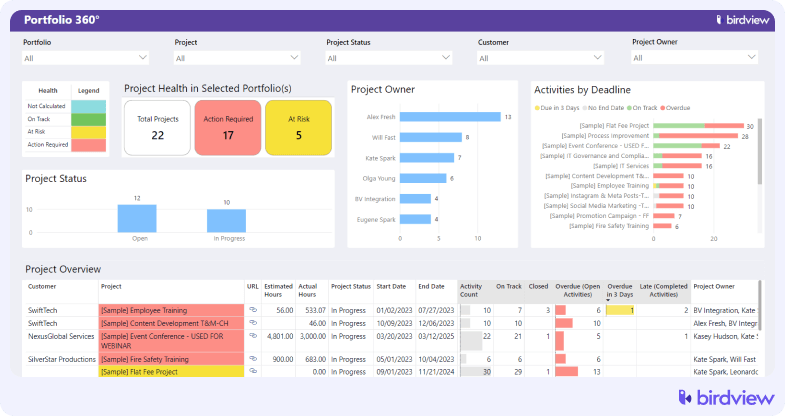
Example: Project portfolio management software such as Birdview PSA helps collect these signals automatically from operational data.
Typical inputs include:
- project profit and margin reports
- resource utilization dashboards
- workload and capacity planning views
- forecast revenue projections
- project health indicators showing schedule or budget risk
When this information is visible in one system, leadership can evaluate projects based on evidence instead of intuition.
The purpose of this step is simple: replace gut feeling with operational data.
Step 2: Build a rationalization matrix
A rationalization matrix helps teams evaluate projects using consistent criteria. It removes emotional bias by turning subjective judgments into structured comparisons.
Each project is scored across four key dimensions:
| Dimension | Key question | Example signals |
| Margin | How profitable is the project expected to be? | forecast margin, cost forecasts |
| Risk | How likely is the project to overrun scope, timeline, or budget? | delivery health indicators, scope volatility |
| Strategic value | Does the project strengthen an important client relationship or market position? | client importance, future opportunities |
| Dependency on key people | Does the project rely heavily on scarce specialists? | workload of senior experts |
Projects can then be mapped across a matrix that highlights where the portfolio is under pressure.
Example rationalization matrix
| Project | Margin | Risk | Strategic value | Dependency on key people | Suggested action |
| Project A | High | Medium | High | Medium | Protect |
| Project B | Low | High | Low | High | Exit |
| Project C | Medium | Medium | High | Low | Stabilize |
| Project D | Low | Low | Medium | Medium | Pause |
This simple matrix quickly reveals which projects deserve protection and which should be reconsidered.
Step 3: Identify portfolio pressure points
Once the matrix is populated, patterns usually become visible within minutes.
Common portfolio pressure points include:
- low-margin projects consuming senior specialists
- high-risk work dominating delivery capacity
- strategic clients competing with operational projects
- projects dependent on a single overstretched expert
These signals highlight where rationalization decisions should begin.
Example: Resource planning dashboards often reveal pressure points such as:
- overloaded roles or specialists
- uneven workload distribution across teams
- projects driving sudden spikes in utilization
When leadership can see these patterns clearly, rationalization decisions become easier to justify and communicate.
Step 4: Decide which projects to protect, pause, or stop
Once portfolio pressure points are identified, projects typically fall into four decision categories.
- Protect: High-margin, strategically important projects with manageable delivery risk. These initiatives should receive priority access to resources.
- Stabilize: Important work that requires scope adjustment, additional resources, or revised timelines. The project continues, but with corrective action.
- Pause: Projects that deliver value but are not time-critical. Pausing these initiatives frees capacity without permanently abandoning the work.
- Exit: Low-margin or high-risk engagements that consume disproportionate capacity. Ending these projects protects long-term organizational health.
This structured classification prevents decisions from being driven by politics or urgency alone.
Step 5: Communicate rationalization decisions clearly
Portfolio rationalization requires transparent communication with both internal teams and clients.
Clear communication prevents misunderstandings and protects long-term relationships.
Common best practices include:
- explaining capacity constraints honestly
- offering revised timelines instead of silent delays
- aligning leadership internally before speaking with clients
- presenting the decision as a way to protect delivery quality
When handled transparently, rationalization decisions often strengthen credibility. Clients generally prefer realistic timelines over projects that stall due to overloaded teams.
Step 6: Prevent the portfolio from becoming overloaded again
Portfolio rationalization should not become a recurring emergency response. Instead, companies should introduce ongoing portfolio governance.
Common governance practices include:
- monthly portfolio reviews
- early detection of resource overload
- regular monitoring of project margins
- aligning the sales pipeline with delivery capacity
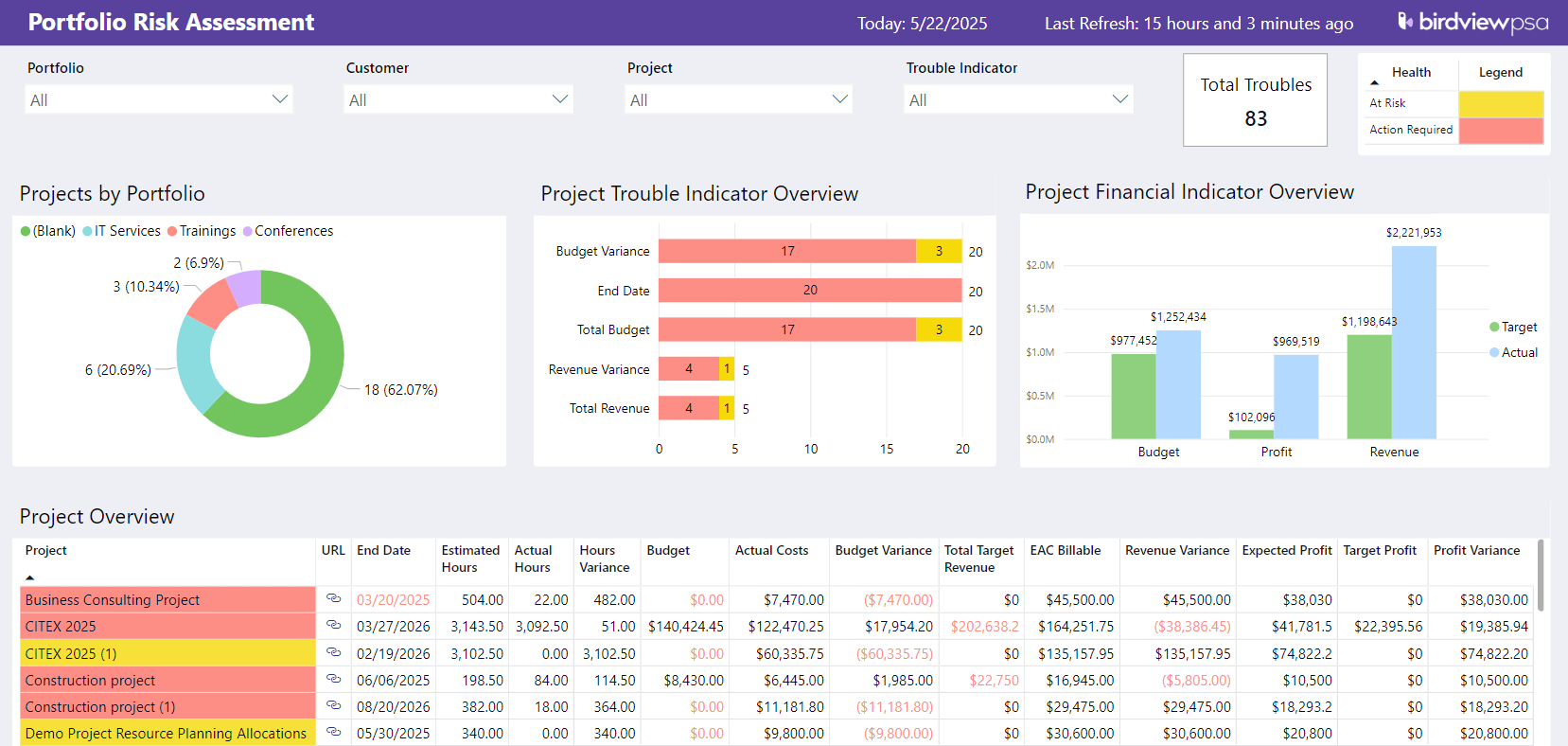
Example: Project portfolio dashboards in systems like Birdview PSA allow leadership teams to monitor operational signals such as:
- capacity versus demand
- portfolio-level profitability
- early delivery risk indicators
This visibility helps organizations detect problems months earlier and rebalance the portfolio before delivery quality declines.
Warning signs your portfolio needs rationalization
Overloaded portfolios usually show a few early warning signs.
Some of the most common signals are:
- utilization that stays above sustainable levels
- projects starting to slip behind schedule
- margins shrinking even while sales remain strong
- senior specialists constantly pulled into firefighting
These patterns often appear months before clients notice delivery problems. Recognizing them early gives leadership time to rebalance the portfolio before delays and quality issues begin to spread.
How Birdview supports portfolio decision-making
Birdview helps leadership teams evaluate their project portfolio by bringing key delivery data into a single view.
Teams can review the portfolio using indicators such as:
- project profitability and margin forecasts
- resource utilization and how work is distributed across teams
- delivery progress and project health indicators
- revenue forecasts across the overall portfolio
Seeing these signals together makes it easier to understand which projects support strategic goals and which ones are stretching delivery capacity.
With clearer operational data, portfolio decisions rely less on intuition and more on measurable evidence.
Final thoughts: Focus is a strategic advantage
Portfolio rationalization is uncomfortable because it requires organizations to stop doing some work in order to protect the work that matters most.
However, avoiding rationalization creates far greater risks. Overloaded portfolios lead to declining delivery quality, exhausted teams, and shrinking margins.
Service firms that regularly evaluate their portfolio and protect their capacity deliver better results for both clients and employees.
Sometimes, the most responsible project decision is simply deciding not to continue a project right now.
FAQ: portfolio prioritization and rationalization
What is portfolio rationalization in project management?
Portfolio rationalization refers to reviewing all active projects and deciding which ones should continue, pause, or stop. Organizations usually consider factors such as profitability, delivery risk, and strategic importance so that limited resources are directed toward the work that matters most.
When should a company rationalize its project portfolio?
Rationalization typically becomes necessary when demand for projects starts to exceed the organization’s delivery capacity. Overloaded teams, shrinking margins, growing delivery delays, or frequent resource conflicts are often early warning signs.
How do service firms decide which projects to pause?
Service firms usually evaluate projects against several criteria, including expected margins, delivery risk, strategic client value, and reliance on scarce specialists. Initiatives with lower value or higher risk are often paused or deprioritized to free up delivery capacity.
What is a portfolio rationalization matrix?
A portfolio rationalization matrix is a simple way to compare projects using consistent criteria. Each initiative is scored across dimensions such as margin potential, delivery risk, strategic value, and dependence on key specialists so leaders can see which projects deserve priority.
Does rationalization damage client relationships?
Not necessarily. When decisions are communicated openly, rationalization often strengthens trust. Many clients prefer realistic timelines and reliable delivery rather than projects that struggle because teams are stretched too thin.
How can software support portfolio rationalization?
Project and resource management platforms make rationalization easier by exposing key operational data. Metrics such as margins, resource utilization, delivery progress, and portfolio profitability help leadership teams evaluate projects with evidence rather than assumptions.