Blog
Blog

Unbilled time in service firms is work that has been completed but not invoiced, creating hidden revenue loss and reducing financial control. It sits between delivery and billing, where work is completed but never turns into revenue.
In practice, this means your team is busy, projects are moving forward, but part of that effort never turns into revenue. The gap is often small per project, but it adds up quickly across teams and time.
What is unbilled time in service firms?
Unbilled time refers to work that has been completed but not invoiced, often due to missed time entries, delayed approvals, or disconnected billing processes.
At a simple level, it comes down to one mismatch:
- Work done does not equal work billed
- Revenue exists in delivery but not in finance
- The loss often stays hidden until it becomes significant
This is why unbilled time is hard to spot. It does not show up as an error. It shows up as lower-than-expected revenue or unclear margins.
Unbilled time vs non-billable time vs unbilled revenue
Unbilled time is work that should be billed to a client but has not been invoiced.
Unbilled revenue is the financial value of that work. It is usually calculated by multiplying unbilled billable hours by the applicable billing rate.
For example, if 50 billable hours are missed at a rate of $150 per hour, that represents $7,500 in unbilled revenue.
Non-billable time is work the firm does not intend to charge to a client, such as internal meetings, admin work, training, sales support, or internal project work.
The difference matters. Non-billable time can be planned and necessary. Unbilled time usually points to a process gap between delivery and billing.
For example, a planned internal training session is non-billable time. A client-requested change that was completed but never logged or invoiced is unbilled time.
Why unbilled time is a serious problem
Unbilled time affects more than billing. It changes how your business performs, how your numbers look, and how decisions are made.
Immediate revenue leakage
The most obvious impact is lost revenue, but it rarely shows up as a single large gap.
It usually happens in small pieces. A missed hour here, an unlogged task there. Individually, these seem minor. As this repeats, it turns into a steady stream of unbilled hours that never reach an invoice.
This is why many firms underestimate the problem. The loss is real, but it is spread across people, projects, and weeks.
Delayed cash flow
Even when time is eventually billed, delays still hurt.
Late time entries or slow approvals push invoicing further out. That delay directly affects when cash comes in. For finance teams, this creates uncertainty in forecasting and puts pressure on short-term liquidity.
In effect, you are financing your own work longer than necessary.
Inaccurate financial reporting
Unbilled time also distorts the numbers you rely on.
If work is done but not reflected in revenue, project margins look worse than they actually are. In some cases, they look inconsistent from one report to another.
This makes it harder to answer basic questions like:
- Which projects are profitable?
- Where are we losing money?
- Are we pricing correctly?
Without clean data, decisions become guesswork.
Reduced profitability
At a broader level, unbilled time quietly reduces overall profitability.
Your team is delivering work, salaries are paid, costs are incurred, but part of that effort never turns into revenue. The result is a growing gap between effort and return.
Many firms try to fix this by pushing utilization higher. But if billing gaps remain, higher utilization does not solve the problem. It only increases the amount of work that risks going unbilled.
Where unbilled time comes from
Unbilled time does not come from one source. It builds up across small gaps in how work is tracked, approved, and billed.
Missing or incomplete time entries
This is the simplest case. The time never gets recorded.
A consultant finishes a task, moves on, and logs it later from memory. A few details are missing. A few hours are skipped. No one flags it because there is nothing to compare against.
Delayed or unapproved timesheets
Here, the time exists but does not move forward.
It sits waiting for approval. If approvals are inconsistent or slow, that delay pushes billing out. Sometimes, it gets forgotten when the billing cycle closes.
Work done outside the defined scope
Not everything is planned. A client asks for a quick change. A team member joins an extra call. The work feels too small to track, so it is not logged. Individually small, these pieces add up to unbilled hours.
Disconnected systems
Even when time is tracked, it does not always reach billing. If time tracking and invoicing live in separate tools, the connection depends on manual steps. That is where entries get lost or missed.
Manual invoicing processes
This is where gaps become visible.
Finance teams pull data from different places, check it, and build invoices manually. Each step introduces a chance to miss something, especially under time pressure.
Signs your firm has unbilled time
Unbilled time rarely announces itself. You need to recognize patterns.
A few signals consistently point to the issue:
- Revenue does not match workload
- Utilization is high, but billing is lower than expected
- Invoicing is consistently delayed
- Data differs across systems
- Project margins look worse than expected
- Finance asks delivery teams to confirm invoice details manually
- Timesheets are often submitted after the billing period closes
- Clients receive late or corrected invoices
Individually, these signs may look like normal operational noise. Together, they usually point to a gap between work completed, time approved, and revenue billed.
How to identify unbilled hours
You cannot fix what you cannot see. Identifying unbilled hours requires simple but consistent checks.
1. Compare time logged vs invoiced
Start with a direct comparison. If your team logs 1,000 billable hours in a month but only invoices 900, the difference is your first signal.
2. Track billable vs non-billable time
Clear categorization matters. If too much time is marked as non-billable without explanation, it may hide missed billing opportunities.
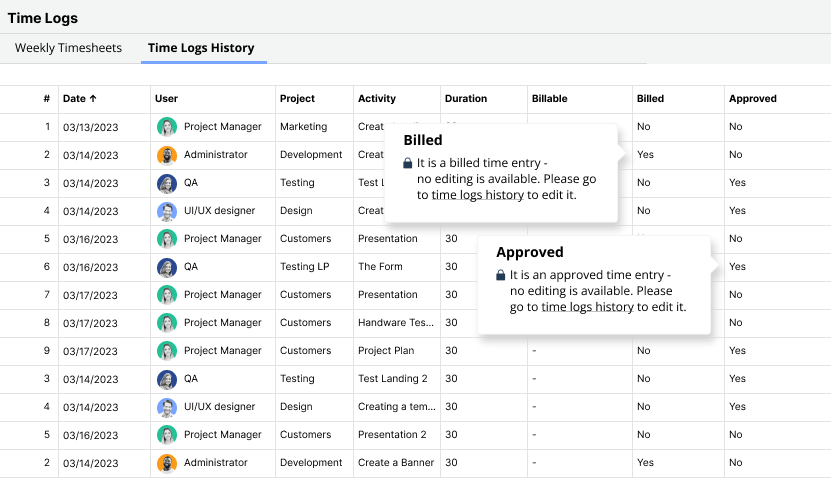
3. Review project-level financials
Look at projects individually. Projects with strong activity but weak revenue often contain unbilled work.
4. Audit time logs regularly
Periodic reviews help catch issues early. A weekly or biweekly audit is usually enough to prevent small gaps from growing into larger problems.
5. Review approved time not yet invoiced
Approved time should not sit in limbo. If hours have been logged and approved but are not attached to an invoice, that is one of the clearest places to find unbilled revenue.
This check helps finance teams separate time-entry issues from billing workflow issues. If the time is approved but not invoiced, the issue is no longer delivery discipline. It is a billing process control.
How unbilled time creates revenue leakage
Unbilled time creates revenue leakage through repetition, not through single large mistakes.
A simple example makes this clear.
| Scenario | Weekly loss | Team size | Annual impact |
| 1 hour missed per person | 1 hour | 10 people | 520 hours |
| 2 hours missed per person | 2 hours | 20 people | 2,080 hours |
| 3 hours missed per person | 3 hours | 25 people | 3,900 hours |
If your average billable rate is $100 per hour, the last scenario represents $390,000 in lost revenue per year.
The pattern is consistent:
- Small gaps → repeated weekly
- Repetition → large financial impact
- Impact → reduced profitability and cash flow
This is why unbilled time should be treated as a system issue, not a people issue.
How to calculate unbilled revenue
To estimate the financial impact of unbilled time, use a simple formula:
Unbilled revenue = Unbilled billable hours × Billing rate
For example, if a firm has 120 unbilled billable hours at an average rate of $150 per hour, the potential unbilled revenue is: 120 × $150 = $18,000
This number does not always mean all revenue is permanently lost. Some hours may still be recovered and invoiced later. But the calculation helps finance and delivery teams understand the size of the gap and decide where to act first.
How to reduce unbilled time in service firms
Reducing unbilled time requires improving the connection between delivery and billing.
Enforce consistent time tracking
Most unbilled time starts here. If time tracking is inconsistent, everything downstream breaks. Clear rules, short entry cycles, and low friction make accurate logging more likely.
Automate time approvals
Delays often come from approvals, not from logging. When approvals depend on manual follow-ups, time gets stuck. Automated workflows keep it moving toward billing without waiting.
Connect time tracking to billing
This is where many firms lose visibility.
Time may be logged and approved, but if it does not flow into billing, it still gets missed. Direct connection removes that gap.
Improve visibility into project financials
Without visibility, gaps stay hidden. Teams need to see what is logged, approved, and billed in real time. That is what allows issues to be caught early, rather than at the end of the month.
Standardize billing workflows
Billing breaks down when the process changes from project to project. Defined steps for turning time into invoices remove ambiguity and reduce missed entries.
The role of systems in preventing missed billing
Tools do not solve everything, but they shape how work flows.
Before improving systems, many firms rely on:
- Spreadsheets for tracking
- Separate tools for time and billing
- Manual reconciliation between systems
This setup makes it easy for data to get lost.
After moving to a more integrated approach, the flow becomes clearer:
- Time is logged in one place
- Approvals are tracked automatically
- Billing pulls from approved data
For example, platforms like Birdview PSA integrate time tracking, approvals, and invoicing into a single workflow. This reduces the number of handoffs and the risk of missed billing.
The key benefit is not the tool itself. It is the removal of gaps between steps.
Example: from unbilled work to captured revenue
A simple process change can turn lost work into captured revenue. The difference is not in how teams work, but in how that work flows into billing.
| Area | Before (revenue leakage) | After (revenue captured) |
| Time tracking | Time logged inconsistently, often delayed or incomplete | Time logged daily with clear expectations |
| Approvals | Timesheets reviewed late or irregularly | Approvals happen automatically and on time |
| Invoicing | Finance builds invoices manually from multiple sources | Invoices pull directly from approved time |
| Billing coverage | Some hours are missed or overlooked | All billable hours are captured and invoiced |
| Outcome | Lower revenue, manual reconciliation, unclear gaps | Accurate billing, faster invoicing, clear financial visibility |
The key shift is simple: remove the gaps between steps.
When time, approvals, and billing are connected, fewer hours fall through the cracks.
Who should own unbilled time reduction?
Reducing unbilled time is not only a financial responsibility. It usually requires shared ownership across project delivery, operations, and billing.
| Role | What they should monitor |
| Project managers | Time entry completeness, scope changes, approvals, and project-level billing readiness |
| Team members | Accurate and timely time entries |
| Resource or operations managers | Utilization patterns, workload, and missing time trends |
| Finance teams | Approved but uninvoiced time, billing cutoffs, invoice accuracy, and revenue leakage |
| Leadership | Margin trends, cash flow impact, and process accountability |
This helps turn unbilled time from a vague problem into a managed operating process.
What to look for in tools that prevent revenue leakage
If you are reviewing tools, focus on capabilities that reduce gaps, not just features.
- Time-tracking accuracy: The system should make it easy to log time accurately and consistently.
- Billing integration: Time data should move directly into invoicing without manual steps.
- Approval workflows: Approvals should be structured and visible, not dependent on email or memory.
- Financial visibility: You need clear insight into logged, approved, and billed time at any moment.
Tools that support these areas help reduce unbilled hours and improve financial control.
If your current setup requires manual steps between time tracking, approvals, and invoicing, that is usually where gaps appear. Reviewing how these steps connect in your system is often the fastest way to reduce missed billing.
FAQ: unbilled time and revenue leakage
What is unbilled time?
Unbilled time is work that has been completed but not invoiced. It usually occurs when time is not logged, not approved, or not connected to billing.
Why does unbilled time happen?
It happens due to process gaps such as missed time entries, approval delays, disconnected systems, and manual invoicing workflows.
How does it affect profitability?
Unbilled time reduces revenue while costs remain the same. This lowers margins and creates hidden revenue leakage across projects and teams.
How can firms reduce unbilled time?
Firms can reduce it by improving time tracking, automating approvals, connecting systems, and increasing visibility into the delivery-to-billing process.
What tools help prevent it?
Tools that combine time tracking, approvals, and billing in one workflow help prevent missed billing by reducing manual steps and improving data flow.