Ksenia Kartamysheva
 A PSA software agreement is a multi-year financial commitment. It is not a one-time purchase. A PSA agreement is a binding contract that governs pricing, licensing, data, uptime, implementation, and exit for three to five years. The contract terms a services firm negotiates at signing determine its flexibility and exit options for the next three to five years. Firms that accept the vendor’s standard contract without negotiation often pay more over the contract life. They also face significant switching costs if the platform underperforms.
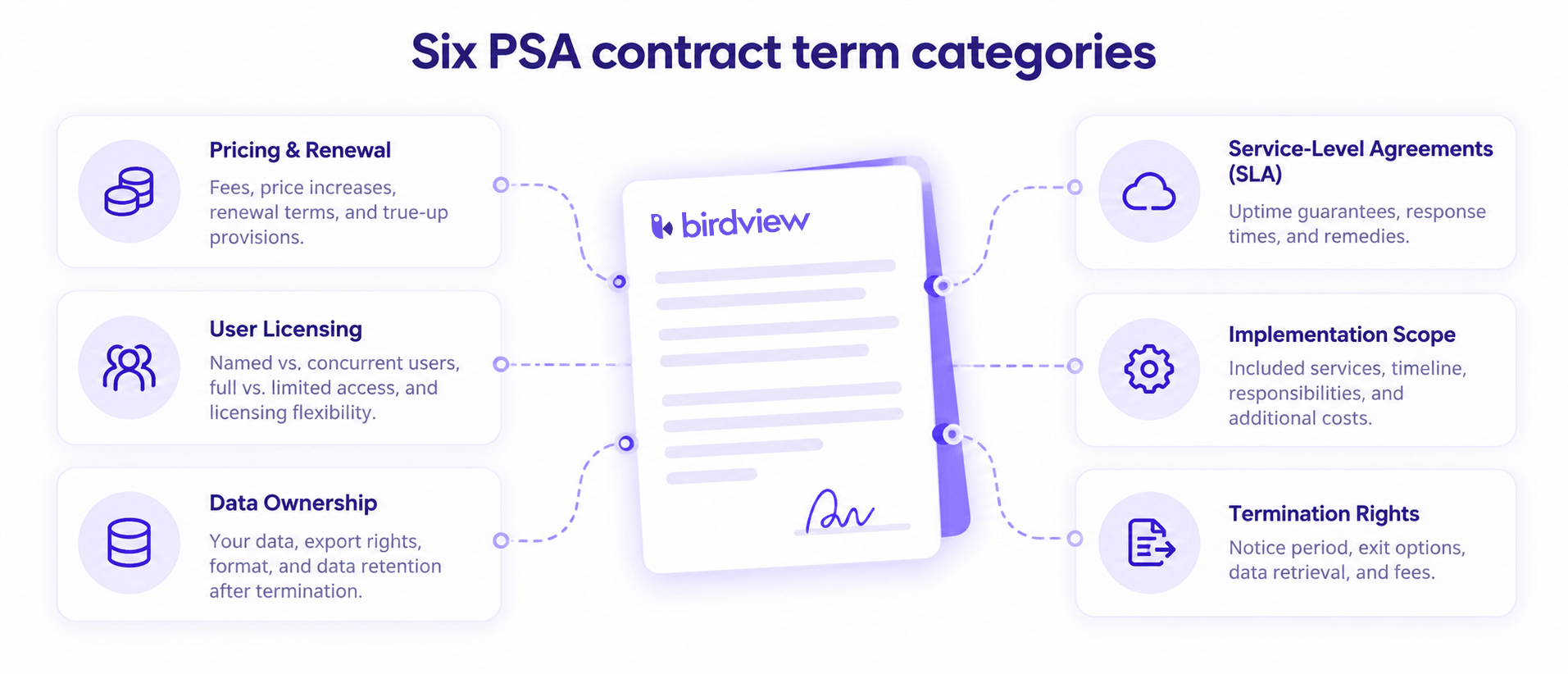
The terms that matter most fall into six categories: pricing and renewal, user licensing, data ownership, service-level agreements, implementation scope, and termination rights. Each category has standard provisions that favor the vendor. Each has alternative provisions that protect the buyer. The difference is negotiation. Therefore, the firm must negotiate all six categories before signing.
SPI Research’s 2026 Professional Services Maturity Benchmark, covering 509 professional services organizations, found that PSA users achieved a median billable utilization of 66.4 percent, compared to 63.5 percent for non-PSA users [1]. The data shows that firms using PSA software outperform those that do not. A business case for PSA software is only as strong as the contract that backs it.
What pricing and renewal terms should you negotiate?
The pricing clause determines what the firm pays every year. For the life of the contract. Standard vendor contracts typically include an annual price escalation, billed at renewal. A firm paying $18,000 per year for 60 users at signing could face a $26,000 bill in year three if the escalation compounds unchecked. The math is brutal. Read the fine print.
Negotiate a price lock for the first two years. Cap annual increases at 3 percent or the Consumer Price Index, whichever is lower. When a vendor refuses to cap increases, negotiate a fixed-term contract (three years) with locked pricing. Not an auto-renewing annual contract.
Three pricing terms to negotiate before signing:
- Price lock for the first two years
- Annual escalation cap at 3 percent or CPI
- True-up clause for user count reductions
Ask for a true-up clause. This adjusts the subscription if the firm reduces its user count mid-term. Without this clause, the firm pays for unused licenses until the next renewal date. A payback period calculation assumes stable costs. An uncapped escalation breaks that model because it introduces unpredictable year-over-year cost increases.
User licensing flexibility
PSA platforms license by named user, concurrent user, or full-platform versus limited-user tier. The licensing model determines how much the firm pays when it adds contractors, part-time staff, or temporary project workers. Choose carefully. The wrong model is expensive.
Named-user licensing charges per individual, regardless of how often they log in. Concurrent-user licensing charges based on the maximum number of simultaneous users. For firms with part-time consultants or seasonal staffing, concurrent licensing can reduce costs significantly [2]. The savings are real.
Negotiate the right to mix full and limited user licenses. A full user needs access to resource management and financial features. A limited user only needs time entry and project visibility. Most vendors offer a limited-user tier at a fraction of the full-user price. They do not always volunteer this option. Ask for it.
Data ownership and portability
The data clause defines who owns the records stored in the PSA platform. It also defines what happens to that data when the contract ends. Standard vendor contracts grant the vendor a perpetual license to use aggregated, anonymized customer data for product improvement. This is acceptable. What is not acceptable is a contract that makes it difficult for the firm to export its own data in a usable format. Data lock-in is the real risk. Insist on portability.
Negotiate the right to export all data in CSV or JSON format at any time, without vendor assistance. This includes projects, resources, time entries, financial records, and custom fields. Include a deadline for the vendor to provide a full data export within 30 days of contract termination at no additional cost. This is non-negotiable.
When a vendor offers a data retention clause that keeps the firm’s data for 90 days after termination, extend it to 180 days. A three-month window is not enough time to migrate to a new platform.
SLA and uptime guarantees
The service-level agreement (SLA) defines the vendor’s commitment to platform availability. It also defines the remedies if they miss it. Standard SaaS SLAs promise 99.9 percent uptime, which translates to roughly 8.7 hours of downtime per year. Premium SLAs promise 99.99 percent, or about 52 minutes per year. The gap matters.
The remedy structure matters more than the uptime number. A contract that promises 99.9 percent uptime but offers only service credits as a remedy is weak. Service credits typically cover a small percentage of the monthly fee. For a $1,500/month subscription, a credit might be $75 to $150. This does not compensate a firm that loses billable hours during an outage. Credits are not enough. The business case for PSA software collapses if the platform is down during peak billing hours.
Negotiate the right to terminate without penalty when the vendor misses the SLA for three consecutive months. Or five times in a single year. Include a defined escalation path for critical outages: 15-minute response for Critical, 1-hour for High, 4-hour for Normal. These numbers matter.
Implementation scope and timeline
The implementation clause defines what the vendor will do to get the firm live on the platform. Standard implementation packages cover configuration, data migration, and training, but the scope varies widely. Some vendors include 40 hours of implementation services. Others include 120. The difference is three times the cost. Get it in writing.
Get the implementation scope in writing as a schedule to the contract. Not as a separate statement of work. Include specific scope items: configured workflows, migrated historical data (specify how many years), integration setup, and end-user training hours. The PSA implementation success metrics you track after go-live depend on what was actually delivered during implementation.
When the vendor misses implementation milestones, the contract should grant the firm the right to extend the go-live timeline without additional cost. Alternatively, the firm should be able to terminate with a full refund of implementation fees.
Termination and transition rights
The termination clause defines how the firm exits the contract. Standard vendor contracts allow termination for cause (vendor breach) but make termination for convenience difficult or expensive. This is deliberate. Vendors want to retain accounts. Fight for exit rights.
Negotiate termination for convenience with 90 days notice after the first contract year. When a vendor refuses this term, negotiate a shorter initial term (one year) with month-to-month renewal thereafter.
Include a transition assistance clause that requires the vendor to cooperate with data migration to a new platform for 180 days after termination. The vendor should provide API access, data exports, and technical support during the transition period at no additional cost. The ROI of PSA software implementation depends on the firm’s ability to switch platforms. No exit means no bargaining power.
Where firms go wrong
Four mistakes account for most PSA contract problems we see:
- Accepting the standard contract without redlines. The vendor’s standard contract is written to protect the vendor, not the buyer. Every clause is negotiable, but only if the firm marks up the contract before signing. Once the contract is signed, the firm has no bargaining power. Firms that accept standard terms without redlines typically pay more over the contract life. They have no exit when the platform fails to deliver.
- Focusing on price, ignoring terms. A 10 percent discount on the subscription is worthless if the contract locks the firm into a five-year term with no termination rights. A 7 percent annual escalation makes it worse. Price is one term among many. Negotiate them as a package.
- Skipping the data export test. Before signing, ask the vendor to demonstrate the data export function. If the export produces a proprietary format that only the vendor can read, the firm is locked in. The export should produce standard CSV or JSON files that any platform can ingest.
- Not negotiating implementation as a contract schedule. Implementation scope described in marketing materials or a separate proposal is not legally binding. When a vendor promises 80 hours of implementation services, that number belongs in the contract, not in a slide deck.
What this changes
A firm that negotiates all six categories pays less over the contract life. It retains the right to adjust user counts as staffing changes. It owns its data and can export it at any time. It can enforce uptime guarantees with real remedies. It has a legally binding implementation scope. It can exit on its own terms. A firm that skips negotiation gets none of these protections. The difference is not theoretical. It shows up in the invoice, the migration cost, and the exit fee.
PSA contract negotiation checklist
Pricing and licensing
- Annual price escalation capped at 3 percent or CPI
- True-up clause for user count reductions
- Mixed full-user and limited-user licensing available
Data and SLA
- Data export in CSV or JSON at any time
- Full data export within 30 days of termination
- SLA with termination rights for repeated breaches
Implementation and exit
- Implementation scope as a contract schedule
- Termination for convenience with 90 days notice
- Transition assistance for 180 days post-termination
FAQ
What contract terms should a services firm negotiate in a PSA agreement?
Negotiate six categories. Pricing and renewal terms come first. User licensing flexibility comes second. Data ownership and portability come third. SLA guarantees with real remedies come fourth. Implementation scope as a contract schedule comes fifth. Termination rights with transition assistance come sixth. The standard vendor contract favors the vendor in all six areas. Redline every one.
Can you negotiate PSA software pricing?
Yes. PSA vendors expect negotiation on subscription price, annual escalation caps, and user licensing tiers. Firms that accept the initial quote without redlining typically pay more over the contract life than firms that negotiate. Negotiate. Always.
What is a good SLA for PSA software?
A good PSA SLA promises 99.9 percent uptime with service credits for missed targets and termination rights for repeated breaches. The remedy structure matters more than the uptime percentage. A 99.99 percent uptime promise with only service credits is weaker than 99.9 percent with termination rights.
Who owns the data in a PSA platform?
The customer owns its data. The contract should state this explicitly and grant the firm the right to export all data in CSV or JSON format at any time. The vendor can retain a license to use aggregated, anonymized data for product improvement, but the firm’s raw data belongs to the firm.
What happens to PSA data when the contract ends?
The contract should require the vendor to provide a full data export within 30 days of termination. The vendor should retain the data for 180 days to allow migration. Without this clause, the vendor can delete the data 30 to 90 days after termination. That leaves the firm no time to migrate to a new platform.
Can a firm terminate a PSA contract early?
Termination for cause (vendor breach) is standard. Termination for convenience is harder to get but worth negotiating. When a vendor will not agree to termination for convenience, negotiate a shorter initial term with month-to-month renewal thereafter.
What implementation terms should be in a PSA contract?
Implementation scope, timeline, and specific items should be a schedule to the contract, not a separate document. Include specific hours, data migration scope, integration setup, and training. When milestones are missed, the contract should allow timeline extension or refund.
Sources
- SPI Research, “2026 Professional Services Maturity Benchmark,” Service Performance Insight, 2026. https://spiresearch.com/reports/2026-ps-maturity-benchmark/
- SaaS Metrics Calculator, “SaaS ROI Calculator 2026,” saasmetricscalculator.com. https://saasmetricscalculator.com/saas-roi-calculator
Related reading
- The mid-market PSA buyer’s guide
- Professional services software requirements checklist
- How to build a business case for PSA software
- PSA implementation success metrics: the executive scorecard
- ROI of PSA Software Implementation
If you are evaluating PSA software, the contract is where the value is captured or lost. Negotiate the six categories above before signing. The vendor expects it, and the terms you accept at signing are the terms you live with for the life of the contract.