Blog
Blog

Project management doesn‘t always get the spotlight it deserves, but for modern businesses, it‘s the backbone of how work gets planned, executed, and delivered. With countless tools flooding the market, finding a solution that truly fits your workflow can feel overwhelming.
With so many options on the market, choosing the right platform can feel overwhelming. This guide compares ten leading project management tools in 2026, focusing on:
- Best fit: for whom each tool is designed
- Core strengths: what makes each platform stand out
- Real-world tradeoffs, because every tool has them
The goal is to help you choose a project management solution that supports your current processes, scales with your growth, and doesn‘t add unnecessary complexity to your day-to-day work.
| Platform | Capterra Rating | Best Use Case For | Key Strengths |
| Birdview Project Management | ★ 4.5/5 | Mid-sized to large enterprises | Smart resource management, BI, financial tracking, portfolio view and billing |
| Workfront (Adobe) | ★ 4.4/5 | Enterprise teams | Workflow automation, Adobe integration, content management |
| Asana | ★ 4.5/5 | Teams of all sizes | Ease of use, flexibility, extensive integrations |
| Trello | ★ 4.5/5 | Small teams, visual thinkers | Kanban boards, simplicity, intuitive interface |
| MS Project | ★ 4.4/5 | Traditional project managers | Gantt charts, Microsoft ecosystem, detailed scheduling |
| Monday.com | ★ 4.6/5 | Teams wanting customization | Visual workflows, automation, customizable dashboards |
| ClickUp | ★ 4.7/5 | Teams needing all-in-one solution | Feature richness, flexibility, custom views |
| Basecamp | ★ 4.3/5 | Small to mid-sized teams | Simplicity, communication tools, flat pricing |
| Smartsheet | ★ 4.5/5 | Spreadsheet-oriented teams | Grid interface, reporting, workflow automation |
| Wrike | ★ 4.3/5 | Marketing and creative teams | Proofing, request forms, custom workflows |
What are the project management tools?
Project management software provides teams with a centralized platform to plan, execute, and track projects from start to finish. These digital solutions help project leaders coordinate work, allocate resources, monitor progress, and keep everyone aligned on goals and deadlines.
Modern platforms usually combine task management, collaboration, reporting, and automation. Many also add AI features that speed up planning, summaries, and risk detection.
How we picked these tools
Our selection process focused on identifying project management platforms that deliver real value across different business contexts. We evaluated each tool based on:
- User ratings and reviews from verified customers on Capterra and G2
- Feature depth across core project management capabilities
- Market presence and adoption rates in 2026
- Innovation and recent product enhancements
- Value proposition relative to pricing
We prioritized tools with strong track records, active development roadmaps, and positive user feedback. Each platform on this list serves a specific audience well, from small teams to enterprise organizations.
📚 Read more: How to choose project management software
Top project management tools 2026
Choosing project management software in 2026 is less about managing tasks and more about how well a platform supports planning, coordination, and decision-making across teams. Different organizations approach project work very differently, depending on team size, delivery model, and the level of control they need over resources, budgets, and timelines.
This comparison covers ten project management solutions commonly used by teams in 2026. The tools range from:
- Enterprise and portfolio-focused platforms: Birdview project management, Workfront
- Flexible work management for cross-functional teams: Asana, Monday.com, ClickUp
- Visual and lightweight task tracking: Trello, Basecamp
- Traditional scheduling-driven project management: Microsoft Project
- Structured, spreadsheet-based planning: Smartsheet
- Workflow and proofing-heavy environments: Wrike
Birdview project management is positioned toward the enterprise end of this spectrum, supporting organizations that need visibility across projects, resources, and finances rather than just task execution.
1. Birdview Project Management
Birdview Project Management stands out as an enterprise-grade solution that combines project planning with robust resource management and financial oversight. The platform offers two main products: Birdview Project Management for general use and Birdview Professional Services for service-oriented businesses.
What sets Birdview apart is its ability to provide visibility across entire project portfolios while maintaining detailed control at the individual project level. The platform excels at helping organizations optimize resource allocation, track budgets, and make data-driven decisions through advanced analytics.
Key features
- Project planning and tracking
Birdview project management provides structured tools for building project plans, defining timelines, and tracking progress against milestones. Teams can manage dependencies, monitor task completion, and quickly see whether projects are moving as expected or drifting off schedule.
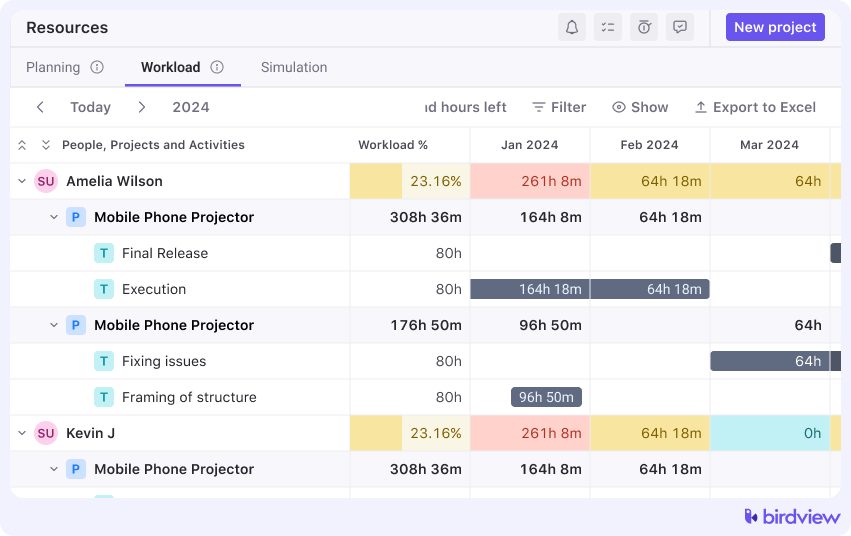
- Resource management
Birdview helps teams plan and allocate resources based on real capacity and availability. By visualizing workloads and utilization, managers can balance assignments, prevent overbooking, and ensure the right people are assigned to the right work at the right time.
- Portfolio management
With portfolio-level views, Birdview allows leaders to see all projects in one place. This makes it easier to compare priorities, assess overall demand, and understand how individual projects contribute to strategic goals before committing resources.
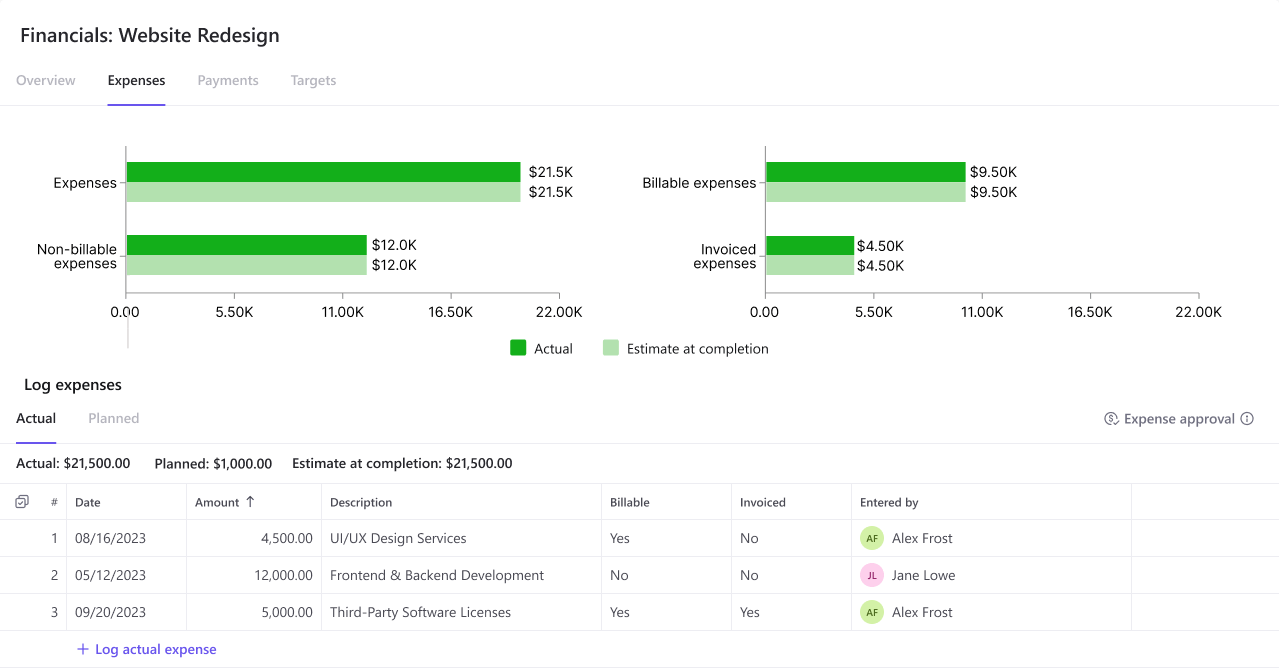
- Time tracking and expense management
Birdview lets teams log time and record project expenses directly against tasks and projects. These entries flow into reports and billing, improving cost accuracy and giving teams clear visibility into time spent and overall project costs.
- Advanced reporting and AI insights
Birdview combines customizable dashboards, advanced reporting, and AI-powered insights to help teams turn project data into clear, actionable information. Role-based dashboards and flexible reports surface key project, resource, and financial metrics, while AI-driven analysis highlights patterns, forecasts demand, and helps identify potential risks earlier in the project lifecycle.
Best for: Mid-sized to large enterprises requiring comprehensive project planning, resource optimization, and financial management capabilities.
Capterra Rating: ★ 4.5/5
Pros:
- Comprehensive feature set covering projects, resources, and finances in one platform
- Strong resource management capabilities with capacity planning
- Scalable architecture suitable for growing organizations
- 24/7 customer support with dedicated account managers for enterprise clients
- Extensive training resources and onboarding assistance
- Flexible pricing starting at $9/user/month
Cons:
- Feature richness can feel overwhelming for very small teams
- Some advanced features require higher-tier plans
💬 Client reviews
“Birdview has transformed how we manage our project portfolio. The resource management features alone have helped us increase utilization by 20% while reducing burnout.” – Capterra review
2. Workfront (now part of Adobe)
Workfront, now part of Adobe’s ecosystem, delivers enterprise-grade project management with powerful workflow automation and digital asset management capabilities. The platform excels at managing complex approval processes and integrating creative work with project execution.
Key features: Workflow automation, project and resource planning, content review and approvals, Adobe Creative Cloud integration, request intake, portfolio tracking, custom dashboards, enterprise reporting.
Best for: Enterprise organizations seeking workflow automation and content management integration, particularly those already using Adobe Creative Cloud.
Capterra Rating: ★ 4.4/5
Pros:
- Enterprise-grade security and scalability
- Excellent for creative and marketing workflows
- Powerful automation reduces manual work
- Strong integration with Adobe tools
Cons:
- Premium pricing may not suit smaller organizations
- Steeper learning curve for new users
- Implementation can require significant time investment
💬 Client reviews
“The Adobe integration has been game-changing for our creative team. We’ve cut approval cycles in half.” – G2 Review
3. Asana
Asana has built its reputation on providing an elegant, user-friendly interface that teams can adopt quickly. The platform balances simplicity with power, offering features that scale from basic task lists to complex portfolio management.
Key features: Task assignments, dependencies, multiple views, project portfolios, workload balancing, automation rules, custom fields, integrations, goal tracking.
Best for: Teams of all sizes looking for an intuitive, flexible project management tool with strong task management capabilities.
Capterra Rating: ★ 4.5/5
Pros:
- Flexible enough for various use cases and team sizes
- Strong mobile apps for on-the-go access
- Regular feature updates and improvements
Cons:
- Advanced features require paid plans
- Limited resource management capabilities compared to enterprise tools
- Reporting could be more robust for complex needs
💬 Client reviews
“Asana struck the perfect balance for our team. It’s powerful enough for our complex projects but simple enough that everyone actually uses it.” – Capterra Review
4. Trello
Trello pioneered the visual board approach to project management, making it instantly recognizable and easy to understand. Its card-based system provides a simple yet effective way to organize work, making it ideal for teams that value visual clarity and simplicity.
Key features: Kanban boards, cards and lists, basic automation, labels and custom fields, timelines and calendars, file attachments, collaboration tools, mobile apps.
Best for: Individuals and small teams seeking a visually intuitive, Kanban-based system for task and project tracking.
Capterra Rating: ★ 4.5/5
Pros:
- Highly visual approach appeals to many users
- Lightweight and fast performance
- Great for agile and kanban workflows
Cons:
- Limited features for complex project management
- Not ideal for resource or financial management
- Can become cluttered with very large projects
- Advanced features require paid plans
💬 Client reviews
“Trello’s simplicity is its superpower. Our team was up and running in minutes, and we haven’t looked back.” – G2 Review
5. Microsoft Project
Microsoft Project has been a staple in project management for decades, offering comprehensive scheduling, resource management, and reporting tools. The platform supports both traditional waterfall and agile methodologies, with deep integration across Microsoft 365.
Key features: Gantt charts, detailed scheduling, resource leveling, critical path analysis, earned value tracking, portfolio planning, Microsoft 365 integration, reporting.
Best for: Traditional project managers and enterprises deeply integrated with the Microsoft ecosystem who need robust scheduling capabilities.
Capterra Rating: ★ 4.4/5
Pros:
- Powerful scheduling and resource management
- Seamless Microsoft ecosystem integration
- Suitable for highly complex projects
Cons:
- Steeper learning curve than modern alternatives
- Interface can feel dated despite updates
- Overkill for simple projects or small teams
- The desktop version has more features than the web version
💬 Client reviews
“For construction project management, nothing beats MS Project’s scheduling capabilities. It handles our complex dependencies flawlessly.” – Capterra Review
6. Monday.com
Monday.com has positioned itself as a work operating system that adapts to how teams work rather than forcing teams to adapt to the software. Its colorful, visual interface and extensive customization options make it popular across diverse use cases.
Key features: Custom boards, visual workflows, automation rules, multiple views, time tracking, dashboards, integrations, document collaboration.
Best for: Teams across various industries seeking a highly customizable platform with visual workflows and powerful automation.
Capterra Rating: ★ 4.6/5
Pros:
- Strong automation capabilities
- Good balance of features and usability
- Regular feature releases and improvements
Cons:
- Pricing can escalate quickly with more users
- Customization freedom can lead to inconsistency
- Minimum 3-seat requirement
- Some advanced features locked to higher tiers
💬 Client reviews
“Monday.com adapted to our workflow instead of making us change how we work. The automation has saved our team hours every week.” – G2 Review
7. ClickUp
ClickUp aims to replace multiple tools with one comprehensive platform. It offers an impressive array of features covering not just project management but also documentation, goal tracking, time management, and team collaboration.
Key features: Multiple project views, task customization, docs and wikis, goal tracking, time tracking, automation, workload views, templates, collaboration tools.
Best for: Teams looking for an all-in-one solution that combines project management with docs, goals, chat, and more.
Capterra Rating: ★ 4.7/5
Pros:
- Free tier includes substantial functionality
- Highly customizable to different workflows
- Active development with frequent updates
Cons:
- Feature abundance can feel overwhelming initially
- Interface complexity may slow adoption
- Performance can lag with very large workspaces
- Frequent updates sometimes introduce bugs
💬 Client reviews
“ClickUp replaced five different tools for us. The learning curve was real, but the productivity gains have been worth it.” – Capterra Review
8. Basecamp
Basecamp takes a different approach than most project management tools, emphasizing communication and collaboration over complex features. Its straightforward design and flat pricing model make it attractive for teams that value simplicity.
Key features: To-do lists, message boards, schedules, file storage, group chat, check-ins, client access, progress visualization.
Best for: Small to mid-sized teams and remote organizations prioritizing communication and simplicity over feature complexity.
Capterra Rating: ★ 4.3/5
Pros:
- Great for remote team communication
- Focus on reducing noise and overwhelm
Cons:
- Limited advanced project management features
- No native time tracking
- Minimal integrations with other tools
- May not suit teams needing detailed reporting
- Less suitable for complex project requirements
💬 Client reviews
“Basecamp keeps our remote team connected without the chaos. It’s refreshingly simple in a world of overcomplicated tools.” – G2 Review
9. Smartsheet
Smartsheet bridges the gap between spreadsheets and project management software. It offers the familiar grid interface that Excel users know while adding powerful project management features, automation, and collaboration tools.
Key features: Grid-based planning, Gantt and card views, automation, dashboards, reporting, resource tracking, forms, integrations.
Best for: Teams comfortable with spreadsheets who need more powerful project management and automation capabilities.
Capterra Rating: ★ 4.5/5
Pros:
- Familiar spreadsheet interface reduces learning curve
- Good for teams transitioning from Excel
- Scales well from small teams to enterprise
Cons:
- Can become expensive as team grows
- Spreadsheet paradigm may not suit all workflows
- Mobile experience less robust than desktop
- Some advanced features require training
💬 Client reviews
“Smartsheet gave us the structure we needed without making us abandon the spreadsheet workflows we know. The automation has been transformative.” – Capterra Review
10. Wrike
Wrike has carved out a strong position among marketing and creative teams with its powerful proofing capabilities and flexible workflow customization. The platform balances ease of use with enterprise-grade features, making it suitable for both growing teams and large organizations.
Key features: Custom workflows, request forms, proofing tools, Gantt charts, workload views, time tracking, cross-project visibility, integrations, reporting.
Best for: Marketing teams, creative agencies, and professional services organizations requiring robust proofing, request management, and custom workflows.
Capterra Rating: ★ 4.3/5
Pros:
- Highly customizable to match business processes
- Strong request and intake management
- Robust integration ecosystem
Cons:
- Can be complex to set up initially
- Pricing increases significantly at higher tiers
- Mobile app has limitations compared to desktop
- Learning curve for advanced features
💬 Client reviews
“Wrike’s proofing features cut our creative review cycles by 40%. The request forms ensure we capture all requirements upfront.” – G2 Review
How to choose the right project management software
Selecting the right project management solution is a critical decision that can impact your team’s productivity, project success rates, and overall operational efficiency. With so many options available, it’s essential to consider what features align best with your business goals and team dynamics. Here are four key factors to guide your selection:
Start with your actual needs. Think about what you need the software to handle, whether that’s agile development workflows, resource scheduling, portfolio management, or integration with tools you already use. A solution that matches your workflow will make adoption easier and deliver value faster.
Look for ease of use. The platform should be intuitive for your team to navigate and straightforward for stakeholders to interact with. A clean, user-friendly interface means higher adoption rates, fewer mistakes, and less time spent on training.
Make sure it can grow with you. As your business evolves, your project management needs will too. Choose a system that’s flexible enough to scale, whether that means handling larger teams, managing more complex projects, or adapting to new methodologies over time.
Check support and pricing. Reliable customer service matters, especially when your team depends on the tool daily. Look for transparent pricing with no hidden costs, and ensure the vendor offers responsive support when you need help.
Bring projects, resources, and finances together with Birdview project management
Birdview project management helps organizations manage projects, resources, and financials in one connected system. By bringing planning, execution, and cost tracking into a single platform, teams gain better visibility, reduce manual coordination, and make more informed decisions while keeping projects on track and under control.