Ksenia Kartamysheva
 Managing cash flow in a project-based business looks simple from the outside: win work, deliver it, invoice it, get paid. In reality, the timing gets ugly fast. Projects overlap, billing lags behind delivery, clients pay late, and payroll shows up like clockwork.
That’s why profit and cash are not the same thing. A firm can look healthy on the P&L and still be one slow-paying client away from a payroll headache.
This is where professional services automation (PSA) helps. PSA connects time tracking, project budgets, resourcing, invoicing, and revenue forecasts in one system. That helps you bill faster, spot overruns earlier, and predict cash gaps before they hit.
In this guide, you’ll learn why profitable project businesses still run out of cash, the operational traps that cause cash crunches, and the practical steps, plus PSA workflows, that keep liquidity stable as you grow.
Key takeaways
- Profit shows performance; cash flow shows survival. You need both.
- Billing speed and collections discipline drive cash. Late invoices create real cash pain.
- DSO is your early warning metric. If it rises, your cash gap is widening.
- PSA reduces cash risk by tightening the chain from time entry to approvals to invoicing to forecasting to collections.
DSO: a simple way to spot cash risk
DSO (Days Sales Outstanding) is how many days it takes your invoices to turn into cash.
A quick estimate is: DSO = receivables ÷ average daily sales. If DSO rises from 24 to 36, you are floating 12 extra days of costs.
Why profitable project firms still run out of cash
Here’s a scenario that plays out more often than most people admit: a services firm has a full pipeline, solid margins on paper, and a team that’s billing hard. Then the CFO flags a problem. There’s not enough cash to cover payroll next week.
It sounds like a contradiction. But in project-based businesses, it’s completely normal. The gap between earning revenue and receiving it can stretch for weeks or months, and during that time, your costs don’t pause. Salaries go out the door on a fixed schedule. Subcontractors invoice you whether your client has paid or not.
The core issue is timing. You might finish a project phase in March, invoice in April, and get paid in late May, if the client pays on time. Meanwhile, the team that delivered that work was on payroll in February. That’s a three-month gap between spending money and recovering it.
Growth makes this worse. Winning more work means hiring ahead, staffing up, and absorbing more costs before the cash comes back. A firm growing at 30% a year can find itself in a tighter cash position than it was at half the size.
Cash flow vs profit: the simple difference
Profit tells you whether your pricing covers your costs over a period of time. Cash flow tells you whether you have money available right now to pay your bills.
| Profit | Cash flow | |
| What it measures | Revenue minus costs over a period | Money actually available right now |
| When it’s recorded | When revenue is earned or invoiced | When payment is received in your account |
| Affected by payment timing? | No | Yes, directly |
| What it tells you | Whether your business model works | Whether you can pay your bills today |
| Risk if ignored | Pricing or margin problems | Payroll gaps, missed payments, insolvency |
In project work, the two can diverge sharply, and that divergence is what creates risk.
When you recognize revenue (or book it on an invoice), it shows up in your P&L. But it doesn’t show up in your bank account until the client actually pays. If your payment terms are net-30 and your clients routinely pay at net-45 or net-60, you’re carrying the cost of that gap yourself.
A simple example: imagine a project worth $100,000 delivered over three months. Your costs are $70,000, salaries, tools, and overhead, paid monthly. You invoice at the end of the project. Your profit is $30,000. But for three months, you’ve been spending without receiving anything back. That’s a cash drain of $70,000 before you see a cent. The project is profitable. But it can still break you if you don’t have the reserves to bridge the gap.
5 common cash flow traps in project-based businesses
Most cash problems in project firms don’t come from bad pricing or poor delivery. They come from operational habits that quietly erode liquidity over time. Here are the traps that show up most often.
- Late or inconsistent invoicing
When project managers are focused on delivery, billing often gets pushed to the back of the queue. It feels like a small thing, but a two-week delay in sending an invoice translates directly into a two-week delay in getting paid. Multiply that across every active project and it becomes a serious drag on cash.
- Poor visibility into budget burn
If you don’t know that a project is consuming 60% of its budget with only 40% of the work complete, you can’t act before the margin disappears. By the time those numbers surface in a monthly report, it’s too late to course-correct without a difficult client conversation.
- Weak accounts receivable tracking
Teams often track whether invoices are sent, but not whether they’re paid. Outstanding receivables pile up quietly. Days Sales Outstanding (DSO) creeps upward. And suddenly you’re owed a lot of money that isn’t in your account.
- Overloaded teams causing billing delays
When delivery staff are stretched thin, administrative tasks like timesheet submission and approval fall behind. That delays invoice generation, which delays payment. High utilization can paradoxically create cash pressure precisely because the team is too busy to keep billing moving.
- Hiring ahead of confirmed revenue
Taking on headcount to capture anticipated demand is sometimes necessary. But if that revenue doesn’t land on schedule, you’re absorbing fixed payroll costs without the income to match. It’s one of the fastest ways to turn a growth story into a cash crisis.
A practical cash protection checklist (6 operational steps)
The good news is that most cash flow problems in project businesses are fixable with better processes. These six steps won’t eliminate all risk, but they address the most common sources of cash pressure in a practical, operational way.
Step 1: Align billing schedules with delivery milestones
Waiting until a project is complete to invoice is one of the most expensive habits a project firm can have. Progress billing, invoicing at defined milestones rather than at the end, keeps cash moving throughout the engagement.
Set billing triggers at project kickoff, not after the fact. When a milestone is agreed, so is the invoice that goes with it. That makes billing a natural part of project delivery rather than an afterthought. In Birdview, you can structure projects around billable milestones and link milestone completion directly to invoice generation, closing the gap between delivery and billing.
Step 2: Shorten the gap between work performed and invoice sent
The longer the lag between timesheets and invoices, the longer the cash gap. Weekly time entry approval, locked timesheets at the end of each billing period, and automated invoice generation from approved time can cut that lag significantly.
Manual reconciliation, pulling hours from a spreadsheet, matching them to a project, checking against budget, takes time and introduces errors. Tools that generate invoices directly from approved time entries remove both problems. Integration with accounting platforms like QuickBooks or Xero means the data flows through without duplication.
Step 3: Monitor burn rate and expected revenue in real time
By the time a project margin problem shows up in a monthly report, the damage is done. Real-time visibility into budget vs. actual effort lets you catch drift early, before you’ve burned through margin without recouping it in billing.
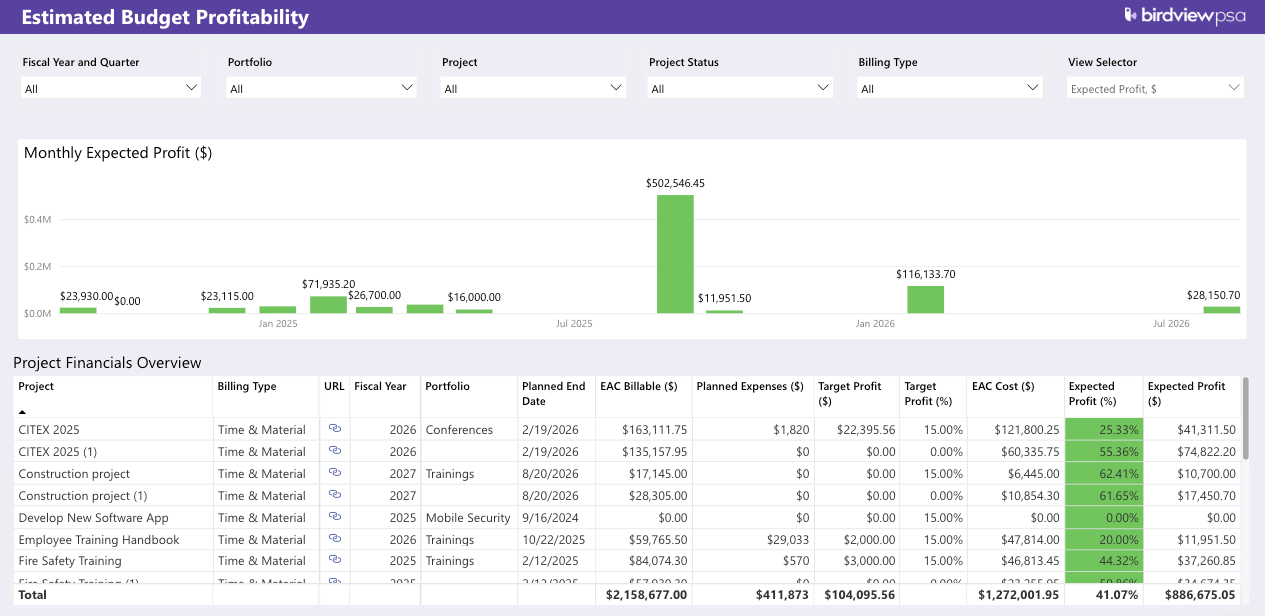
If a project is consuming cost faster than revenue is being recognized, that’s a signal to look at staffing, scope, or billing frequency. Catching it in week four of an eight-week project is very different from catching it in week seven. Birdview’s project profit reports let you track expected revenue alongside actual costs without waiting for the month-end close.
Step 4: Forecast cash flow, not just revenue
Revenue forecasting tells you what you expect to earn. Cash flow forecasting tells you when you expect to actually receive it, and that’s the number that matters for payroll.
A rolling 30-to-90-day cash forecast, updated monthly, gives your finance team and project leadership a shared view of what’s coming in and when. Factor in your actual payment terms, not just the terms you invoice on. If your clients consistently pay 15 days late, build that into your model. And keep confirmed revenue (contracted, in-flight work) separate from probable revenue (pipeline, verbal agreements). They carry different risk, and blending them together gives you false confidence.
Step 5: Control scope to protect cash
Scope creep doesn’t just affect project margins. It affects cash flow directly. Delivering additional work without a change order means absorbing costs you won’t be able to bill for, and over multiple projects, that adds up fast.
Formal change request documentation isn’t just good project management practice. It’s a cash protection mechanism. Every scope change should trigger an update to the budget, the billing plan, and the revenue forecast before the work starts, not after.
Step 6: Watch utilization without overextending payroll
High utilization looks great on a dashboard. But if your team is fully booked on work that hasn’t been billed yet, you’re paying salaries against revenue that hasn’t arrived. Capacity planning should sit alongside pipeline visibility. Before committing to headcount, compare confirmed project demand against available capacity and check whether the revenue from that demand will land before the payroll costs hit.
Warning signs your next cash crunch is already forming
Cash problems rarely appear overnight. They tend to surface through patterns that are easy to overlook until they compound.
1. Revenue grows while cash declines
One of the most telling signals is revenue increasing while your bank balance shrinks. On paper, performance looks strong. In reality, the gap between earning and receiving is widening. Rising DSO tells the same story from a different angle. Invoices may be issued, but collections are slowing.
2. Repeated margin adjustments mid-project
If project margins are frequently revised downward during delivery, it signals deeper structural issues.
Consistent estimate corrections often point to:
- Weak scoping discipline
- Pricing misalignment
- Billing process gaps
When profitability keeps eroding after work begins, forecasting accuracy is already compromised.
3. Dependence on future pipeline to cover current obligations
If this month’s payroll depends on next month’s expected deals, the business is operating without a safety net.
Relying on projected revenue rather than collected revenue increases exposure. Pipeline is not cash, and treating it as such magnifies risk during slowdowns or delayed payments.
How PSA software reduces cash flow risk (Birdview example)
The reason cash flow is hard to manage in project businesses is usually fragmentation. Time tracking lives in one tool, billing in another, resource planning in a third. Nobody has a complete view, and by the time you stitch it together, you’re looking at the past.
Birdview connects time, cost, and billing in one system, which means the data you need to make cash decisions is always current and always connected. That doesn’t mean the tool does the work. Cash discipline is a habit, and habits live with people. But having the right visibility makes it much easier to build those habits and actually act on what you see.
- Unified time and cost tracking: When time entries, cost rates, and project budgets live in the same system, margin data updates automatically as work is logged. There is no need to manually reconcile spreadsheets to understand profitability. This reduces lag between operational activity and financial insight.
- Real-time project profit tracking: Project profit reports show current margin performance based on actual logged effort and costs. Instead of discovering erosion at month-end, leaders can see compression as it forms and intervene early.
- Expected revenue forecasting: Birdview’s expected revenue reports project forward based on booked work, scheduled effort, and active contracts. This gives leadership a view of where revenue is likely to land, not just what has already been invoiced.
- Resource capacity visibility: Cash flow risk often begins with over-allocation or misaligned capacity. Workload and capacity views reveal where strain could lead to delays, overruns, or margin pressure.
Final thoughts
Profitability and liquidity are not the same thing, and conflating them is one of the most common reasons project firms find themselves in avoidable trouble. The fix isn’t complicated. It’s about shortening billing cycles, improving visibility, forecasting more carefully, and treating scope changes as financial events, not just delivery inconveniences.
None of this requires a finance team of ten. It requires the right processes, the right data, and people who treat cash flow as an operational priority, not just a finance problem.
FAQ: cash flow management in project-based businesses
Why does my project firm show profit but struggle with cash? Because profit is recognized when revenue is earned, not when it’s received. Timing differences between delivering work and getting paid create gaps that can drain liquidity even in healthy businesses.
What is Days Sales Outstanding (DSO) and why does it matter? DSO measures how long it takes, on average, to collect payment after invoicing. A rising DSO means clients are taking longer to pay, which stretches your cash gap and increases risk.
How does PSA software help with cash flow? PSA tools like Birdview connect project delivery data with billing and financial reporting. That means you can invoice faster, track burn rate in real time, forecast expected cash receipts, and catch problems before they become crises.
What’s the simplest way to improve billing speed? Approve timesheets weekly, lock them at the end of each billing period, and automate invoice creation from approved time. Removing manual steps is usually the fastest way to close the gap between work done and invoice sent.