Vadim Katcherovski
 AI is doing to companies what the internet did 25 years ago. It’s not a feature you add. It’s a shift in how businesses operate, compete, and deliver value. The companies that treated the internet as a side project, a microsite here, an email newsletter there, fell behind and many didn’t survive. The ones that rewired their operations around it became the companies that define industries today.
AI is that same kind of moment. And we believe the companies that don’t make it part of their DNA won’t make it through the next decade.
There’s a pattern in how most companies approach AI. They pick a process, bolt on a tool, announce the initiative, and move on. Maybe it saves some time. Maybe it doesn’t stick. Either way, it stays small. That’s not transformation. That’s decoration.
We’re doing something different at Birdview PSA. We’re treating AI as a full company transformation. Not adding it to a few workflows, but rethinking how every function operates. Sales, Marketing, Customer Success, Product, Operations. All of them. And we’re going to share the entire journey: what works, what breaks, and what we learn along the way.
This is the first post in a weekly series. No varnish. No “and then AI magically solved everything.” Just the real story of a seasoned SaaS company going all in on becoming AI-native.
My name is Vadim Katcherovski, CEO of Birdview PSA. I’ll be writing every post in this series. Not because we don’t have a marketing team, but because AI transformation is not something you delegate. If I’m asking every function leader to own their transformation, I should be the one sharing what that looks like from the top.
Why we’re doing this
Birdview PSA helps companies manage projects, resources, and finances. We’re actively building AI assistance and agent functionality into our platform that will help our customers work smarter with intelligent automation.
But here’s the thing: you can’t build great AI products for customers if you don’t understand what AI transformation actually feels like from the inside. The messy parts. The data problems. The resistance. The moments where the agent confidently gives you the wrong answer.
So we made a decision: every function at Birdview will go through AI transformation. Not as a side project. As the way we operate.
The goal: Automate every function (where it makes sense)
The goal is not to replace people or eliminate processes. It’s the opposite.
We automate repeatable work so our team gets time back. Time they can spend on decisions, relationships, and problems that actually need a human brain. When an AI agent handles post-call admin, the sales rep doesn’t disappear. The sales rep gets 20 minutes back to prepare for the next conversation, dig into a deal, or talk to a customer.
Every function has work that’s necessary but repetitive: updating CRM fields, compiling reports, scoring accounts, creating decks. That work still needs to happen. But it doesn’t need a person doing it manually every time.
When we automate those tasks, two things happen. People move faster. And they focus on higher-value work they were already supposed to be doing but never had time for.
This is not about doing more with fewer people. It’s about the same people achieving more with better workflows.
Here’s where we’re applying this across the company:
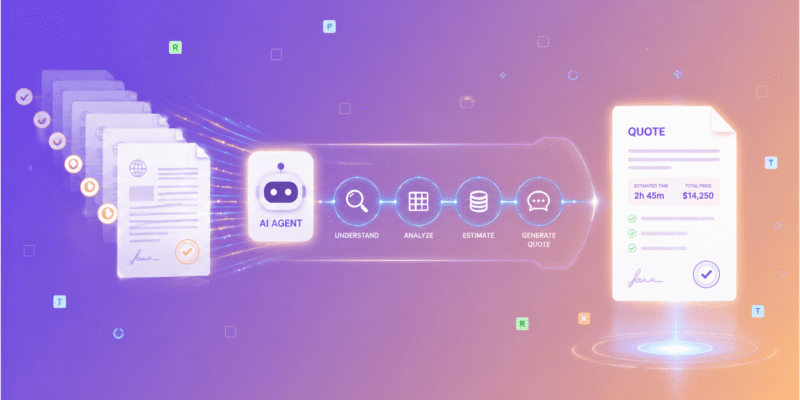
- Sales: call intelligence, coaching, pipeline scoring, deck and proposal generation.
- Customer Success: account health scoring, risk detection, renewal intelligence, proactive outreach triggers.
- Marketing: content pipeline automation, campaign execution, analytics, competitive monitoring.
- Product and Engineering: integration estimation and scoping, coding, feature prioritization signals, release communication.
- Operations: reporting, compliance, internal knowledge management.
Each function has dozens of processes. We’re mapping every one, identifying what requires human judgment and what doesn’t, and building AI workflows for the rest.
The key to all of this: Context
Here’s what we’ve learned so far that nobody warns you about: the hardest part of AI automation isn’t the AI. It’s the context.
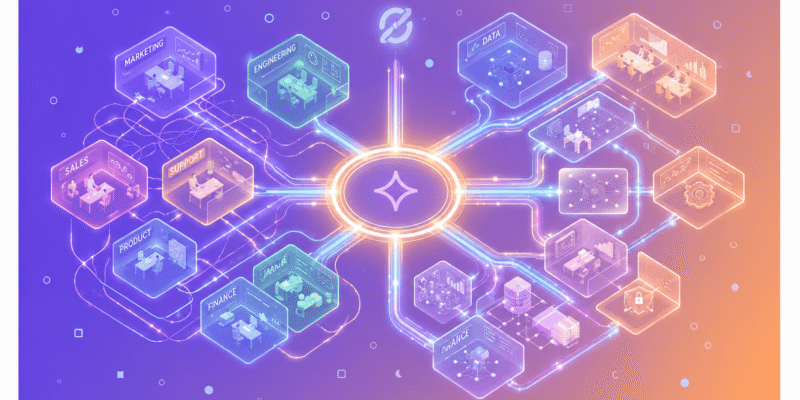
An AI agent is only as useful as the information it can access. And in most companies, including ours when we started, that information is scattered across ten different systems. Your CRM knows about deals. Your support tool knows about tickets. Your product analytics know about usage. Your finance system knows about revenue. Nobody has the full picture.
Before you can automate a single process, you need to answer: what data does this workflow need, and where does it live? Then you need to make that data accessible. Securely, reliably, in a format an agent can actually use.
We call this making the company “readable” for AI. It’s not glamorous work. It’s building the pipes, defining the data owners, setting up the access rules. But without it, every AI agent you build will be smart in isolation and useless in practice.
Protecting customer data is not optional
When you’re pulling data from multiple systems and feeding it to AI agents, data protection isn’t an afterthought. It’s a prerequisite.
Every automation we build goes through the same questions: What customer data does this touch? Where does it flow? Who can see the outputs? What happens if the AI hallucinates something about a customer and a human acts on it?
We’ve made decisions that slowed us down. Scoping access per role, keeping certain data out of AI pipelines entirely, building audit trails before building features. We don’t regret any of them. If you’re going to restructure your company around AI workflows, you need to get this right first.
What this series will cover
- Function deep dives: how we’re automating Sales, CS, Marketing, Product, and Ops. The processes, the context required, the architecture decisions, and the results.
- Honest lessons: what surprised us, what went wrong, the economics, and the hard questions about data and trust.
- Practical takeaways: frameworks you can apply to your own company, regardless of your industry or team size.
We’re not pretending we’ve figured it all out. We’re learning fast and sharing as we go.
What’s next
Next week, we’re going deep on Sales automation. It was the first function we tackled, and we’ll walk through the workflows we’ve automated so far and the first steps we took to get there. If you’re thinking about where to start with AI in your own company, Sales is a strong candidate, and we’ll explain why.
If you’re a founder, operator, or functional leader thinking about what it actually takes to make your company AI-native, not just AI-curious, this series is for you.
Subscribe to get weekly posts delivered to your inbox. No spam, no hype. Just the real story from inside the build.
Stay updated on Birdview's AI Automation Journey
This is Part 1 of “Becoming AI-Native,” a weekly series from the Birdview PSA team on our AI transformation journey. Follow along here on Birdview’s blog, on Vadim’s LinkedIn