Ksenia Kartamysheva
 - Cost-to-complete (CTC) is the estimated cost still needed to finish a project, based on remaining scope and current cost performance.
- Estimate at completion (EAC) equals actual cost incurred so far plus CTC, giving a single forecast of total project cost.
- Budget variance is backward-looking, showing whether a project is over or under budget to date. CTC and EAC are forward-looking, showing whether the project will finish over budget.
- There are two ways to calculate CTC: bottom-up, re-estimating remaining tasks directly, for at-risk engagements, and performance-based, CTC = (budget at completion minus earned value) divided by cost performance index, for stable engagements.
- A project can show a small, 10% variance-to-date and still be tracking toward a 33% total overrun, which is why EAC catches risk that variance-to-date alone misses.
- CTC and EAC are only as accurate as the underlying time and budget data. Incomplete or delayed time entries make both figures unreliable.
- Recalculate CTC on a monthly cadence for the full portfolio, and more frequently, using the bottom-up method, for any engagement already flagged as at risk.
Cost-to-complete (CTC) is the estimated cost still required to finish a project, based on remaining scope and current performance. Added to costs already incurred, it produces the estimate at completion (EAC), a forward-looking total cost. Budget variance only shows how far off plan a project is so far.
Budget variance answers one question: are we over or under budget right now. It does not answer whether the project will finish over budget. A project can show a small, tolerable variance at 40% complete and still be on track to land 25% over its original budget by closeout. CTC is the number that catches that gap before it becomes unrecoverable.
Most professional services firms never build this habit. Roughly 55% of the professional services operations we’ve reviewed didn’t track project cost against labor at all, and the ones that did usually stopped at variance-to-date and never projected the number forward, which is exactly the gap CTC closes.
This article covers the CTC formula, two ways to calculate remaining cost, a full worked example, how CTC relates to EAC and budget variance, and how finance teams use the number operationally.
What is cost-to-complete?
Cost-to-complete is the projected cost of all remaining work on a project, calculated from where the project actually stands today rather than from the original plan.
In construction and engineering, where the concept originated, CTC usually covers remaining materials, equipment, and subcontracted deliverables. In a professional services context, remaining cost is almost entirely billable labor at its loaded cost, plus any remaining third-party or subcontractor spend. A services firm rarely has a materials line to project; it has hours left to deliver and a rate at which someone will actually deliver them.
The field does not fully agree on terminology. Some practitioners use CTC and estimate to complete (ETC) interchangeably; others treat ETC as the formal earned value management term and CTC as the plain-language equivalent used in day-to-day reporting. Both describe the same underlying number: cost still to be spent. This article uses CTC and ETC as synonyms and notes the overlap here rather than picking a side silently.
The cost-to-complete formula
CTC equals the remaining scope of work multiplied by the cost rate at which that work will actually be delivered, not the rate originally budgeted, if current performance suggests a different rate is more realistic.
There are two common ways to arrive at that number.
Bottom-up CTC. Re-estimate every remaining task or hour directly from the current project plan. A project lead or delivery manager reviews what is left, reforecasts hours against current staffing, and rolls the total up. This is the most accurate method and the most effort. It is best suited to complex or troubled engagements where a formula-based shortcut would hide real risk.
Performance-based CTC. Project remaining cost using the cost performance already observed on the project, applied to the remaining budgeted work. This method uses the cost performance index (CPI), a ratio of earned value to actual cost, as defined in the Project Management Institute’s earned value management standard. It is faster than a bottom-up re-estimate and appropriate for stable, well-understood engagements.
Use bottom-up CTC for anything a service delivery dashboard has already flagged as at risk. Use performance-based CTC as the default monthly sweep across the rest of the portfolio, where re-estimating every project by hand is not practical.
Worked example: calculating CTC and EAC
The fastest way to understand CTC is to run it once with real numbers.
Take a $200,000 fixed-fee engagement. The team has spent $80,000 so far, 40% of the total budget. But milestone tracking shows only 30% of the actual scope has been delivered. That gap between money spent and work done is the whole story.
Convert this into earned value terms:
- Budget at completion (BAC): $200,000, the total approved budget.
- Earned value (EV): the budgeted value of work actually completed, 30% of $200,000, or $60,000.
- Actual cost (AC): what has really been spent, $80,000.
First, calculate the cost performance index: CPI = EV ÷ AC = $60,000 ÷ $80,000 = 0.75. For every dollar spent, the project has earned only $0.75 of completed work.
Next, calculate the remaining cost using the performance-based method: CTC = (BAC − EV) ÷ CPI = ($200,000 − $60,000) ÷ 0.75 = $140,000 ÷ 0.75 = $186,667.
Add that to what has already been spent to get the estimate at completion: EAC = AC + CTC = $80,000 + $186,667 = $266,667.
That is $66,667 above the original $200,000 budget, an overrun of roughly 33% if current performance holds.
Now compare two ways a finance lead might read this project at the same point in time. The naive read looks only at variance-to-date: EV − AC = $60,000 − $80,000 = negative $20,000, about 10% of the budget. That looks manageable, the kind of gap a project manager might promise to close by the next milestone. The CTC-informed read shows the same project is tracking toward a 33% total overrun. Variance-to-date and CTC are looking at the same project and telling two different stories, because one looks backward and the other looks forward.
Cost-to-complete vs. estimate-at-completion vs. budget variance
These three numbers answer three different questions. They are not alternatives to each other; a finance review that skips any one of them is missing part of the picture.
| Metric | What it answers | Time orientation | Data needed | Who uses it day to day |
| Budget variance | How far off plan are we, to date | Backward-looking | Budgeted cost vs. actual cost to date | Project managers, weekly status checks |
| Cost-to-complete (CTC) | How much is left to spend to finish the work | Forward-looking | Remaining scope, current cost performance | Finance leads, delivery managers |
| Estimate at completion (EAC) | What will this project actually cost, in total | Forward-looking | Costs incurred to date plus CTC | Finance leads, CFOs, portfolio reviews |
EAC is not a second opinion on the original budget. It is an updated forecast built from what the project has actually shown so far. The number finance teams actually need for reserve planning and for pricing future similar work is the gap between EAC and the original budget, not the variance-to-date figure alone.
How finance teams use CTC operationally
CTC and EAC only create value when they are reviewed on a fixed cadence and feed real decisions, not when they sit in a one-time report.
A practical cadence: a monthly portfolio-wide sweep using performance-based CTC, with more frequent bottom-up recalculation for any engagement already flagged. That review should feed three decisions.
Whether to intervene on a specific project. Set an intervention threshold, for example a projected EAC exceeding the original budget by more than a firm-set percentage. Once a project crosses that line, it moves from routine monitoring into active management, the same kind of trigger that shows up in the early warning signs of a project heading toward an overrun.
Whether portfolio-level reserves are adequate. If several projects are independently tracking toward overruns, the aggregate EAC gap across the portfolio is the number that should inform contingency planning, not the sum of individual variances.
Whether pricing on future similar work needs to change. A pattern of EAC consistently exceeding budget on one type of engagement is usually a scoping or estimating problem, not a delivery problem. Feeding CTC data back into how the next similar deal gets priced closes a loop most firms never close, and it connects directly to how well sales scoping matches what delivery actually experiences.
CTC is only as reliable as the underlying time and budget data behind it. The same complete, timely time-entry habit firms need to build in the first 90 days after go-live is what CTC depends on months later; if entries are incomplete or delayed, both the actual cost figure and the remaining-scope estimate built on top of it will be wrong in the same direction.
Common CTC mistakes
Using the original budgeted rate instead of the rate current performance actually suggests. This bakes optimism into the formula itself and produces a CTC that understates real risk.
Recalculating too rarely. A CTC figure that is three months stale is worse than no CTC figure, because it creates false confidence exactly when a project needs attention.
Applying bottom-up re-estimation uniformly across the whole portfolio. This burns delivery managers’ time on stable engagements that a performance-based sweep would have covered in minutes, and it slows down review of the projects that actually need the detailed look.
Treating CTC as a one-time number instead of a rolling forecast. A CTC calculated once at kickoff or once at the halfway mark has already gone stale by the next reporting cycle. The value comes from watching how the number moves.
Where this fits
CTC turns variance-to-date into a forward-looking forecast. EAC is the number that actually predicts whether a project lands on budget, and it is the number worth showing in a monthly finance review, not variance alone.
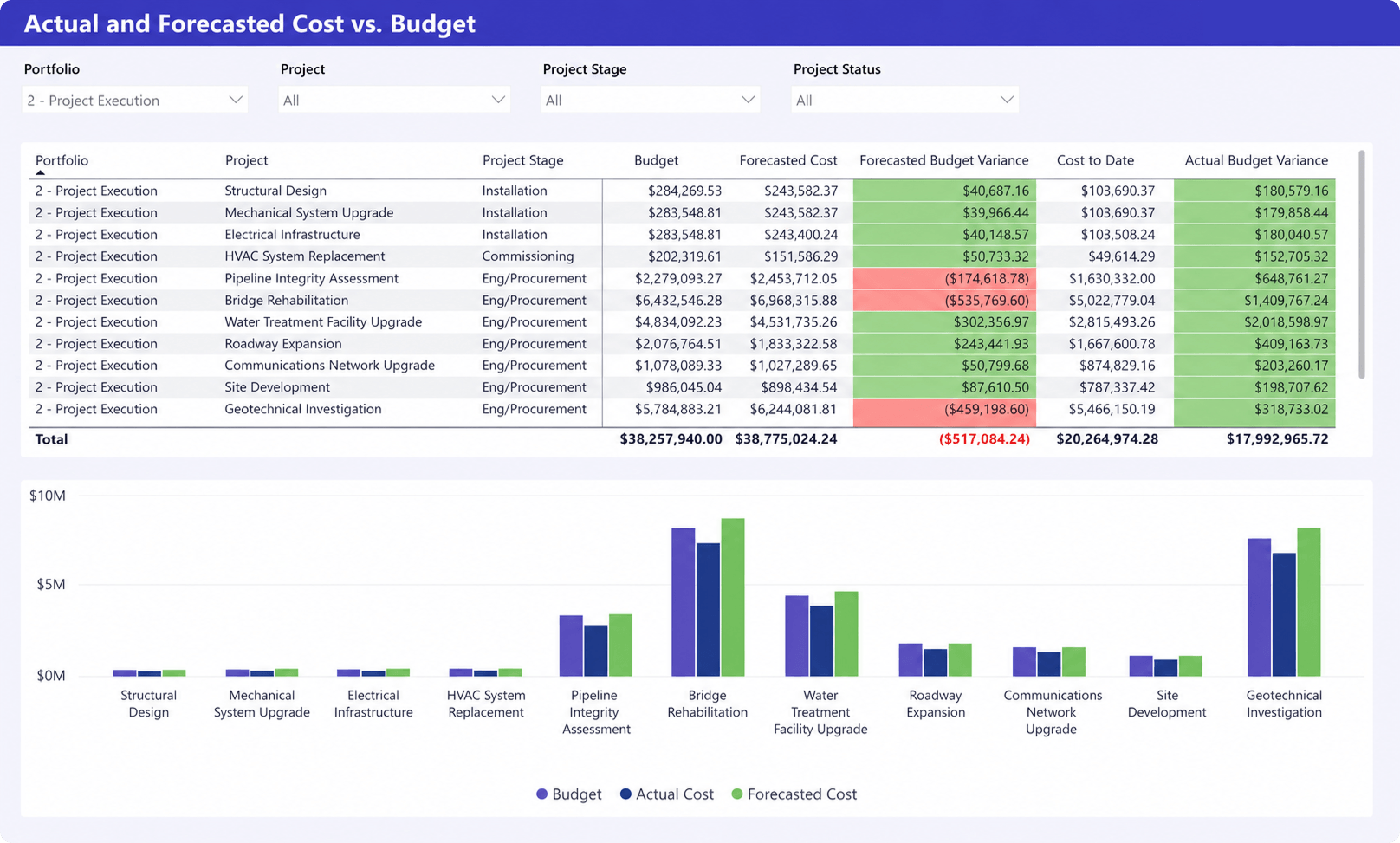
If this calculation currently lives in a spreadsheet, the inputs it depends on (time entries, budgeted cost, remaining scope) usually already exist in whatever system runs project delivery. A Birdview demo is worth a look if you want to see CTC and EAC calculated against live project data instead of rebuilt by hand every month.
FAQ
What is the difference between cost-to-complete and estimate-at-completion? Cost-to-complete is the projected cost of the work still remaining on a project. Estimate at completion adds that figure to costs already incurred, producing a single forecast of what the entire project will cost by the time it finishes.
How do you calculate cost-to-complete? Use bottom-up CTC (re-estimating remaining tasks directly) for at-risk engagements, or performance-based CTC for stable ones: CTC = (budget at completion − earned value) ÷ cost performance index. Add CTC to actual cost so far to get EAC.
Is cost-to-complete the same as ETC? Often, yes. In formal earned value management terminology, ETC (estimate to complete) is the standard term for remaining cost. Many practitioners use CTC interchangeably with ETC in day-to-day reporting; both describe the same figure.
How often should CTC be recalculated? Recalculate CTC on a fixed monthly cadence for a portfolio-wide sweep, using the performance-based method. Recalculate more frequently, and with a bottom-up re-estimate, for any engagement already flagged as at risk.
Sources
- Project Management Institute, The Standard for Earned Value Management, PMI.org – https://www.pmi.org/learning/library/earned-value-analysis-forecast-outcomes-7898
- Project Management Institute, “To-Complete Performance Index (TCPI),” PMI.org – https://www.pmi.org/learning/library/to-complete-performance-index-tcpi-6009