Arkady Katcherovski
 Engineering projects are at the forefront of innovation and development, ranging from constructing intricate infrastructures to designing cutting-edge technologies. The management of such projects involves a unique set of challenges and demands a specialized approach.
This article is designed to guide you through effective engineering project management, help you distinguish it from engineering management, and show what skills a good engineering project manager should have. We will enhance your understanding of how these practices support informed decision-making. Additionally, we’ll introduce project management templates compatible with the engineering project management software Birdview PSA to streamline the initiation of your upcoming projects.
Engineering operations is the firm-level loop that keeps running after each project closes: who is available next week, which phase of which job consumes them, and whether approved time has already become an invoice. The sections after Skills cover that loop; everything above stays the project-level guide.
What is engineering project management?
Engineering project management uses a structured approach to plan, organize, and manage projects to meet specific goals and requirements. Unlike general project management, which can apply to a wide range of industries, engineering project management is tailored to the unique needs and challenges of engineering fields, such as civil, mechanical, electrical, and software engineering.
At its core, engineering project management is about transforming ideas and designs into tangible results. This process begins with defining clear project objectives–what needs to be accomplished and why. It then involves breaking down these objectives into smaller, manageable tasks, assigning resources, and setting timelines. Throughout the project, the project manager ensures that all elements, including resources, budgets, and schedules, are aligned with the project’s goals.
Key principles of engineering project management
These principles of engineering project management are your toolkit for making smart decisions, managing risks, and getting the most out of your resources. By effectively planning limited engineering resources, you can overcome common challenges like tight budgets and deadlines, keeping your projects on track and delivering the innovative results you’re aiming for.
✅ Clarifying the project’s core is essential in engineering project management. Engineers and project managers collaborate to define goals, deliverables, and constraints.
💡 Example: In the Channel Tunnel project, defining the project’s goals, deliverables, and constraints was crucial. Engineers and project managers collaborated to outline key aspects like the tunnel’s length, safety, and environmental impact, ensuring the project’s scope was clear. This helped keep the project on track despite challenges such as unexpected geological conditions and political negotiations between the UK and France.
✅ A comprehensive risk management plan covering technical aspects and environmental factors offers proactive solutions to potential issues.
💡 Example: NASA’s Mars Rover missions highlight the importance of a comprehensive risk management plan. Anticipating potential technical failures and environmental challenges, NASA’s project managers developed contingency plans for various scenarios. When the Spirit rover got stuck in soft soil, the team quickly adapted, repurposing the rover for stationary research, showcasing the effectiveness of proactive risk management.
✅ Efficient resource allocation–including human capital, time, and budget – is critical in engineering project management. For engineering firms, accurate resource forecasting enables project managers to harmonize resources and achieve optimal results.
💡 Example: The Burj Khalifa’s construction required meticulous resource management. With over 12,000 workers and just-in-time delivery of materials due to space constraints, project managers had to allocate resources precisely. This careful planning allowed the project to progress smoothly and be completed in just over six years, an impressive feat for such a monumental structure.
✅ Collaboration and communication are paramount. Engineers, clients, stakeholders, and project managers should uphold communication channels to ensure everyone is aligned.
💡 Example: Developing the Airbus A380 involved seamless collaboration across multiple countries. Project managers established robust communication channels and regular coordination meetings to keep teams aligned. Despite initial challenges like design mismatches, the project succeeded due to the strong emphasis on communication and collaboration.
✅ Balancing project requirements within limited budgets and tight timelines is a common challenge in engineering project management. Project managers must employ strategic planning to meet these constraints.
💡 Example: The Sydney Opera House’s construction faced budget overruns and delays due to its ambitious design. After reassessing the project, strategies were implemented to better balance costs and timelines, such as simplifying design elements and enforcing stricter controls. Though over budget and late, the project’s completion provided valuable lessons in managing design within practical constraints.
Best practices in engineering project management
Managing engineering projects effectively requires adhering to several best practices, each tailored to meet the unique demands of various engineering disciplines. Below are essential practices and how they can be adapted across different fields like software, civil, mechanical, and electrical engineering.
1. Plan thoroughly
Begin with detailed planning, defining objectives, deliverables, timelines, and resources. A well-structured plan acts as a roadmap for the entire project.
💡 Examples: In civil engineering project management, incorporate physical constraints, regulatory requirements, and environmental impacts into the plan. Use tools like Gantt charts to map out construction phases, ensuring resources are allocated appropriately.
2. Manage risks
Identify potential risks early and create strategies to mitigate them, including technical and external factors like regulatory changes.
💡 Examples: In mechanical engineering project management, extensive testing and prototyping are conducted to uncover design flaws early. Regular risk assessments keep the project on track.
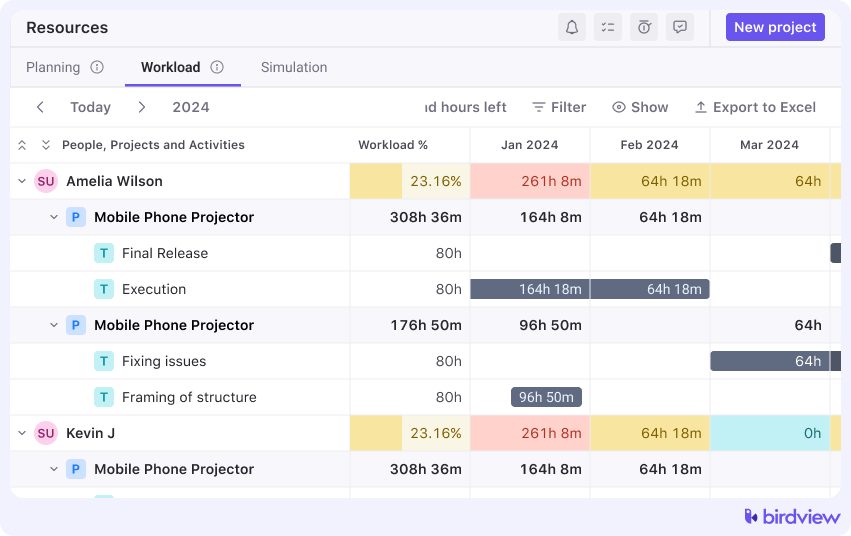
3. Allocate resources wisely
Ensure the right resources–human, material, and financial–are available when needed to keep the project moving forward without delays.
💡 Examples: In software engineering project management, balance workloads among developers, prioritizing critical tasks while preventing burnout.
4. Foster collaboration and communication. Maintain strong collaboration and communication among all team members, stakeholders, and clients to ensure alignment and prevent misunderstandings.
💡 Examples: For multidisciplinary projects, use collaboration tools and regular meetings to coordinate between different engineering disciplines, ensuring smooth integration of all project components.
5. Monitor and adapt continuously. Regularly track progress against the project plan, making adjustments as needed to stay on course, especially in dynamic environments.
💡 Examples: In civil engineering project management, conduct weekly site inspections and progress meetings to quickly address any delays or quality issues, making necessary adjustments to resources or schedules.
Comprehensive project planning, risk assessment, and resource allocation are crucial for success. Agile methods enhance adaptability, enabling teams to handle changes in a project efficiently. Professional services automation software like Birdview PSA improves teamwork, efficiency, and quick decision-making. Regular progress checks and early assessment of milestones help identify issues and make timely corrections. Involving clients, management, and all stakeholders throughout the project ensures expectations are met, ultimately enhancing overall project success.
Engineering project management is a dynamic and demanding field that requires a blend of technical expertise, strategic planning, and effective communication. Successfully navigating through the complexities of engineering projects not only leads to the delivery of innovative solutions but also contributes to advancements in the engineering field as a whole. Embracing best practices and addressing challenges head-on are key elements in ensuring the triumph of engineering projects.
PMO services are vital in engineering project management for driving consistency, efficiency, and quality across complex projects. By standardizing processes and equipping teams with the right tools, the PMO helps navigate technical challenges, align stakeholders, and ensure timely, on-budget delivery of innovative solutions.
The PMO is the method layer: templates, cadence, standards. The weekly staffing board that decides who is on which job this week is a different seat, covered in the ownership section below.
Engineering project management vs. engineering management
Engineering Project Management and Engineering Management are two distinct but interconnected fields within the realm of engineering. In general, Engineering Project Management is akin to steering a single ship through the challenges of a specific journey, while Engineering Management involves orchestrating an entire fleet to ensure all ships contribute to the overall success of the navy (organization). Both roles require leadership, strategic thinking, and a deep understanding of engineering principles, but they differ in their scope and focus.
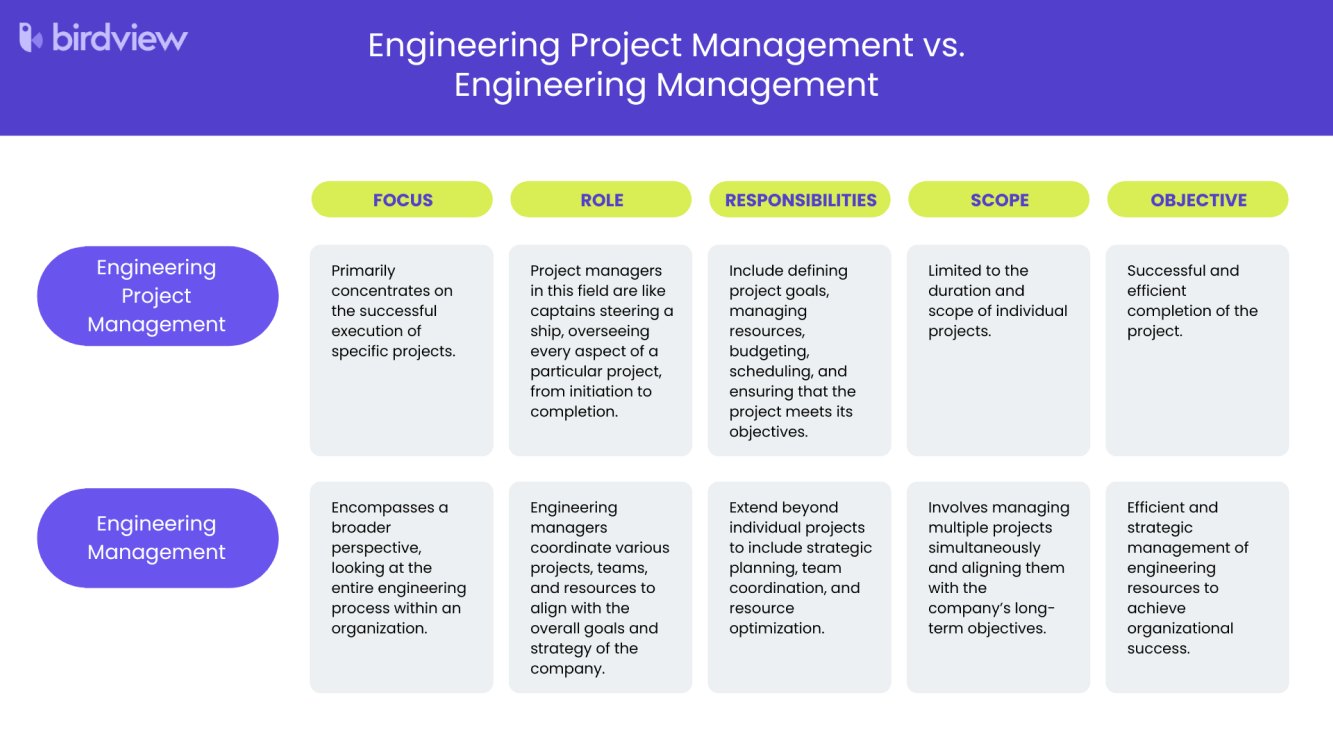
⚙️ Engineering Project Management
Focus: Primarily concentrates on the successful execution of specific projects.
Role: Project managers in this field are like captains steering a ship, overseeing every aspect of a particular project, from initiation to completion.
Responsibilities: Include defining project goals, managing resources, budgeting, scheduling, and ensuring that the project meets its objectives.
Scope: Limited to the duration and scope of individual projects.
🎯 Objective: Successful and efficient completion of the project.
🛠️ Engineering Management
Focus: Encompasses a broader perspective, looking at the entire engineering process within an organization.
Role: Engineering managers act as generals overseeing the entire fleet. They coordinate various projects, teams, and resources to align with the company’s overall goals and strategy.
Responsibilities: Extend beyond individual projects to include strategic planning, team coordination, resource optimization, and ensuring that engineering efforts contribute to the organization’s success.
Scope: Involves managing multiple projects simultaneously and aligning them with the company’s long-term objectives.
🎯 Objective: Efficient and strategic management of engineering resources to achieve organizational success.
In essence, Engineering Project Management is akin to steering a single ship through the challenges of a specific journey, while Engineering Management involves orchestrating an entire fleet to ensure all ships contribute to the overall success of the navy (organization). Both roles require leadership, strategic thinking, and a deep understanding of engineering principles, but they differ in their scope and focus.
Engineering project manager vs. project engineer
The roles of an Engineering Project Manager and a Project Engineer are distinct within the engineering domain. Here’s an overview of each role:
⚙️ Engineering Project Manager
The objective is the successful execution of engineering tasks, contributing to the overall success of the project.
📈 Responsibilities: Defining project objectives and scope; creating project plans, schedules, and budgets; allocating resources and managing project teams; overseeing project execution to ensure goals are met; communicating with clients and stakeholders; and managing project risks.
The objective is the successful execution of engineering tasks, contributing to the overall success of the project.
🛠️🛠️ Project Engineer
Primarily involved in the technical aspects of engineering projects and ensuring their successful implementation.
📈 Responsibilities: Providing technical expertise and guidance, collaborating with the project team to design and develop solutions, the objective is the successful execution of engineering tasks, contributing to the overall success of the project, implementing engineering plans, and ensuring adherence to technical standards, conducting testing and quality assurance, coordinating with different engineering disciplines.
The objective is the successful execution of engineering tasks, contributing to the overall success of the project.
🏆 Birdview PSA Client Success Stories:
How a mechanical engineering company increased annual revenue and profits by 10% and 15%
How Birdview increased the Nommon engineering team’s work capacity by 25%
The engineering project management oversees the entire project, dealing with planning, coordination, and strategic decision-making. On the other hand, the project engineer is more involved in the technical implementation, ensuring that engineering solutions align with project goals and quality standards. While both roles collaborate closely, they have distinct focuses and areas of expertise within the project team.
Skills needed for engineering project management
As an engineering project manager, you play a pivotal role in turning complex ideas into reality. To excel in this role, you’ll need a diverse skill set that blends technical expertise, strategic thinking, and strong interpersonal abilities. Here’s a breakdown of the essential skills you’ll need to successfully manage engineering projects and lead your team to success.
1. Technical knowledge
While you may not be the one designing circuits or drawing up blueprints, a solid understanding of the technical aspects of your project is crucial. This knowledge allows you to make informed decisions, understand the challenges your team might face, and communicate effectively with engineers and other technical experts.
💡 How to develop it: Stay up-to-date with the latest trends and technologies in your field. Explore resume examples from professionals in technical roles to identify key skills and competencies and build knowledge around them. Consider taking courses, attending workshops, or simply engaging with your technical team to deepen your understanding.
2. Strategic planning
As an engineering project manager, you’re responsible for setting the direction of the project. Strategic planning involves defining project goals, breaking them down into actionable tasks, and developing a roadmap that guides the project from start to finish.
💡 How to develop it: Practice breaking down complex projects into smaller, manageable components. Use project management tools to organize tasks, set priorities, and track progress. Regularly review and adjust your plans to ensure they remain aligned with the project’s objectives.
3. Risk management
Engineering projects often involve high stakes and multiple uncertainties, from technical challenges to budget constraints. Effective risk management allows you to anticipate potential problems, develop mitigation strategies, and keep the project on track even when unexpected issues arise.
💡 How to develop it: Start by identifying common risks in your projects and create a risk management plan for each one. Practice scenario planning to prepare for various outcomes, and always have contingency plans ready to deploy.
4. Leadership and team management
Leading a team of engineers, designers, and contractors requires more than just technical know-how–it demands strong leadership skills. As a project manager, you need to inspire your team, keep them motivated, and ensure that everyone is working towards the same goals.
💡 How to develop it: Focus on building your leadership style–whether it’s through delegation, mentorship, or leading by example. Regularly check in with your team, offer constructive feedback, and be open to receiving it as well. Remember, a successful project is as much about the people as it is about the process.
5. Communication skills
Clear and effective communication is the backbone of successful project management. You’ll need to convey complex technical information to non-technical stakeholders, keep your team informed about project developments, and facilitate discussions that lead to actionable decisions.
💡 How to develop it: Practice both verbal and written communication. When discussing technical details, aim to simplify complex concepts without losing accuracy. Encourage open communication within your team, fostering an environment where everyone feels comfortable sharing ideas and concerns.
6. Time management
Engineering projects are often bound by tight deadlines. As a project manager, your ability to manage time efficiently will directly impact the project’s success. You need to balance competing priorities, allocate time wisely, and ensure that milestones are met on schedule.
💡 How to develop it: Use tools like Gantt charts or project management software to plan and track your time. Learn to prioritize tasks based on their importance and urgency, and don’t be afraid to delegate when necessary. Regularly review your progress and adjust your schedule as needed to stay on track.
7. Problem-solving ability
Every project encounters challenges–whether they’re technical glitches, resource shortages, or unexpected delays. Your ability to think critically and solve problems quickly can make the difference between a minor setback and a major disruption.
💡 How to develop it: Cultivate a proactive approach to problem-solving. When faced with a challenge, assess the situation from multiple angles, consider potential solutions, and act decisively. Encourage your team to contribute ideas, fostering a collaborative approach to overcoming obstacles.
8. Financial acumen
Budget management is a crucial aspect of project management. You need to ensure that the project stays within financial constraints while still meeting its objectives. This requires a good understanding of budgeting, cost estimation, and financial reporting.
How to develop it: Familiarize yourself with financial tools and software commonly used in project management. Practice creating and managing budgets and regularly review financial reports to monitor the project’s financial health.
Those reports are still a project-level skill. The operations checks that sit next to them (WIP margin from logged hours, approved time with no invoice) are named in the margin section below.
Scope of engineering operations inside a PSA-run firm
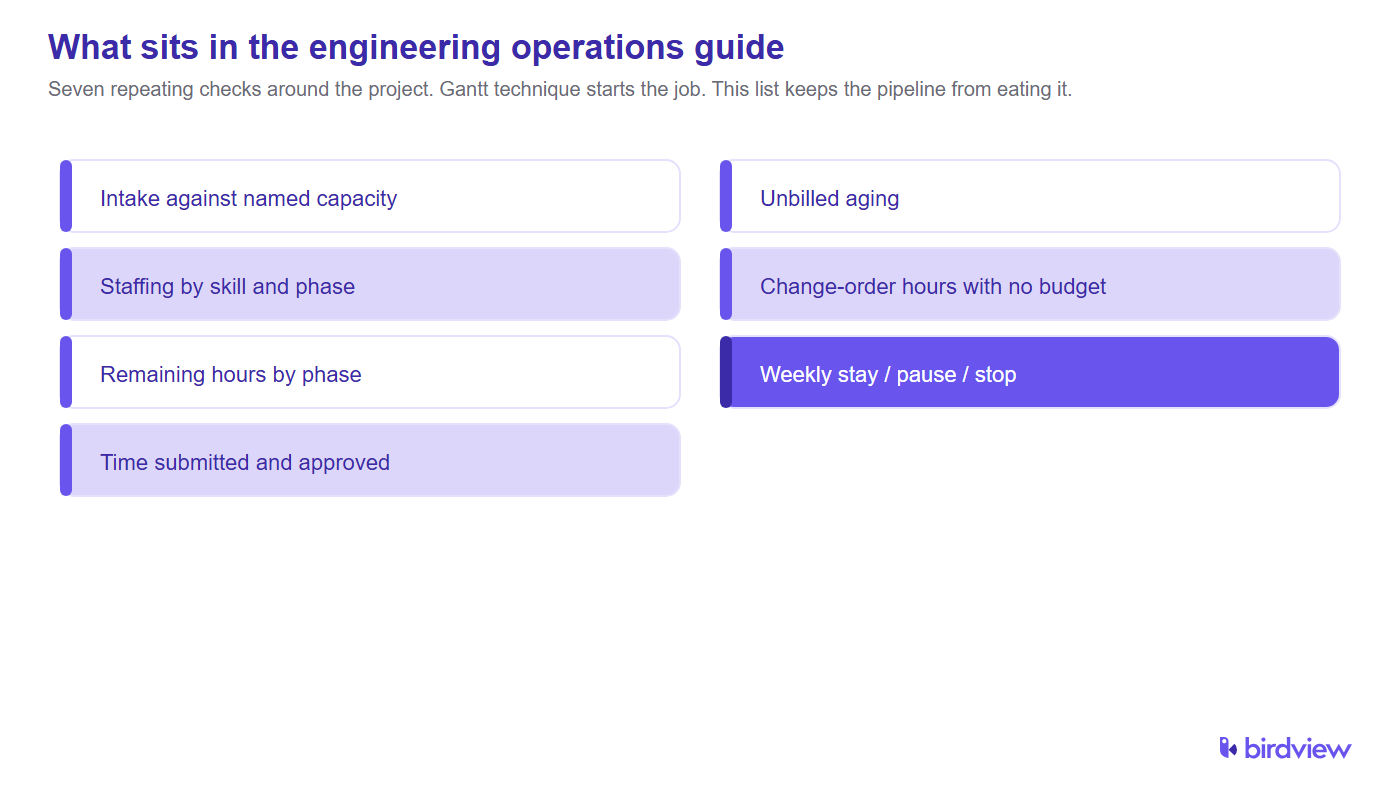
An engineering operations guide for a PSA-run firm is not a second catalog of Gantt tricks. It names the repeating work that sits around the project: who is available next week, which phase of which job consumes them, whether approved time has become an invoice, and who can pause a phase when that skill is already over booked.
What belongs on that list, in practice:
- Intake of new jobs against named remaining capacity, not against a hope that “someone will free up”
- Staffing by skill and phase, not by a single utilization donut
- Remaining hours by phase, updated when drawings, procurement, or site work move
- Time that is submitted, approved, and aged when it is still unbilled
- Change-order hours that have no budget line
- A weekly review that can stay, pause, or stop a phase
That is the guide. Project management templates still start the job. Operations keeps the pipeline from eating the job.
Engineering operations versus software ops and delivery ops
Software engineering ops (incident rotation, CI, the on-call roster) exists to keep a product running. Project delivery ops in a consulting firm is often the PMO calendar: kickoff, status, close. Engineering operations in a PSA-run firm sits between those two.
People are on several jobs at once. Design, procurement, site, and commissioning do not share one remaining-hours number. Hours have to become invoices without a monthly dump from a personal spreadsheet.
APM’s Body of Knowledge 8th edition draws the line this article needs: project management has a final deliverable and a finite timespan; management is an ongoing process [1]. The finite job is what the earlier sections already cover. The operations loop is what stays running so the next job can be staffed and billed.
Sister language for the services firm, not the engineering-only cut, lives in the professional services operations guide.
Day-to-day processes that sit in engineering operations
Monday’s board is not a status meeting. It is a remaining-hours meeting.
Who is on which phase this week, and who finishes Friday. Time sitting in “submitted” with no approver. Approved billable hours with no draft invoice. A change order that moved scope and never moved the budget. A civil package that looks 60% complete on hours while the site crew is idle because drawings slipped.
Those five lines are the day-to-day. If they only exist in chat, operations is theater.
Resource and utilization planning for engineering firms
Forecasting named people against named remaining work is the planning job. A firm-wide utilization tile is a lagging score, not a staffing plan.
SPI Research’s 2026 Professional Services Maturity Benchmark (509 professional service organizations) reports that Level 5 firms show 42% more billable utilization than Level 2 peers [2]. That gap is a maturity reading. It is not a number to paste onto every engineer this week. Engineering operations plans utilization against remaining phase hours and scarce skills. The resource forecasting pains on the sister page are the same pains: over-commit, then discover the geotech or the electrical lead is already on two other jobs.
Nommon’s engineering team raised work capacity 25% once remaining work and assignments were visible in one place. That is an operations result, not a motivational poster.
Multi-phase delivery inside engineering operations
Design, procure, construct, and commission cannot share one percent-complete. A job can be “on hours” in design and already late for site because the next phase has no named crew.
Operations has to hold remaining hours by phase and refuse to start the next phase when the named skill is already over 100% this week. Percent complete without remaining hours is how a multi-phase job looks healthy until the gate.
HBR’s 2011 Flyvbjerg and Budzier case is a cutover story, not an engineering-site story, and it still belongs here. Levi Strauss migrated to a single SAP system on a proposed budget of less than $5 million. In the second quarter of 2008 the company took a $192.5 million charge against earnings, closed its three U.S. distribution centers for a week, and the CIO resigned [3]. The operations failure is the same shape: a phase (or system) switch with no remaining-work check against the live constraint.
Margin and billing checks that belong in operations
WIP margin from logged hours and cost rates, this week, not last quarter’s closed books. Approved billable hours with no invoice, and the age of that bucket. Change-order hours that never hit the budget. Milestone or retainage billing that does not match the hours already in the job.
A green utilization tile with a fat unbilled pile is leakage in slow motion. SPI’s 2026 benchmark reports Level 5 firms at 250% higher project margins than Level 2 peers [2]. Operations does not “achieve” that number by wishing. It shows which live jobs are walking away from it this week. Sister formulas live on project financial KPIs.
SES Consulting’s published result (annual revenue +10%, profits +15%) sat on that kind of visibility, not on a prettier Gantt.
Ownership of engineering operations
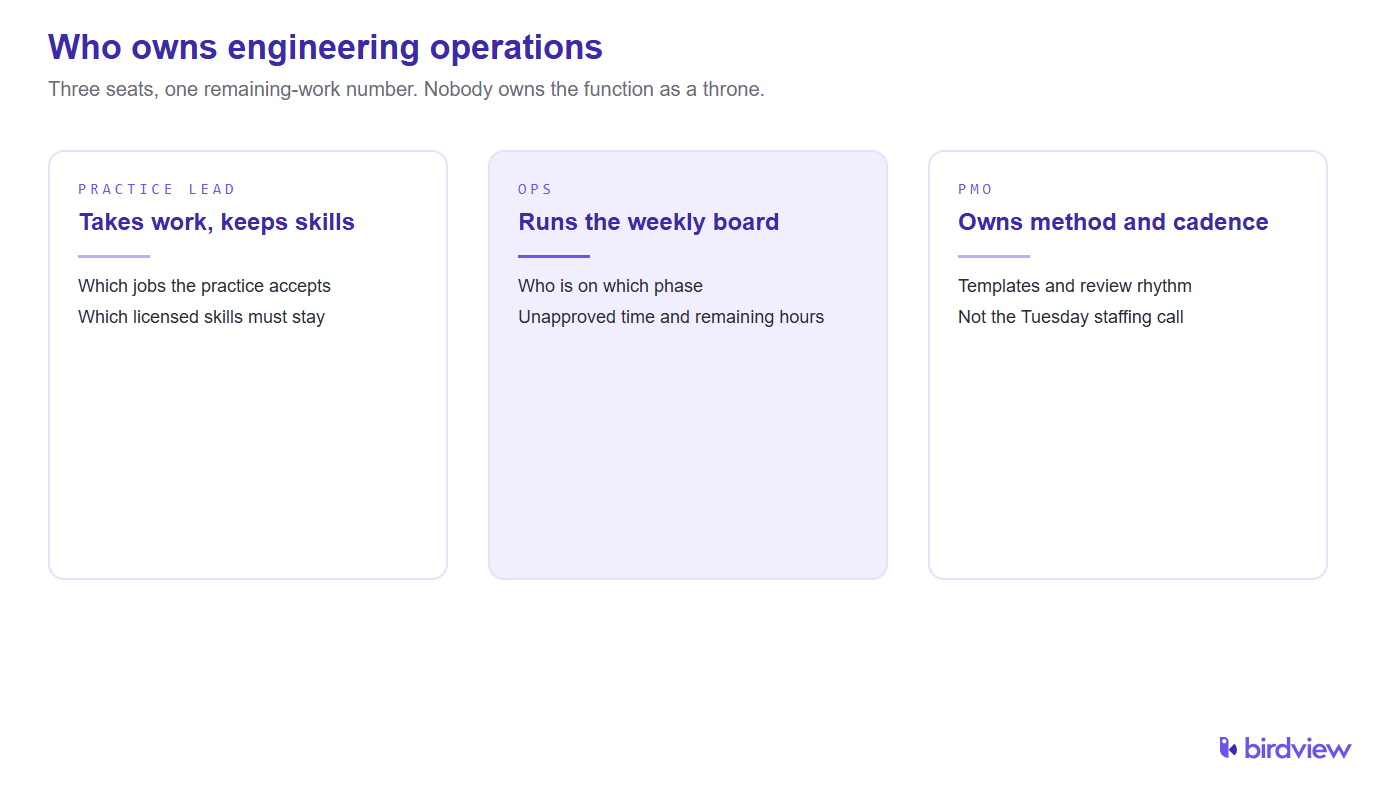
Practice lead owns which jobs the practice takes and which skills the practice must keep. Ops (delivery operations, whatever the nameplate) owns the weekly board: who is on which phase, whose time is unapproved, which job is over remaining hours. The PMO owns the method, the templates, and the review cadence. It does not own the Tuesday staffing call unless you have given it that seat on purpose.
Three owners and no remaining-work number is how the function disappears. One owner who is also selling work is how the board gets overwritten by the loudest client.
Building engineering operations in a mid-size consulting firm
Start with one weekly board, one remaining-hours field, one unbilled aging list. Name the three seats. Run that for 90 days before you buy a dashboard pack.
Do not stand up eight reports on day one. Do not keep utilization in a personal spreadsheet “until PSA is ready.” EuSpRIG’s research summary states that the majority (more than 90%) of spreadsheets contain errors, and that about 50% of spreadsheet models used operationally in large businesses have material defects [4]. An engineering firm that runs staffing and billing in those models is running operations on a known-faulty ledger.
Mid-size here means you already have overlapping jobs and scarce licensed people. You do not need an enterprise PMO to start. You need the board, the remaining hours, and a pause rule.
Staffing through billing on one PSA spine
PSA can run engineering operations from staffing through billing when time, remaining work, named assignments, and invoices share the same project record. The engineering project management software layer on this page is the job. The ops layer is whether that record also holds utilization against remaining phase hours, and whether approved time becomes a draft invoice without a spreadsheet hop.
If staffing lives in one tool and billing in another, you do not have operations. You have a weekly export.
Final thoughts
Birdview PSA is a versatile engineering project management software tool designed to manage all types of engineering projects and teams.
Whether in civil, mechanical, chemical, or electrical engineering, Birdview PSA seamlessly fits into any engineering team. With just a few clicks, you can effortlessly prioritize and handle tasks. Obtain a comprehensive view of your projects to spot and eliminate bottlenecks and enhance workflows. Check out Birdview’s engineering project management plan templates to find the one that fits each major phase of your project.
The same record that holds the plan should hold remaining phase hours, approved time, and the draft invoice. That is the operations test, not a new slogan.
Gain full visibility, control, and confidence with Birdview PSA
or
FAQ
What should an engineering operations guide cover in a PSA-run firm?
Intake against named capacity, skill-and-phase staffing, remaining hours, time approval, unbilled aging, change-order hours with no budget, and a weekly stay/pause call. Gantt technique is project management. Those seven lines are operations.
Is engineering operations the same as software engineering ops or project delivery ops?
No. Software ops keeps a product running. Delivery ops is often the PMO calendar. Engineering operations staffs people across overlapping jobs and phases and turns those hours into invoices. APM treats project management as finite; operations is the ongoing process around it.
What day to day processes sit in engineering operations for consulting firms?
The weekly remaining-hours board, unapproved time, unbilled approved hours, change orders that never hit the budget, and phases that look complete on hours while the next crew is idle.
How do engineering firms plan resources and utilization in operations?
Against remaining phase hours and named skills, not a firm-wide donut. Industry maturity gaps belong on a benchmark slide. They do not belong as a target on every engineer this week.
Who owns engineering operations, a practice lead, ops, or the PMO?
Split the seats. Practice lead takes work and keeps skills. Ops runs the weekly board. PMO owns method and cadence. One remaining-work number has to be shared or the function vanishes.
Can PSA run engineering operations from staffing through billing?
Yes, when assignments, remaining work, approved time, and invoices live on the same project record. Separate staffing and billing tools leave you with a weekly export, not operations.
Sources
- Association for Project Management. What is project management? (APM Body of Knowledge 8th edition: project management has a final deliverable and a finite timespan; management is an ongoing process). https://www.apm.org.uk/resources/what-is-project-management/
- SPI Research. 2026 Professional Services Maturity Benchmark (509 professional service organizations; Level 5 vs Level 2 billable utilization and project margins). https://spiresearch.com/reports/2026-ps-maturity-benchmark/
- Bent Flyvbjerg and Alexander Budzier. Why Your IT Project May Be Riskier Than You Think. Harvard Business Review, September 2011 (Levi Strauss SAP migration: proposed budget under $5 million; $192.5 million charge in Q2 2008; three U.S. distribution centers closed for a week). https://hbr.org/2011/09/why-your-it-project-may-be-riskier-than-you-think
- European Spreadsheet Risk Interest Group. Research and Best Practice (majority (more than 90%) of spreadsheets contain errors; about 50% of spreadsheet models used operationally in large businesses have material defects). https://eusprig.org/research-info/research-and-best-practice/