Ksenia Kartamysheva
 Project management is changing, and it is happening fast. In many professional services firms, AI tools already support forecasting, summaries, alerts, and reporting. Some teams are excited. Others are cautious. Most sit somewhere in the middle, trying to figure out what this means for their project managers.
The real question is not whether AI will replace PMs. It will not. The question is what a strong PM looks like when automation and data-driven insights handle part of the work.
That is where the hybrid PM comes in. In this article, “hybrid PM” means a project manager who pairs human judgment with AI-supported analysis, not “hybrid delivery” as in Agile plus Waterfall. A hybrid PM can read the signals in dashboards and forecasting tools, and they know when to challenge them. They use automation to remove noise, not to avoid responsibility.
Why project management is changing now
A few years ago, being a great PM meant being organized, communicative, and good at keeping things on track. Those qualities still matter. But the baseline has shifted.
AI is already handling a lot of the heavy lifting. Repetitive tasks like status reporting, time entry reminders, and workload summaries are increasingly automated. Data that used to take hours to compile can appear in seconds. This is genuinely useful, but it also raises the bar. If your PM team is still spending most of their time manually building reports, they’re behind.
At the same time, client expectations have gone up. Service firms are being asked to deliver faster, communicate more clearly, and flag risks before they become problems. That requires real-time insight, not end-of-month spreadsheets.
Here’s the tension: PMs who ignore AI risk falling behind. But PMs who blindly trust it risk something worse: making bad decisions with false confidence. The goal is neither extreme. It’s knowing how to work alongside AI in a way that sharpens your judgment rather than replacing it.
What a “hybrid PM” actually means
The hybrid PM is not a technical AI specialist. They do not need to build models or understand algorithms. What they do need is a new balance of skills.
- They need comfort with data. They should not feel intimidated by utilization reports or margin dashboards. They should be able to ask simple but important questions. Why is this project trending over budget? Why is utilization high but output feels low?
- They need strong process thinking. AI works best on structured data. If your team logs time inconsistently or budgets are vague, no tool will save you. The hybrid PM understands that good inputs lead to useful insights.
- They double down on human skills. Communication. Negotiation. Expectation setting. These do not go away. If anything, they become more important. When a forecasting view in Birdview shows that a team will be overloaded in three weeks, someone still needs to have the conversation with stakeholders about shifting scope or timelines.
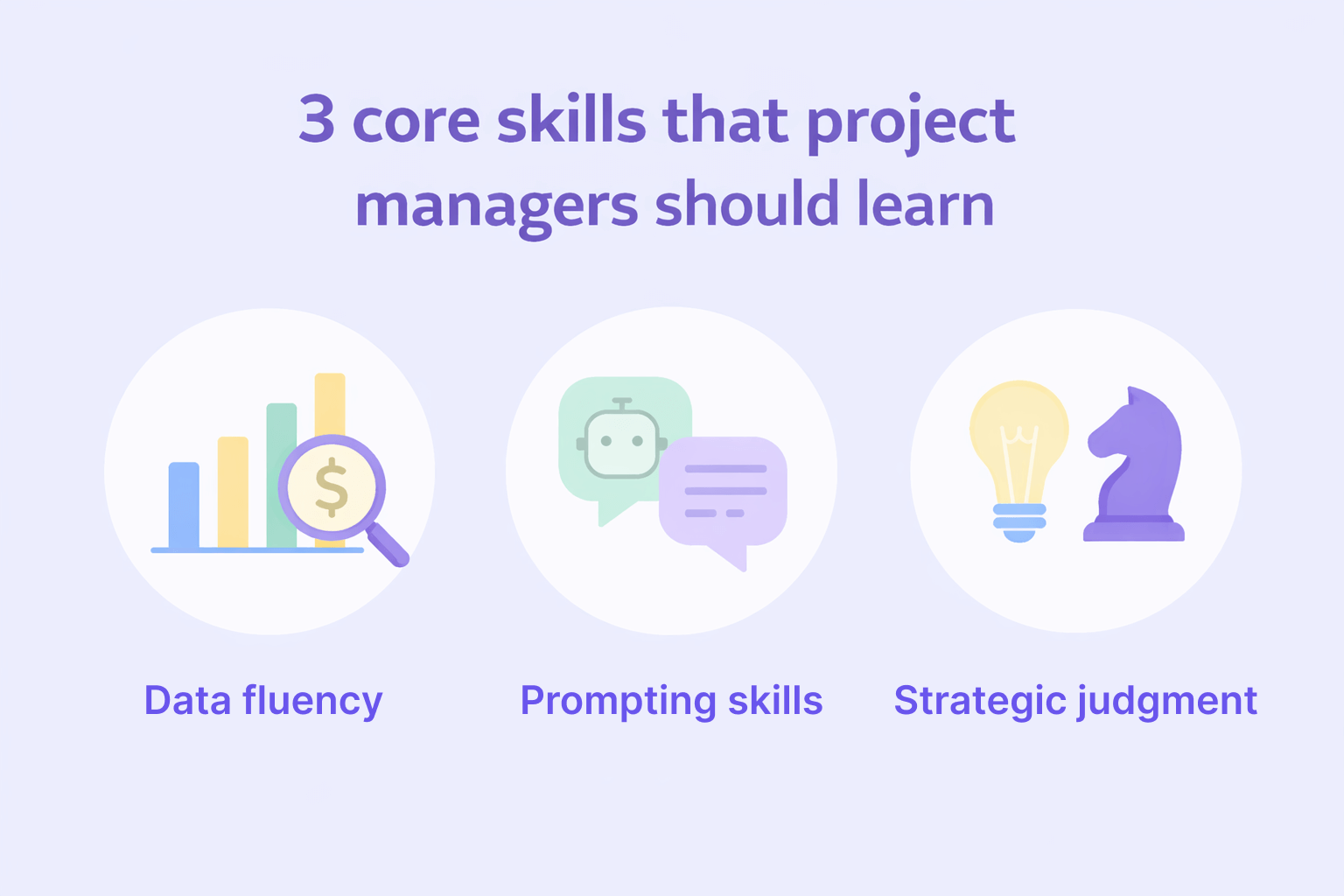
The hybrid PM skillset: 3 core competencies
If you are responsible for a PMO, this is the moment to rethink your capability model. The strongest PMs over the next few years will stand out in three areas.
Data fluency (utilization, margin, forecasting)
Not data science. Not coding. Data fluency means being comfortable reading and interpreting operational and financial signals.
A hybrid PM should be able to:
- Understand utilization trends
- Interpret margin drift
- Compare planned vs actual effort
- Spot inconsistencies in forecasting
- Ask better questions when numbers look off
Data fluency means moving from “what does this say?” to “why is this happening?”
Prompting skills for project work
This may sound technical. It is not. Prompt engineering in project environments means knowing how to ask AI the right questions.
If AI tools are generating summaries, risk flags, or workload insights, the PM must frame the context properly.
For example:
- Ask for risk patterns across similar project types.
- Ask for anomalies in time allocation by role.
- Ask for trends in revenue realization over three months.
Weak prompts produce generic answers, while precise prompts produce useful insight. Many teams use an AI prompt generator to quickly create structured prompts for tasks like project summaries, risk analysis, or workload insights, helping PMs get more accurate results from AI agent tools.
Hybrid PMs treat AI like a junior analyst. They guide it. They refine questions. They challenge outputs. This is a skill. It can be trained.
Strategic judgment (decisions AI can’t make)
This is where humans stay firmly in control.
AI can tell you that utilization is above 90 percent. It cannot decide whether to:
- Hire
- Delay a project
- Renegotiate scope
- Protect team wellbeing
- Absorb short-term pressure
Strategic insight means understanding trade-offs. It means connecting operational data to business decisions. If expected revenue drops in Birdview’s forecast view, a strategic PM does not simply report it upward. They connect it to pipeline health, staffing levels, and client dependencies.
From manual management to strategic orchestration
Many PMOs are still stuck in manual management mode. This is not sustainable. It also wastes your strongest talent. Future-proofing your team means deliberately reducing manual friction and increasing strategic focus.
The hybrid PM does three things consistently:
- Uses structured systems as a command center.
- Interprets signals instead of compiling them.
- Initiates action earlier.
How AI supports project managers in practice
Across service firms today, AI is showing up in a handful of consistent areas:
- Forecasting resource demand. Rather than manually calculating who will be needed and when, AI tools can surface demand signals based on project pipelines and historical patterns.
- Identifying workload imbalances. Automated alerts when someone is under or over-utilized give PMs a heads-up before a problem becomes a crisis.
- Flagging budget or margin risks early. Instead of waiting for a monthly finance review, AI can flag when a project is tracking off-budget mid-sprint.
- Automating reporting and status updates. Pulling together project status data across multiple workstreams, without someone spending three hours manually updating slides.
These aren’t future capabilities. They’re available now, and teams that use them have more time for the work that actually moves the needle.
📚 Read more: Best PSA software with AI in 2026
The hybrid PM roadmap: a 5-step plan to upskill your team
Step 1: Audit current PM workflows
Before you can improve anything, you need to see clearly where the time actually goes.
Ask your PMs to estimate how much time they spend weekly on:
- Manual reporting
- Data gathering
- Capacity checks
- Rebuilding financial numbers
- Stakeholder alignment
- Risk mitigation
You’ll probably find that a significant chunk of their hours goes toward tasks that could either be automated or eliminated entirely. Manual status reports. Copy-pasting data between tools. Chasing people for time entries.
Once you’ve identified those tasks, map where AI could either handle them or at least provide better input. Also, look for the decisions your PMs are making on incomplete data. Those are the spots where better tooling can have the most immediate impact.
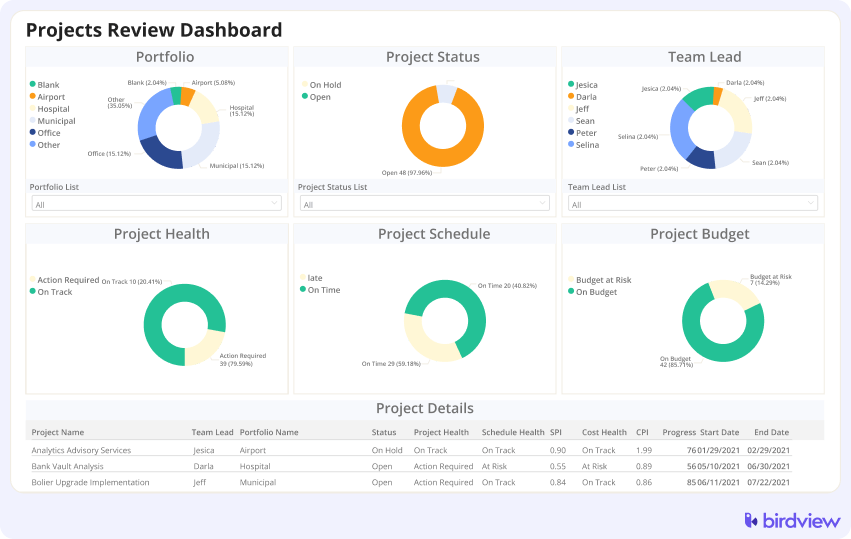
Example: Birdview already provides unified dashboards for projects, resources, and financials, eliminating duplicate tracking. Stop exporting data unless absolutely necessary.
Step 2: Standardize your data foundation
Hybrid PMs depend on clean data. Without consistent time tracking, structured project templates, and defined rate rules, dashboards become noise.
As a PMO lead, focus on:
- Standardized project structures
- Clear phase definitions
- Consistent time entry practices
- Defined cost and billing rates
If your data is messy, your dashboards will be misleading. And if your dashboards are misleading, AI-assisted insights will mislead your PMs. Get this right first.
Example: Birdview’s templates and structured planning tools help enforce consistency across projects. When projects follow similar logic, your reporting becomes comparable.
Step 3: Train PMs to read and challenge dashboards
Once you have reliable data, start building the habit of using it.
A practical starting point: schedule a standing weekly review where PMs look at utilization and margin reports together. Not to present them, but to interpret them. What looks unexpected? What needs follow-up? What decision does this data suggest?
Example: In Birdview, the resource forecasting view lets you see projected demand against available capacity before things become urgent. Train your PMs to use that view to inform staffing conversations, not just to react to them.
The key habit to build here is asking “why” behind the numbers. A metric going up or down is just a fact. What caused it, and what it means for the project, is where the PM adds value.
Step 4: Shift PM focus from reporting to action
If your PMs are spending more than a couple of hours a week building status updates and slides, something is wrong with the setup.
Automated reporting, such as in Birdview, can pull together project health data, budget status, and milestone progress without anyone manually compiling it. The goal is to use that recovered time for higher-value activity: resolving risks early, having harder conversations with stakeholders before issues escalate, and thinking ahead rather than documenting what already happened.
Automated alerts also matter here. When Birdview flags a budget overrun or a utilization spike, that’s a trigger for action, not a notification to acknowledge and ignore. Train your PMs to treat those alerts as the starting point for a conversation.
Step 5: Create feedback loops
AI tools get better when you tell them when they were wrong. More importantly, your team gets better when you do the same.
Build in a regular practice of comparing AI-supported forecasts against what actually happened. Did the resource forecast match reality? Did the margin estimate hold? When it didn’t, what was the reason?
This isn’t about blame. It’s about calibration. Teams that review their forecasts honestly and adjust their processes based on what they learn will get more accurate over time. Teams that ignore misses will keep making the same ones.
Using Birdview PSA as a hybrid PM command center
A hybrid PM needs one environment where time, budget, resources, and delivery data connect without friction. Switching between disconnected tools is not just inefficient. It creates blind spots and delays decisions.
Birdview PSA is designed to act as that central command layer for PMO leads and project managers operating in this hybrid role.
Real-time dashboards
Birdview PSA brings utilization, project financials, and delivery status into a single live view. PMs see what is happening now, not what happened last month. When a project begins to drift, the signal appears early, giving teams time to respond before the issue compounds.
Resource forecasting
Capacity planning is built into the workflow. PMs can compare future demand against available resources and spot bottlenecks before they hit. Instead of reacting to overload, teams can make forward-looking staffing decisions based on upcoming work.

Scenario planning
Before committing to a decision, PMs can test different outcomes. Extend the timeline by two weeks. Reassign a consultant. Adjust scope. Birdview PSA allows teams to model the financial and utilization impact first, so client conversations are based on data rather than assumptions.
📚 Read more: Resource forecasting and scenario planning
Automated reporting
Manual status updates consume valuable time. Automated reporting pulls data directly from live projects, reducing repetitive admin work. That time can then be redirected toward stakeholder alignment, risk management, and strategic planning.
AI-assisted support
Birdview’s AI capabilities are designed to support real project work, not replace decision-making. Each feature builds on structured data already in the system, helping PMs move faster and make better-informed choices.
- AI project plan assistant: Starting from a blank screen slows momentum. The AI project plan assistant generates a complete work breakdown structure from a simple project name. Tasks and sub-tasks are created automatically, giving teams a structured starting point that can be refined and adjusted as needed.
- AI resource assistant: Matching the right people to the right work becomes easier with AI support. The AI resource assistant recommends allocations based on roles, skills, availability, and cost. PMs can begin with soft allocations during planning and confirm them later, making it useful both for early forecasting and last-minute adjustments.
- AI timeline forecasting: Instead of relying only on estimates, the AI timeline forecasting feature uses machine learning to predict likely completion dates based on real capacity and historical project data. Teams can simulate different scenarios and see how schedule changes may affect delivery timelines before committing.
- AI message assistant: Clear communication matters. The AI message assistant helps summarize long threads, improve clarity, adjust tone, and correct grammar. This reduces time spent rewriting updates and supports more consistent communication with stakeholders.
How to measure progress in the hybrid PM journey
You can’t manage what you don’t measure. Here’s how to know if your upskilling investment is working:
- Reduced manual reporting time is the clearest early signal. If PMs are spending significantly fewer hours per week on status compilation, that’s time being redirected somewhere more valuable.
- Faster risk detection means catching budget overruns and resourcing gaps earlier in the project lifecycle. Track how far in advance your team is identifying risks compared to six months ago.
- Improved margin predictability means your financial estimates at the start of a project are closer to actuals at the end. This is a lagging indicator, but one of the most meaningful ones for service firm leadership.
- Higher confidence in delivery forecasts means PMs can look at a project’s trajectory and make a reliable call on whether it will hit its milestones. That confidence comes from better data, better interpretation, and better habits over time.
Final thoughts: the future PM is not replaced, just upgraded
There’s a lot of noise right now about AI replacing jobs. In project management, the reality is more nuanced and, frankly, more interesting.
The PMs who struggle in this era will be the ones who refuse to engage with data, who treat AI as a threat, or who stick to coordination-only roles when the job is asking for more. The ones who thrive will be the ones who use AI to see more clearly, decide more confidently, and lead more proactively.
Upskilling your team for this isn’t a one-time training session. It’s a shift in how your firm thinks about the PM role. What skills it values. What it measures. What it rewards.
Start with the audit. Clean up your data foundation. Build the habit of reading dashboards critically. And help your PMs see that the goal was never to be a task tracker. It was always to drive outcomes.
FAQ: human-AI collaboration in project management
Q: Does adopting AI tools mean we need to hire new types of PMs?
A: Not necessarily. Most existing PMs can develop hybrid skills with the right training and support. The bigger shift is usually in how firms define success for the PM role, not in who they hire.
Q: What if our project data is too inconsistent to use AI tools reliably?
A: Start there. Data hygiene is a prerequisite, not an afterthought. Investing in clean project structures and consistent time tracking will pay off before any AI tool does.
Q: How do we get PMs to actually change their habits?
A: Structural change helps more than exhortation. If you want PMs to use dashboards instead of manual reports, remove the manual report from the process entirely. Make the new behavior the default path, not the optional one.
Q: What’s the biggest mistake firms make when introducing AI to their PM teams?
A: Introducing the tool before the culture is ready for it. If leadership still rewards heroic firefighting over proactive risk management, no amount of AI capability will change how your PMs behave.
Q: How long does it take to see results from hybrid PM upskilling?
A: The early wins, like reduced reporting time and faster risk flags, can show up within a quarter. The bigger changes, like improved margin predictability and stronger stakeholder communication, take longer. Plan for a six-to-twelve-month horizon for meaningful organizational change.