Ksenia Kartamysheva
 Project profitability is the total profit a project generates in dollars. Project margin is the percentage of revenue the project keeps as profit. Profitability shows financial impact, while margin shows efficiency.
Project profitability vs project margin comes down to this: profitability shows how much money a project actually makes, while margin shows how efficiently it makes it. You need both to understand whether a project is worth doing and how well it is being delivered.
Many teams use these terms interchangeably. That creates confusion in pricing, reporting, and decision-making. Once you separate them clearly, project financial performance becomes much easier to manage.
What is the difference between project profitability and project margin
Project profitability is the absolute financial result (revenue minus cost), while project margin is the percentage that shows how efficiently a project generates profit relative to revenue.
These terms are often confused because they both relate to profit. They use the same inputs, revenue, and cost, but answer different questions.
- Profitability answers: How much money did we make?
- Margin answers: How efficiently did we make it?
You can have a project with a high margin but low total profit. You can also have a project with a lower margin but much higher total profit.
Both metrics are needed because they serve different decisions. Profitability helps you understand impact. Margin helps you understand efficiency. Ignoring one leads to incomplete conclusions.
Why teams confuse project profitability and project margin
When teams mix up margin and profitability, decisions start to drift. What looks like a strong project on paper may not actually contribute much to the business, and what seems less efficient may be more valuable overall.
- Incorrect pricing decisions
The first issue shows up in pricing. When teams focus only on margin, they tend to favor projects with higher percentages, even if those projects generate less total profit. This can lead to rejecting larger opportunities that would contribute more to the business overall.
- Misleading performance reporting
The second problem appears in performance reporting. A project can look successful because it maintains a strong margin, but still have a limited financial impact. At the same time, a lower-margin project may quietly drive most of the revenue. Without separating these metrics, reports can tell an incomplete story.
- Poor project prioritization
This also affects how teams prioritize work. Delivery teams may lean toward smaller, high-margin projects because they appear more efficient. Over time, this shifts focus away from projects that actually move the business forward financially.
- Inconsistent financial communication
Another issue is communication. Finance teams often speak in terms of profitability, while delivery teams focus on margin. If these definitions are not aligned, the same project can be interpreted in different ways depending on who is reviewing it.
Example: A project with a 40% margin on $10,000 revenue generates $4,000 profit. Another project with a 20% margin on $100,000 revenue generates $20,000 profit. If you only look at margin, you pick the wrong project.
How to calculate project profitability
Project profitability measures the total financial outcome of a project. It includes project revenue, labor costs, expenses, and sometimes allocated overhead
To calculate project profitability, use the formula:
Profitability = Revenue – Cost
To calculate it correctly, you need accurate cost inputs:
- Fully loaded labor rates
- External expenses
- Subcontractor costs
- Relevant overhead where applicable
If costs are incomplete, profitability becomes misleading.
Use profitability when you need to understand the total financial impact. It helps compare projects by actual return, evaluate client value, and make portfolio-level decisions.
How to calculate project margin
Project margin measures how efficiently a project generates profit relative to its revenue.
To calculate project margin, use the formula:
Margin (%) = (Revenue – Cost) ÷ Revenue
For example:
- Revenue: $50,000
- Cost: $35,000
- Profit: $15,000
- Margin: 30%
This tells you the project keeps 30% of its revenue as profit.
Margin vs markup (quick clarification)
Margin and markup are not the same. Margin is based on revenue, while markup is based on cost
Example: Cost = $100. Price = $150. Markup = 50%. Margin = 33%
Use margin when you need to evaluate efficiency. It helps with pricing decisions, cost control, and comparing how well different projects are delivered.
Realization vs margin (important distinction)
Realization and margin are often confused, but they measure different things.
- Realization explains why revenue changes
- Margin reflects the result after that change
If realization drops, margin follows, but margin alone does not explain the cause.
Profitability vs margin: side-by-side comparison
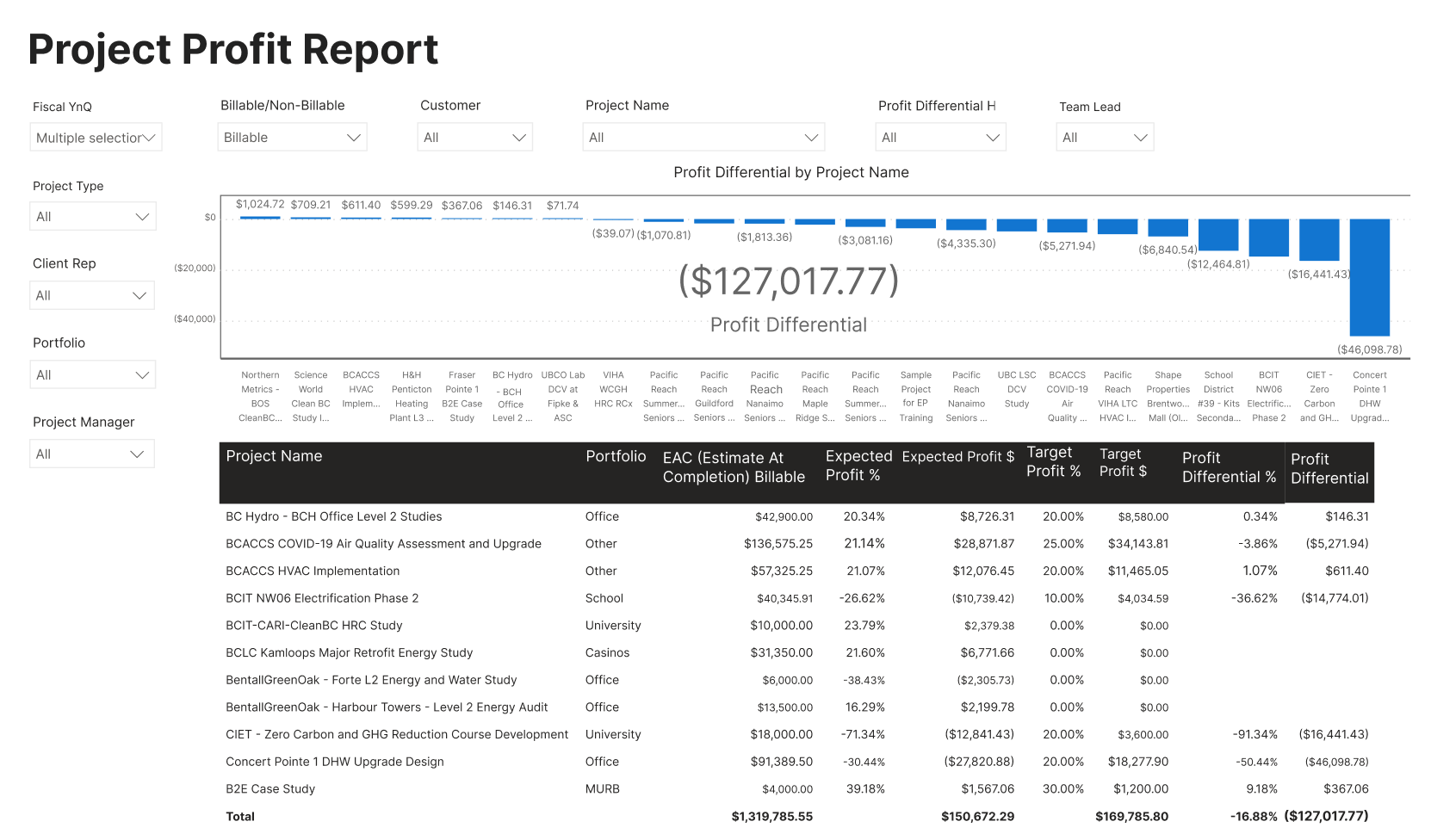
Project profitability is an absolute number, while project margin is a percentage. Profitability shows how much money a project generates. Margin shows how efficiently that money is generated.
They answer different questions.
- Profitability answers: How much did we earn?
- Margin answers: How well did we deliver?
They are used in different situations.
Profitability is used for portfolio decisions and understanding the total impact. Margin is used for pricing, cost control, and comparing efficiency across projects.
They cannot replace each other.
A project can have a strong margin but low financial impact. Another project can have a lower margin but contribute much more profit.
You need both to make balanced decisions.
Margin without profitability lacks context. Profitability without margin hides efficiency problems.
| Aspect | Project profitability | Project margin |
| Type | Absolute value | Percentage |
| Focus | Financial outcome | Efficiency |
| Key question | How much did we earn? | How efficiently did we earn it? |
| Best use | Portfolio decisions | Pricing and performance analysis |
How profitability and margin behave across project types
Different project types change how profitability and margin behave.
Fixed-fee projects
In fixed-fee work, revenue is set upfront.
- Margin depends heavily on cost control
- Profitability depends on execution discipline
- Scope creep directly reduces margin
A fixed-fee project can quickly shift from profitable to unprofitable if costs increase.
Time and materials (T&M) projects
In T&M projects, revenue grows with billed time.
- Profitability depends on utilization and billing rates
- Margin is more stable, but it depends on the rate structure
- Write-offs reduce both revenue and margin
Here, performance depends more on the amount of work billed than on strict cost control. This means profitability is less about cost control and more about how much work is actually billed and collected.
Practical examples (simple scenarios)
The difference between margin and profitability becomes clearer when you look at simple, real numbers.
Example 1: high margin, low profit
Revenue: $8,000
Cost: $4,000
Margin: 50%
Profit: $4,000
Good efficiency, but low total impact.
Example 2: low margin, high profit
Revenue: $200,000
Cost: $160,000
Margin: 20%
Profit: $40,000
Lower efficiency, but much higher financial value.
Example 3: same project, different outcomes
Revenue: $50,000
- Cost A: $30,000 → Margin 40%, Profit $20,000
- Cost B: $40,000 → Margin 20%, Profit $10,000
Same revenue, different execution leads to very different results.
How to use profitability and margin together
The best decisions come from using both metrics at the same time. Use margin to assess efficiency and profitability to assess impact
For example, you can use profitability and margin together for:
- Pricing new work: Use margin targets to ensure pricing covers costs. Use profitability to ensure the project is worth pursuing.
- Prioritizing projects: Balance high-margin projects with high-profit projects.
- Evaluating client relationships: A client may deliver consistent profit even with lower margins.
Strong-performing teams do not optimize for one metric. They balance efficiency and total contribution depending on business goals.
Signs you are using the wrong metric
Using the wrong metric rarely shows up as a single mistake. It usually appears as patterns in decisions, reporting, and priorities.
One clear sign is focusing only on high-margin projects. These projects look efficient, but they may not contribute much to overall revenue or profit. If your portfolio is full of high percentages but low financial impact, margin is likely overused.
Another sign is ignoring total profitability in decision-making. If teams rarely discuss how much money a project actually generates, important opportunities can be missed. Projects that look less efficient may still be the most valuable.
Inconsistent reporting across teams is also a warning signal. If finance reports one view of performance and delivery teams present another, it often means margin and profitability are being used interchangeably without clear definitions.
You may also notice confusion during pricing discussions. If some stakeholders talk in percentages while others focus on total value, decisions become harder to align. This usually indicates that the metrics are not clearly understood or applied.
Over time, these issues lead to misaligned priorities. Teams optimize for efficiency when they should focus on impact, or vice versa.
A simple check helps clarify the situation. If you cannot clearly answer both of these questions for a project, you are likely relying on the wrong metric:
- How much profit did this project generate?
- How efficiently was that profit generated?
Both answers are needed for a complete financial view.
Step-by-step: How to track both metrics correctly
Tracking project profitability and project margin correctly is not just about formulas. It depends on having consistent data, clear ownership, and regular review. Most issues come from gaps in one of these areas.
Step 1: Define a consistent cost structure
Start with how you calculate costs. This is where most inaccuracies begin.
Labor should not be tracked at billing rates. Use true cost rates, including salary, benefits, and realistic overhead allocation if you include it in reporting. If one team uses fully loaded costs and another uses partial costs, your margin and profitability numbers will not be comparable.
Also, decide early:
- Do you include overhead in project profitability?
- How do you treat shared resources or internal roles?
These choices must stay consistent. Otherwise, trends over time become meaningless.
Step 2: Ensure accurate revenue tracking
Revenue needs to reflect how the project actually earns money, not just what was planned.
For fixed-fee projects, revenue is often recognized over time. That means your profitability depends on progress tracking accuracy, not just invoicing.
For T&M projects, revenue depends on what is billed and accepted. If teams log time but do not bill it, or if write-offs are common, profitability will look inflated until adjustments are applied.
This is where many teams get caught. They track revenue based on assumptions, not actuals.
Step 3: Calculate margin and profitability regularly
Do not wait until the end of the project to check performance. By then, most issues cannot be fixed.
Track both metrics throughout delivery:
- Weekly for active projects
- Monthly for portfolio reviews
Look at trends, not just snapshots. A declining margin usually signals rising costs or delivery inefficiencies. A drop in profitability may point to revenue issues, scope changes, or write-offs.
Early visibility gives you a chance to act, not just report.
Step 4: connect financial data to delivery data
Numbers alone do not explain what is happening.
When margin drops, you need to see:
- Which roles are over-consuming time
- Where estimates were inaccurate
- Which tasks are driving cost overruns
When profitability drops, you need to understand:
- Whether revenue is delayed or reduced
- Whether utilization is lower than expected
- Whether scope expanded without pricing changes
This connection between financial metrics and actual work is what turns reporting into decision-making.
Step 5: Use both metrics in reporting and decisions
Reports should always show margin and profitability together, not separately.
At the project level:
- Margin highlights delivery efficiency
- Profitability shows financial value
At the portfolio level:
- Margin helps compare execution quality
- Profitability helps prioritize business impact
When both are visible, trade-offs become clear. You can choose between efficiency and scale with full context, instead of guessing.
How Birdview supports margin and profitability tracking
Tracking project margin and profitability only works if your data reflects reality. In many teams, it doesn’t. Revenue sits in one tool, time tracking in another, costs in spreadsheets, and someone tries to reconcile everything at the end of the month.
That is where things start to break.
With Birdview PSA, the main difference is that financial data is not separate from delivery data. Time, resources, budgets, and billing all feed into the same system. That changes how you see both margin and profitability.
Time tracking directly impacts cost
Every time entry immediately affects project cost.
If higher-cost resources are used, margin drops right away. This makes staffing decisions visible in financial terms, not just operational ones.
Revenue reflects real delivery, not just plans
Revenue updates based on how the project actually earns money.
In fixed-fee work, you can compare progress to budget. In T&M, only billed and accepted work counts. Write-offs and discounts reduce both profitability and margin as they happen.
Cost structure is built into resource rates
Each resource has a defined cost rate, so every hour logged has a real financial impact. This helps expose hidden issues, like overusing senior staff on lower-value work, which directly reduces margin.
Budget tracking highlights margin risk early
Budget vs actual tracking shows how quickly costs are consumed. If spending outpaces progress, it signals margin erosion early, especially in fixed-fee projects where costs are capped but effort is not.
Real-time visibility instead of delayed reporting
Margin and profitability update continuously, not just at month-end. This allows teams to act during delivery, not after the outcome is already fixed.
Forecasting shows where the project is heading
Forecasting uses current data to estimate final profitability. If trends point to lower margins, teams can adjust scope, staffing, or timelines before the project finishes.
Portfolio view puts projects in context
At the portfolio level, you can compare projects by both efficiency and total impact. This helps balance high-margin work with projects that drive the most profit.
Final thoughts: margin shows efficiency, profitability shows impact
Project margin and project profitability answer different questions.
Margin tells you how well you deliver. Profitability tells you what you actually earn.
Using both together leads to better pricing, better prioritization, and more accurate reporting.
If your team currently relies on only one of these metrics, it is worth reviewing how project financial performance is tracked today and where visibility can be improved.
FAQ: project profitability and project margin
Can a project be profitable but still have a low margin?
Yes, and this is common in larger projects. A project can generate strong total profit because of its size, even if the margin percentage is relatively low. This is why margin alone should not drive decisions.
Which metric should be used for pricing decisions?
Margin is usually the starting point for pricing because it ensures costs are covered efficiently. However, profitability should also be considered to confirm that the project is worth the effort in absolute terms.
How often should margin and profitability be reviewed during a project?
They should be reviewed regularly during delivery, not just at the end. Weekly reviews for active projects and monthly portfolio reviews are a practical baseline for most teams.
Why does project margin change over time?
Margin changes when either costs increase or revenue decreases. This can happen due to scope changes, inefficient resource use, write-offs, or incorrect initial estimates.
What is the most common mistake when tracking these metrics?
The most common mistake is relying on only one metric. Using only margin hides the true financial impact, while using only profitability hides inefficiencies in delivery.
How does realization affect project financial performance?
Realization affects how much planned revenue is actually earned. When realization drops due to discounts or write-offs, both profitability and margin decrease because total revenue is lower.
Should overhead always be included in project profitability?
It depends on how your organization defines profitability. Including overhead gives a more complete view of true financial performance, but it requires consistent allocation across projects to stay comparable.
Can two projects with the same margin have very different outcomes?
Yes. If the revenue size is different, the total profit will also be different. Two projects can have identical margins but contribute very different amounts to the business.
How do you know if a project is worth continuing mid-delivery?
You need both metrics. Profitability shows whether the project still delivers value, while margin shows whether it is being delivered efficiently. A decline in either may require adjustment.