Ksenia Kartamysheva
 ESG projects don’t behave like other consulting work. You know this if you’ve ever watched a six-month sustainability assessment stretch into eighteen months, or if you’ve tried to scope a carbon reduction strategy while regulations were still being written.
Environmental consulting firms are being asked to deliver more ESG work than ever. Clients need help meeting disclosure requirements, managing climate risk, and proving they’re making progress on environmental commitments. But the projects themselves are messy. They involve uncertain timelines, shifting regulations, multiple review cycles, and stakeholders who don’t always agree on what success looks like.
Why ESG consulting projects are harder to manage (timelines, stakeholders, compliance)
Standard project management approaches fall short here. Treating an ESG engagement like a typical consulting project leads to scope creep, budget overruns, and teams buried in documentation they can’t tie back to billable work. The firms that do this well aren’t just organized. They’ve adapted how they structure, track, and deliver ESG projects from the start. And most teams only realize how complex it is once they’re already in it.
Long timelines and overlapping phases
ESG projects often run for months or even years. An environmental impact assessment or emissions inventory can span multiple reporting cycles. That makes progress harder to judge using standard milestones. A project can look slow on paper while meaningful work is still happening.
Multiple stakeholders with different expectations
Most ESG projects involve more than one client contact. Sustainability teams, legal, finance, auditors, and sometimes regulators all weigh in. Each group cares about something different.
Some want clear recommendations. Others want defensible documentation. Feedback from one group can easily conflict with another, and consultants are often left to reconcile the differences without slowing delivery.
Regulatory pressure and audit requirements
Many ESG projects are tied to compliance. Whether driven by CSRD, SEC rules, or frameworks like TCFD, deliverables must meet defined standards and deadlines.
That means the work has to be traceable. Assumptions, data sources, and decisions need to be documented as the project moves forward. Quality alone is not enough without proof.
High risk of scope creep and reporting gaps
Scope often shifts as ESG projects progress. New regulations appear. Data changes. Client needs expand. Without clear scope control, projects can grow quietly in ways that affect timelines and margins. At the same time, heavy reporting requirements increase the risk of missing deliverables if ownership is unclear.
What ESG project management really means in practice
Managing an ESG project isn’t about following a task list. It’s about steering a complex engagement toward a defined outcome while staying compliant, transparent, and profitable.
ESG projects are managed around outcomes
Unlike traditional consulting work, ESG projects are driven by specific external outcomes. The goal is delivering results that withstand scrutiny. This includes verified emissions inventories, compliant sustainability reports, or regulatory-ready risk assessments.
This means project structures must be built around:
- Clear deliverables with external relevance
- Evidence that supports conclusions
- Review cycles that align with regulatory expectations
Progress is measured by outcome readiness, not internal task completion.
Delivery, compliance, and transparency must move together
Every ESG project operates under three simultaneous pressures. The work must be delivered on time, meet regulatory standards, and remain transparent to clients and auditors.
That requires:
- Traceable data with clear sources
- Documented assumptions and methodologies
- Ongoing visibility into how conclusions are reached
Without this balance, projects either fall short of compliance or lose client trust.
Why ESG projects fail when treated like standard projects
Standard consulting projects often rely on a fixed scope, a linear timeline, and clear handoffs between phases. ESG projects don’t work that way. If you lock the scope too early, you’ll be stuck when regulations change. If you plan linearly, you won’t account for overlapping work streams or revision cycles. Without built-in compliance tracking, you will scramble for audit documentation at the end. These projects require flexibility, disciplined documentation, and total visibility across the engagement.
The 2026 regulatory landscape
The era of purely voluntary ESG reporting is fading fast, as mandatory climate disclosure requirements expand in the U.S. (for example, California’s SB 253 and SB 261).
In the U.S., SEC climate disclosure requirements remain uncertain. The SEC adopted climate disclosure rules in 2024, then issued an order to stay them during judicial review, and later voted to end its defense of those rules in court.
For project managers, the takeaway is straightforward. Treat audit readiness as part of delivery from day one. Build a traceable trail of sources, assumptions, decisions, and approvals as you go.
Step-by-step ESG project management process for consulting teams
Here’s how to structure and run ESG projects in a way that keeps them on track, compliant, and profitable.
Step 1: Structure ESG projects around outcomes and milestones
What to define: Start by defining the outcomes the project must deliver, not just the activities involved. ESG projects succeed or fail based on whether they produce review-ready outputs such as a verified emissions inventory or a compliant report.
How to manage it
Organize work around clear phases such as assessment, analysis, implementation, and reporting. Each phase should end with a tangible deliverable. Avoid vague tasks with no endpoint. If work cannot be clearly finished, it cannot be reliably tracked or billed.
Example: In Birdview PSA, project templates can be built around outcome-based phases and milestones. Each milestone can represent a client- or auditor-facing deliverable, making progress visible and review-ready rather than task-driven.
Step 2: Build realistic project plans for long timelines
What to define: Accept that ESG projects evolve over time. Your plan should provide structure without assuming everything is known upfront.
How to manage it
Plan in stages rather than one fixed schedule. Build in buffers for regulatory changes, client reviews, and multi-department approvals. Revisit the plan regularly and adjust it as assumptions change instead of treating the initial plan as final.
Example: Birdview allows project schedules to be updated without breaking downstream reporting. When timelines shift, dependent tasks, resource allocations, and financial forecasts update together, helping teams adapt without losing control.
Step 3: Track time and effort with compliance in mind
What to define: Time tracking in ESG work needs to support billing, forecasting, and auditability.
How to manage it
Track time by activity type, such as data collection, analysis, reporting, and compliance documentation. Separate billable consulting work from internal research. This gives you clarity on where effort goes and protects margins.
Example: Birdview lets teams log time against specific activities and phases, not just projects. This creates an audit trail that can be tied back to deliverables and supports both client reporting and internal analysis.
Step 4: Control scope changes early
What to define: Clearly define what constitutes a scope change before the project starts.
How to manage it
Treat additions such as new reporting requirements, expanded boundaries, or extra stakeholder engagement as formal changes. Document the impact on timeline and cost, and review them before work begins. Avoid informal add-ons that erode profitability.
Example: Scope changes in Birdview can be reflected directly in updated schedules, budgets, and forecasts. This makes the impact visible to both delivery teams and finance before changes are approved.
Step 5: Maintain clear internal and client visibility
What to define: Decide who needs what level of visibility and when.
How to manage it
Keep internal working documents separate from client-facing outputs. Share progress through milestones rather than raw task lists. Align updates with the client’s reporting and compliance cycles so communication stays relevant.
Example: Birdview dashboards allow internal teams to track detailed progress while sharing high-level milestone status with clients or leadership. This keeps communication outcome-focused without exposing unnecessary complexity.
What you should track from day one
You do not need a complicated system. You need consistent data. Start with these six basics.
1. Deliverables and milestones
Build the plan around outputs, not activities. “Wetland delineation report submitted” beats “work on wetland tasks.”
2. Dependencies and approvals
Environmental work is full of gates. Permits, lab results, stakeholder review, and client sign-off can shift dates fast. If you’re waiting on something external that needs to be visible in your plan.
Tip: Track approvals as milestones with owners and due dates. Do not hide them inside task comments where they’ll get forgotten. Make them part of the critical path so everyone can see what’s blocking progress.
3. Resource capacity by role
You need to know how many hours of a senior specialist you can realistically get next month. ESG projects often need specific expertise at specific times. If your wetland ecologist is booked solid, you can’t just swap in someone else.
Tip: Plan capacity in ranges. Example: “Senior hydrologist 6 to 10 hours per week” instead of “hydrologist 40 hours in May.” Ranges account for the reality that people work on multiple projects and have varying availability.
4. Budgets by funding source
One project can have three contracts and two grants. Each one can have different cost eligibility rules. What’s billable under one funding source might not be under another.
5. Time and expenses that actually reflect reality
Field days, travel, lab fees, subcontractors, and admin time add up. You need to track all of it, not just the hours that feel like “real work.”
Tip: Separate “billable to client,” “grant eligible,” and “internal non-billable.” Those are different buckets, even when the work feels the same. A pre-proposal site visit might be an internal investment. The actual site assessment is billable. Know the difference and track accordingly.
6. Risks and assumptions
Weather delays, access issues, stakeholder pushback, and data gaps are not rare events. They are the job. Every ESG project runs on assumptions that may not hold.
How Birdview supports ESG project management in environmental consulting
Birdview is built for the kind of complexity ESG projects involve. It’s designed to handle long timelines, detailed tracking, and the need for visibility across different stakeholders.
- Structuring ESG projects with phases, milestones, and templates
Projects can be set up around clear phases and milestones that reflect how ESG work is actually delivered. Templates help teams start from a consistent structure and adapt as requirements change.
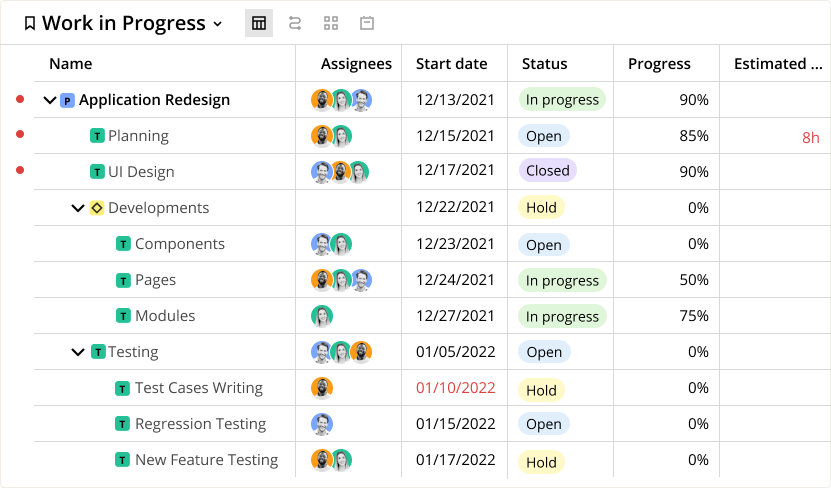
- Tracking time and costs across long-running engagements
Time and costs can be tracked by phase and activity type, giving visibility into effort and helping teams compare actuals to estimates as the project progresses.
- Managing scope changes and budget impact
When scope shifts, schedules and budgets can be updated together so the impact is visible early, not discovered later.
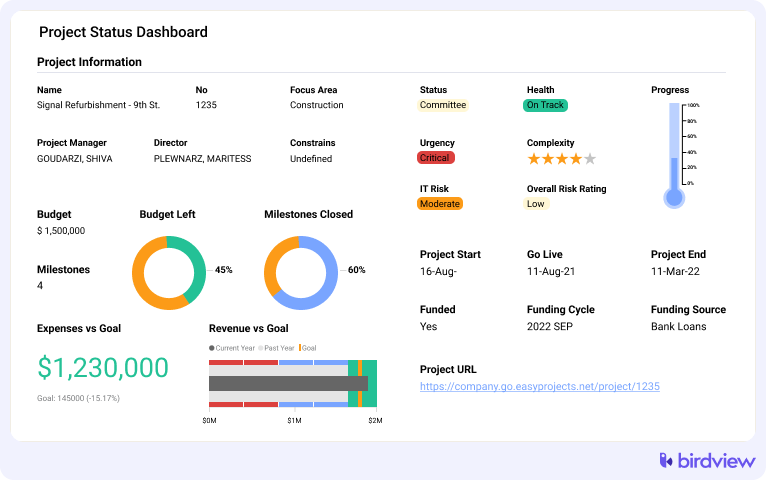
- Using dashboards to monitor progress, effort, and risk
Dashboards provide a high-level view of milestone status, effort, and potential risks without relying on constant status updates.
- Supporting audit-ready records for compliance and reporting
Project data, time logs, and documentation are kept in one place, making it easier to support audits and client reviews.
Best practices for delivering ESG projects consistently
Consistency doesn’t happen by accident. It comes from applying the same standards and learning from each project.
1. Standardize ESG project templates where possible
Don’t reinvent the wheel for every project. If you do a lot of carbon footprint work or sustainability reporting, create a standard template with the typical phases, deliverables, and tasks. You can always customize it, but starting with a template saves time and reduces the chance of missing something important.
2. Review progress and effort monthly, not just at milestones
Monthly reviews keep you honest. Look at what got done, how much effort it took, and whether you’re still on track. This is especially important for long projects where small issues can compound over time. Catching a budget problem in month two is a lot easier than discovering it in month ten.
3. Use historical data to improve future ESG estimates
After each project, look at your actuals versus your estimates. Where were you off? What took longer than expected? Use that information to refine your approach for the next engagement. Over time, your estimates will get sharper, and your project plans more realistic.
4. Treat compliance work as part of delivery, not overhead
Documentation, verification, and audit preparation aren’t extras. They’re core parts of ESG project delivery. Budget for them, track them, and treat them with the same importance as analysis or client-facing work. This mindset shift prevents compliance work from becoming a last-minute scramble.
ESG projects succeed with structure, not heroics
ESG projects are demanding. They require patience, attention to detail, and the ability to manage complexity over long periods. But they don’t require heroics.
What they require is structure. A clear scope. A realistic plan. Disciplined tracking. Regular reviews. The ability to adjust when things change, which they will.
Environmental consulting firms that consistently deliver successful ESG projects aren’t doing it through sheer force of will. They’re doing it with systems that support good project management from the start. They’ve learned that treating ESG work like standard consulting doesn’t work, and they’ve adapted accordingly.
FAQ: ESG project management in environmental consulting
Q: What makes ESG project management different from other consulting projects?
A: ESG projects typically run longer, involve more stakeholders, require audit-ready documentation, and are tied to regulatory deadlines. They’re also more prone to scope changes because regulations and client needs evolve during the engagement.
Q: How do you prevent scope creep in ESG projects?
A: Define what’s included in the original scope with reference to specific frameworks or requirements. Use formal change requests for anything that falls outside that scope, and connect scope changes to their impact on timeline and cost before approving them.
Q: What’s the best way to track time on ESG projects?
A: Track time by activity type, not just by project. Separate assessment work from data collection, analysis, reporting, and compliance documentation. This gives you visibility into where effort is going and helps with future estimates.
Q: How long should you plan for an ESG project?
A: It depends on the deliverable, but most ESG projects run for several months to over a year. Plan in stages with built-in review points rather than trying to map out the entire project upfront. This gives you flexibility to adjust as you go.
Q: What tools help manage ESG projects more effectively?
A: Project management platforms that support phase-based planning, detailed time tracking, scope change management, and dashboards for visibility across long engagements. Tools built for complex professional services work tend to fit ESG projects better than simple task managers.
Q: How do you keep ESG projects profitable?
A: Control scope tightly, track effort accurately, and review budget versus actuals regularly. Treat compliance and documentation work as billable deliverables, not overhead. Use historical data to improve your estimates over time.
Q: What documentation do you need for ESG project audits?
A: You need records of data sources, calculation methodologies, who did what work and when, client approvals, and version histories of reports. Essentially, a clear trail from raw data to final deliverable that an external reviewer can follow.
Q: How often should you review progress on ESG projects?
A: Monthly at a minimum for long projects. More frequent reviews for shorter engagements or high-risk phases. Regular reviews help you catch budget issues, scope drift, and timeline slippage before they become serious problems.