

The basis of any successful project is a well-thought-out budget. The project budget is your financial plan; it outlines the expected costs associated with taking a project from concept to completion. It’s not just about the numbers–it’s about setting a clear path for resource allocation and financial planning.
What is a project budget?
There are multiple interpretations of the definition of Project Budget. At Birdview PSA, we use the following description:
Project Budget is the amount that the final Project Cost should not exceed.
In other words, Project Budget is a Planned (Budgeted) Project Cost.
Naturally, once a Project Manager sets a target for their Project Budget, this target should be compared to the EAC Project Cost. As a Project Manager, you want to make sure that your project stays under or on budget: Project Budget – EAC Project Cost should be equal or greater than zero. This difference is usually referred to as Budget / Cost Variance.
Budget vs. cost variance in project management
Cost variance involves checking how well your project is sticking to its budget. It looks at the difference between the budget planned before starting the project and the actual amount spent.
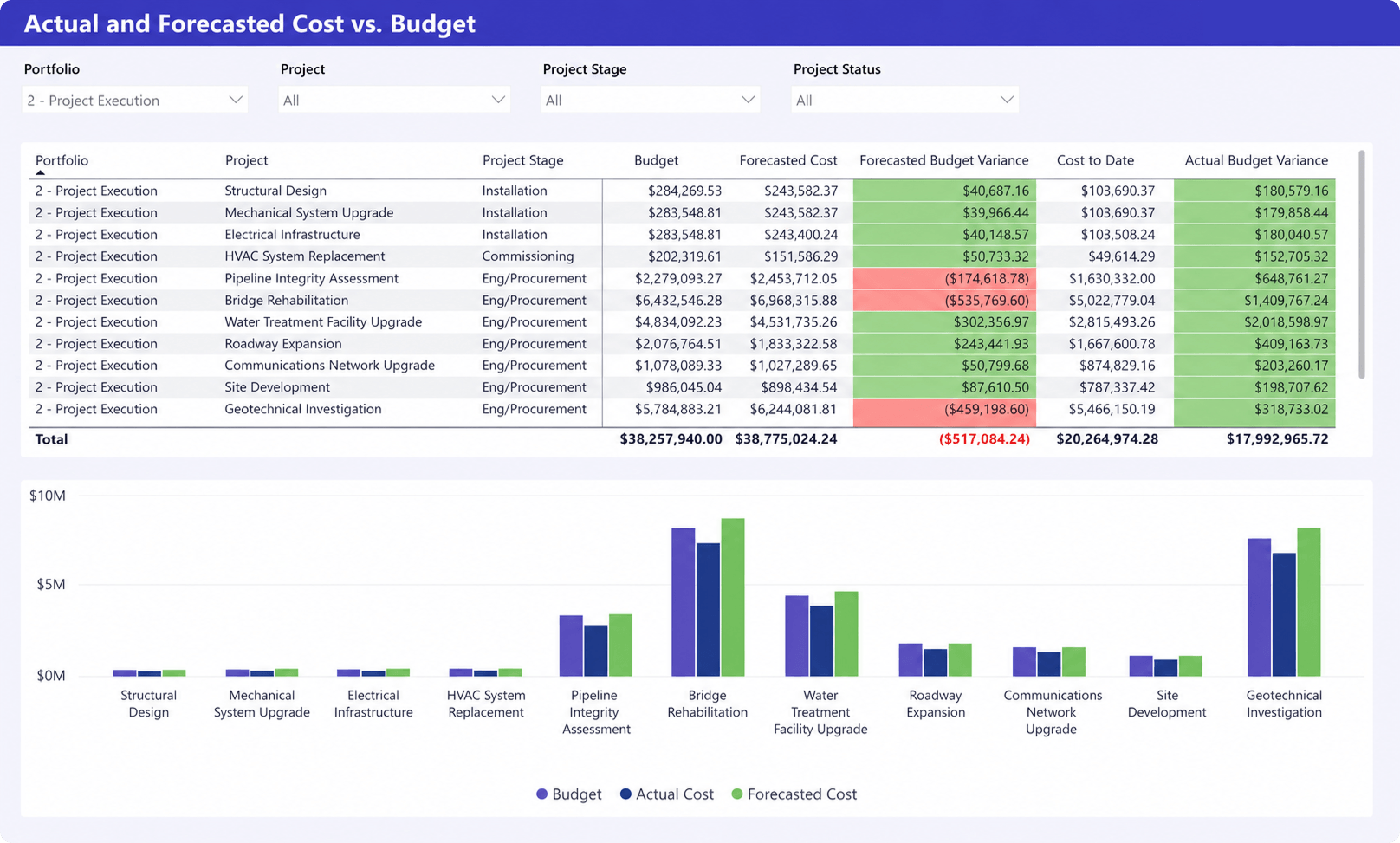
If your Cost Variance is negative, it means that you will be over your allocated budget when the project is completed. You need to mitigate this risk as soon as possible or prepare for a tough talk with the project stakeholders.
How to calculate project budget?
Sometimes you are given a fixed project budget that you have to work with. If that is the case, congratulations, your job just got easier (spoiler alert: it did not).
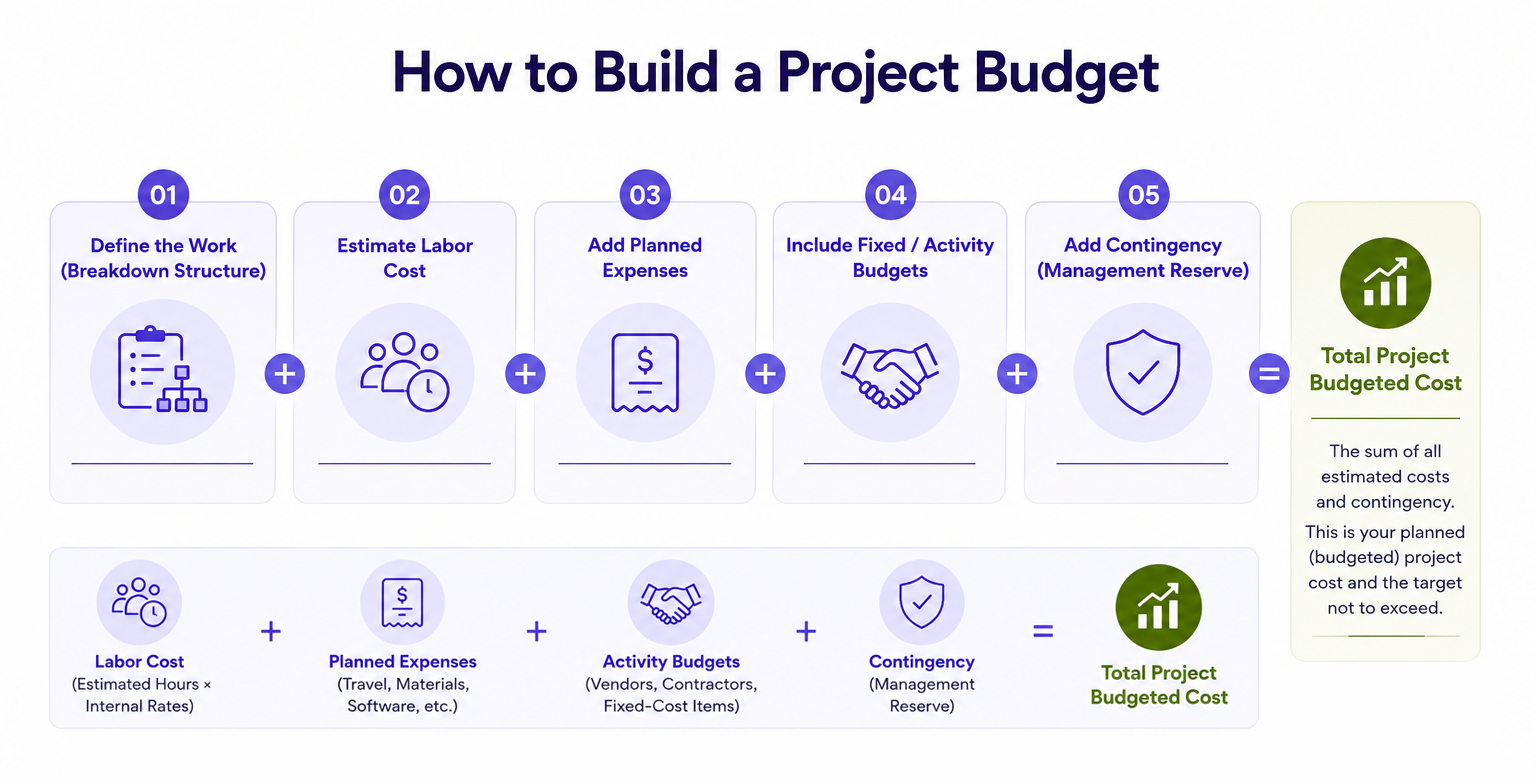
More often, especially with billable projects, you need to calculate your project budget (internal planned cost) to prepare a quote for your customer. Here are the four steps we recommend following:
- Create your work breakdown structure (WBS) (i.e. the list of tasks needed to complete the project).
- Work with your team to estimate the time required to complete each task. Estimated time multiplied by the internal rates of team members assigned to each task will give you the estimated labor cost, an essential aspect of budget management in project management.
- Add all planned expenses.
- Some tasks might have a fixed cost, for example, if they are to be completed by vendors or contractors. If you do not want to record these tasks as planned expenses, you can add a separate budget for each such task (activity).
- At this point, you got all the estimated costs of a project; this is what you think your project will cost you. However, it is always good to add some additional contingency padding to cover some unexpected risks.
The summary of the Labor Cost + Planned Expenses + Activities Budgets + Contingency Project Budget padding will give you the Total Project Budget or the way it is called in Birdview PSA: Total Project Budgeted Cost. This comprehensive approach to budget management in project management ensures that all financial aspects of the project are considered and managed effectively.
Further Reading
Key project budget metrics to track
Effective project budget management requires more than comparing planned and actual spending. Project managers should also track remaining expected costs, the forecasted total cost at completion, budget variance, and profitability. The table below summarizes the key metrics used throughout the budgeting process.
| Budget Metric | What It Tells You | Calculation |
|---|---|---|
| Project Budget | The total amount approved or planned for completing the project. | Planned Labor + Expenses + Other Project Costs + Contingency |
| Actual Cost | How much the project has actually cost to date. | Actual Labor Cost + Actual Expenses + Other Recorded Costs |
| Estimate to Complete (ETC) | The estimated additional cost required to finish the remaining project work. | Forecast Cost of Remaining Work |
| Estimate at Completion (EAC) | The total cost the project is currently expected to reach by completion. | EAC = Actual Cost + ETC |
| Budget Variance | How far the current forecast is expected to finish above or below the project budget. | Budget Variance = Project Budget − EAC |
| Cost Variance % | The expected budget variance expressed as a percentage of the total project budget. | (Budget Variance / Project Budget) × 100 |
| Project Profit | The amount of project revenue remaining after project costs are deducted. | Project Profit = Project Revenue − Project Cost |
| Profit Margin | The percentage of project revenue retained as profit after project costs. | (Project Profit / Project Revenue) × 100 |
How to monitor project budget burn rate
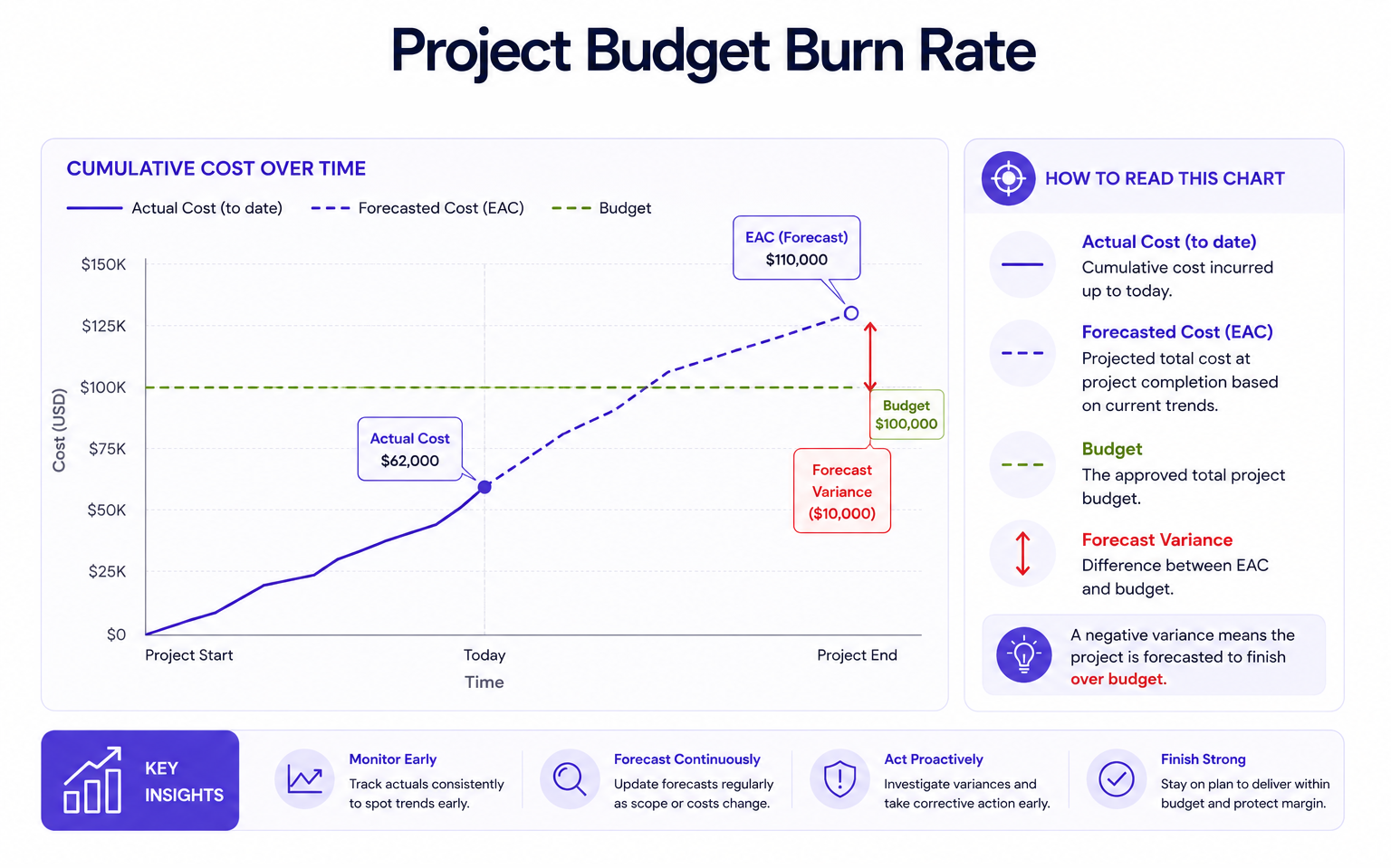
Project budget burn rate shows how quickly a project is consuming its available budget over time. Monitoring the burn rate helps project managers identify whether spending is progressing at a sustainable pace or whether the project is likely to exhaust its budget before the work is complete.
Looking only at actual cost can hide future budget problems. A project may still appear to be within budget today while its current spending pattern and remaining work indicate that the final cost will exceed the approved budget. For this reason, budget monitoring should combine actual cost to date with Estimate to Complete (ETC) and Estimate at Completion (EAC).
EAC = Actual Cost to Date + ETC
Compare the updated EAC with the project budget throughout delivery. If the forecasted cost begins approaching or exceeding the budget before the project is complete, investigate the cause early. Higher-than-expected labor hours, additional expenses, scope changes, or inaccurate original estimates can all accelerate budget consumption.
How to control project costs throughout delivery
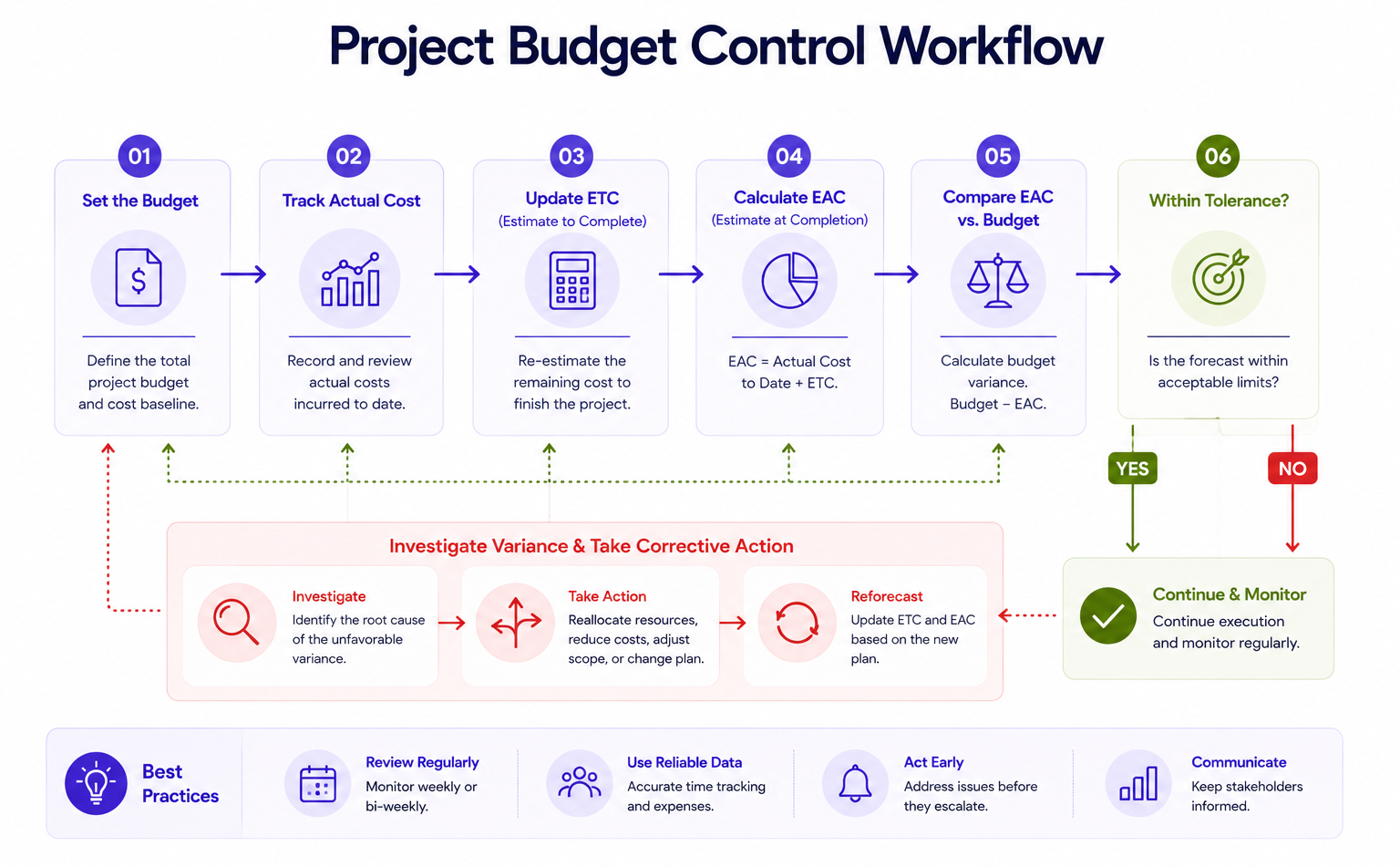
Project budget management is an ongoing process rather than a one-time planning exercise. Once the budget is established, actual costs and remaining work should be reviewed regularly so that the forecast reflects the latest project conditions.
A practical cost-control cycle starts with the approved budget, tracks actual costs, updates ETC, recalculates EAC, and compares the new forecast with the budget. If the forecast remains within an acceptable range, the project can continue to be monitored. If the variance becomes unfavorable, the project manager should investigate the cause, take corrective action, and reforecast.
Project budget management: use cases and examples
Now that we have covered the breakdown of project finances, we will review a few different project billing scenarios and see which financial metrics would be useful in each case.
1. Managing the budget for an internal project
Scenario: You need to organize a company retreat.
Financial needs:
- Prepare a budget for the retreat.
- Monitor costs as the preparation goes on.
Initial Setup:
- Create a detailed project plan (WBS)
- Specify estimated hours for the tasks, where internal labor costs are expected (for example, Marketing department acting as a profit center and charging internally for its work on the retreat signage)
- Add planned expenses for each task in the plan that has any costs associated with it (for example, accommodation booking, catering, canoe rental, etc.)
- Set aside an additional budget for unexpected expenses and force majeure.
- Combine estimated labor cost (24 hours * $50/hr = $1,200), additional contingency project budget ($4,500), and all planned expenses ($18,600).
- Your total project budgeted cost comes to $24,300.
Metrics to track:
- As the project progresses, compare the Actual Project Cost and Estimate at Completion (EAC) Project Cost with Project Budget to make sure you’re staying on track.
2. Managing a flat fee project
Scenario: The Customer Success team needs to implement and deploy a software platform for a customer. Implementation will be sold as a fixed cost contract. This project will only involve labor costs, with no expenses to occur.
Financial needs:
- Determine the value of the contract using a 30% profit margin requirement.
- Make sure certain high-risk activities do not exceed their budgets.
- Monitor overall internal labor costs.
- Bill customer and track payments according to the agreed schedule.
- Calculate project profitability.
Initial Setup:
- Create a detailed project plan (WBS). Use a template if available.
- Assign employees to each task.
- Specify estimated hours for all tasks (activities).
- Make sure all resources involved in the project have their internal rates specified.
- Add the budget for all activities that have a previous demonstrated history of potentially exceeding estimated costs.
- Set aside an additional budget for unexpected expenses and force majeure.
- Calculate Estimate at Completion (EAC) Project Cost:
Labor Cost ($7,000) + Additional Project Budget ($1,000) = $8,000
- Calculate Project Flat Fee based the desired 30% Profit Margin.
Project Fee = Project Cost ($8,000) + 30% = $10,400
- Setup agreed upon payment schedule, i.e., 25% prepayment, 20% when the initial platform configuration is done, 35% when the training is completed, 20% when User Acceptance Testing is completed.
- Make sure your team tracks their time.
Metrics to track:
- For high-risk activities, monitor and compare their Activity Actual cost with Activity Budget.
- Compare Actual Project Cost, EAC Cost and Estimated to Complete (ETC) Cost with the overall Project Budget.
- Record and track all received payments.
- Monitor project profitability.
3. Managing the budget for Time and Materials contracts with a profit margin goal
Scenario: A time and material contract has been signed for an IT Support project. An in-house team, as well as 3rd-party contractors, will be involved. Different billing rates and fixed billing amounts need to be applied based on the type of activity performed.
Financial needs:
- Set different billing rates based on the type of activity performed (hourly or fixed cost).
- Add a 15% billing markup for all jobs performed by vendors and contractors.
- Monitor overall internal project costs and maintain a 30% profit margin.
- Monitor billable hours compared to total available hours to maintain at least 75% Utilization rate.
- Bill customer monthly.
Initial Setup:
- Create a detailed project plan.
- Assign employees to each task.
- Specify estimated hours for all tasks (activities).
- Make sure all resources involved in the project have their internal rates specified.
- Set Project Billing Type as “Time and Material” and choose “Activity Rate” as a billing preference.
- Specify hourly billing rates for activities that should be billed based on time (both for internal team and 3rd-party contractors).
- For all fixed cost activities performed by 3rd parties:
- Add them as actual non-billable expenses.
- Add them as fixed-fee activity billing costs with an extra 15% markup.
- Add all labor-based payments to 3rd parties as non-billable expenses as well.
- Set a 30% Profit Margin as a target to track.
Metrics to track:
- Compare Actual Project Cost, EAC Cost, and Estimated to Complete (ETC) Cost with the overall Project Billing.
- Record and track all time logs and expenses.
- Monitor project profitability.
- Compare Billable and Non-Billable Time Entries to monitor Utilization Rate.
- Run monthly billing reports to charge the customer for all unbilled activities.
4. Managing the budget for Time & Material contracts with rate cards
Scenario: A time and material contract has been signed for an engineering project. Billing will be based on the role a person has in the project.
Financial needs:
- Set different billing rates based on the role, skills, and seniority of each team member.
- Set a target revenue of $250,000 and a target profit amount of $50,000.
- Monitor overall internal project costs.
- Bill customer monthly.
Initial Setup:
- Create a detailed project plan.
- Assign employees to each task and assign them the appropriate role in this project.
- Specify estimated hours for all tasks (activities).
- Make sure all resources involved in the project have their internal rates specified.
- Set Project Billing Type as “Time and Material” and choose “Rate Cards” as a billing preference.
- Specify Rate Cards for this project.
- Set a $250,000 revenue target and a $50,000 profit target.
Metrics to track:
- Compare Actual Project Cost and Actual Billing to track real-time project profit, and EAC Cost vs. EAC Billing to track expected profit.
- Record and track all time logs and expenses.
- Monitor project total billing (revenue) and profitability.
- Run monthly billing reports to charge the customer for all unbilled activities.
FAQs:
Why is a project budget important?
A project budget provides a financial framework for the project, guiding spending and ensuring the project is completed within its financial constraints.
How often should I review my project budget?
Review your budget regularly, at least once a month, or more frequently for fast-paced or critical projects.
What do I do if my project is going over budget?
Identify the causes of the overrun, assess the impact, and explore options such as reallocating resources, adjusting project scope, or securing additional funds.
Can project management software with a budgeting module be useful?
Project management software equipped with a budgeting feature can significantly increase precision in budget forecasts, simplify monitoring, and boost the efficiency of reporting, thereby enhancing the overall management of budgets.

