

Coordinating dozens of projects, people, and priorities can quickly turn into chaos without a plan. For PMO leaders, consultants, and portfolio managers, it’s about making sure every project serves a bigger purpose. Project portfolio management (PPM) process connects day-to-day execution with strategic goals, helps your team work smarter, and gives you a clearer view of what’s driving value.
In this guide, we’ll walk through each stage of the PPM lifecycle and show you how to build a process that’s easy to manage, scale, and improve as your organization grows. The same stages become a portfolio governance framework when you name decision rights, review cadence, and pause-or-stop rules, not only intake and prioritization steps. For the wider guide map, see the project portfolio guide.
What is the project portfolio management process?
Project portfolio management process is about how well your organization handles the big picture of project work. It’s making sure the full mix of projects connects back to your business strategy. That means having a clear process for choosing what to work on, figuring out how to get it done, and checking in along the way to see if it’s all delivering the value you expected. While project management focuses on getting a specific job done, portfolio management zooms out to help you pick the right mix of projects that support overall business direction.
- Collect and review new project ideas
- Prioritize work that truly supports strategic goals
- Match resources with where they’ll have the most impact
- Stay on top of project progress and adapt when needed
A portfolio governance framework is the decision layer on top of that process: who may approve work, which criteria rank it, how often leaders review live status, and what evidence triggers stay, pause, or stop. Without that layer, the six stages below still run, but decisions drift into email and politics.
Project portfolio management stages
Creating a process for managing your project portfolio starts with a clear structure. These stages offer a step-by-step approach to help your team stay organized, use time and resources wisely, and keep projects aligned with broader business priorities. You can always adapt the details to fit your team, but the structure here gives you a reliable place to start.
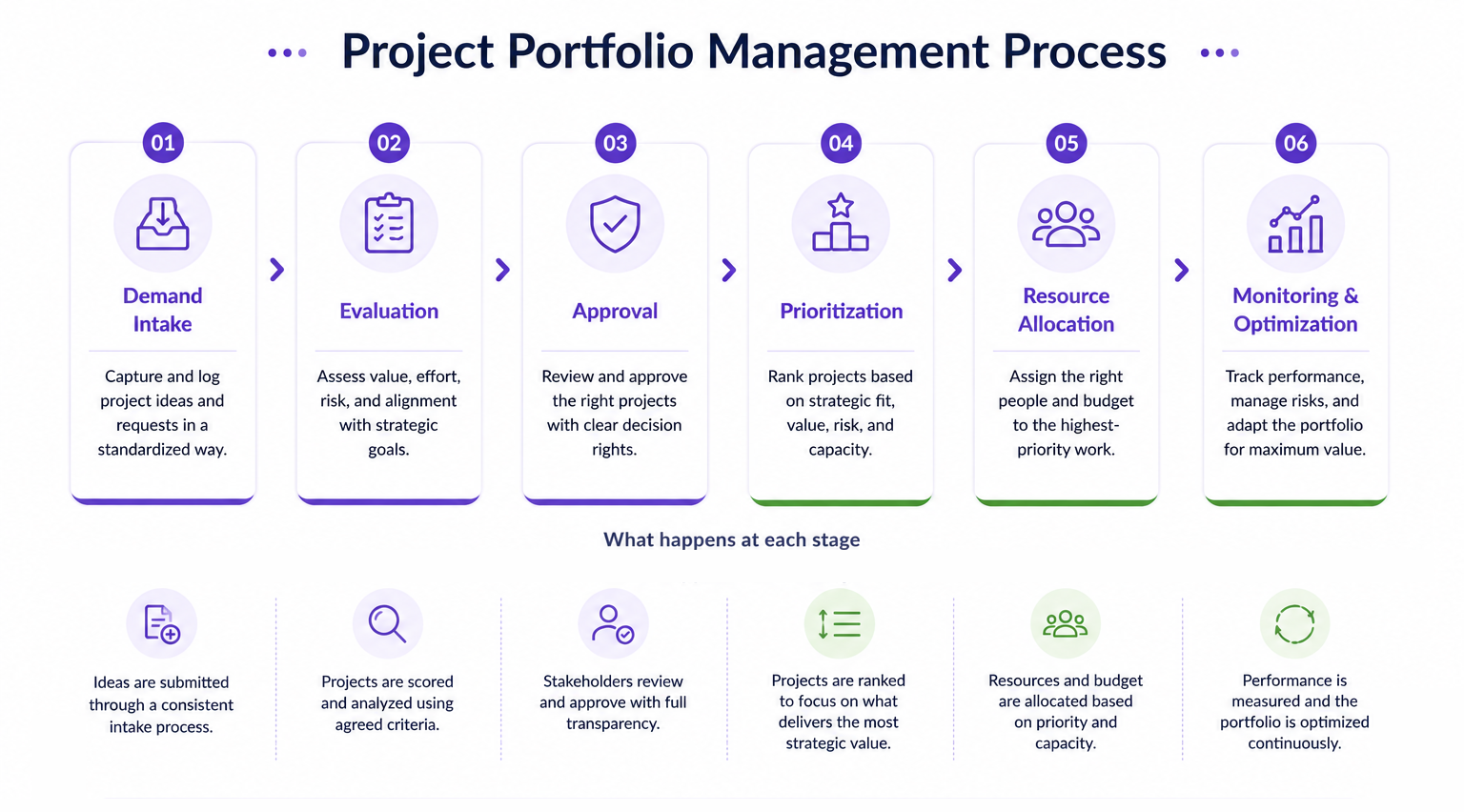
| Stage | Objective | Outputs | Birdview tools to help |
|---|---|---|---|
| Demand intake | Collect project ideas consistently | Standardized proposals, intake backlog | Custom forms, request pipeline |
| Evaluation | Assess project value, effort, and alignment | Scoring results, shortlists, business cases | Custom fields |
| Approval | Ensure the right projects get formal sign-off | Approval records, audit trails | Automated workflows, approval routing, activity log |
| Prioritization | Rank projects based on strategic fit and urgency | Prioritized project list, visual portfolio view | Portfolio dashboards, filtering |
| Resource allocation | Assign people and budget efficiently across projects | Resource plans, team assignments | Resource Planning, Workload View, capacity forecasting |
| Monitoring and optimization | Track progress, spot risks, and adapt as needed | Performance metrics, real-time visibility | BI dashboards, timeline tracking, health indicators |
1. Demand intake
This stage is all about gathering project ideas and requests from across your organization. These might come from department leaders, executives, or client feedback. Without a structured intake process, it’s easy for ideas to be overlooked or to pile up without clarity.
To bring order to the process:
- Use a centralized intake form for submitting proposals
- Collect important data like business impact, cost estimate, and timing
- Assign someone like a portfolio coordinator to manage incoming requests
📍 Example: A Custom form allows teams to submit proposals in a standardized format. Submitted ideas feed directly into the request pipeline, giving stakeholders visibility and structure.
2. Evaluation
Once ideas are in the system, it’s time to evaluate which ones are worth pursuing. This means looking at potential value, risks, and how well a project fits with your overall goals.
A solid evaluation step includes:
- Scoring each request on value, timing, effort, and risk
- Getting input from finance, operations, strategy, or other relevant teams
- Using templates so every project is evaluated consistently
Some projects may not move forward right away, but this step helps you focus on the strongest opportunities.
📍 Example: With Custom fields, teams can apply consistent criteria to proposals. This enables better side-by-side comparisons of ideas across the portfolio.
3. Approval
Before any project kicks off, it usually needs a formal go-ahead. This step brings in governance and makes sure the organization stays focused on the right work.
To manage this process:
- Define thresholds for when higher-level approval is needed
- Clearly identify who’s responsible for each decision
- Keep a record of who approved what and when
📍 Example: An automated approval flow directs each request to the appropriate reviewers, logs decisions, and builds an approval history you can reference at any time.
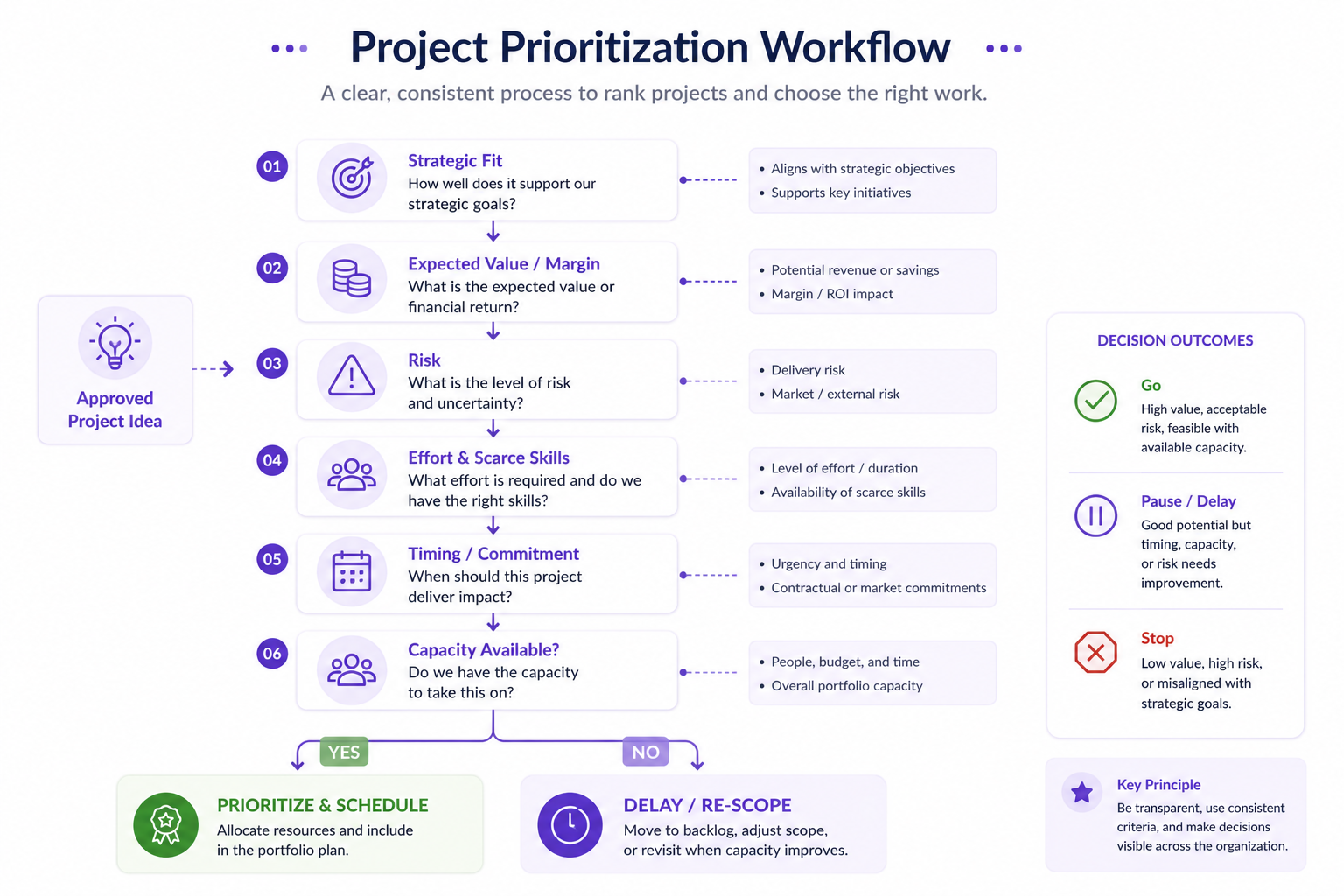
4. Prioritization
Once a project is approved, the next question is: when should it start? With limited time, people, and money, you’ll need to decide what comes first.
Prioritization can be done using:
- Scoring systems that weigh impact, urgency, and required effort
- MoSCoW method to classify work as Must, Should, Could, or Won’t do
- Visual tools that map out value vs. risk
These tools help make decisions more transparent and focus efforts on the work that matters most.
📍 Example: Portfolio views can display projects with filters and scores to highlight those that align best with business strategy. Teams can use tags and custom dashboards to spotlight top priorities.
5. Resource allocation
With your priorities set, it’s time to assign the right people and resources to the right work. This step helps to ensuring that no one is stretched too thin and the team can actually deliver.
To do this well:
- Look at team capacity across locations, roles, and departments
- Use planning tools to catch conflicts and availability gaps
- Build in some buffer space to handle changes
📍 Example: Resource Planning and Workload View tools give real-time insight into team availability and assignments. Managers can spot overloads quickly and make adjustments to keep delivery on track.
6. Monitoring and optimization
Once a project starts, portfolio management shifts into active monitoring. The goal here is to make sure each project delivers what it promised–and if not, make adjustments.
To stay on top of performance:
- Track budget, timelines, scope, and expected outcomes
- Use live dashboards to see how things are going
- Schedule regular check-ins to adjust resources or priorities as needed
📍 Example: Business Intelligence Dashboards bring together performance data from across the portfolio. PMOs can watch trends in real time, flag risks quickly, and make informed decisions without relying on delayed manual updates.
Further reading:
Why consulting firms need a portfolio governance framework
Consulting firms need a portfolio governance framework because sold work arrives faster than capacity and margin can absorb it. Pipeline looks healthy. Delivery still starts late, scarce skills stay double-booked, and leadership learns about risk after the client already felt it.
A framework does three jobs the six PPM stages alone do not:
- Name decision rights. Who may keep, pause, or stop work, and on what evidence.
- Force capacity into the vote. Approvals without a staffing view create phantom starts.
- Protect margin in flight. Write-downs and overtime should trigger a review before quarter close.
SPI Research’s 2026 Professional Services Maturity Benchmark draws on 509 professional services organizations. In that same benchmark, Level 5 firms report about 42% more billable utilization than Level 2 peers [1]. Revenue can still grow while people stay misallocated. Governance is how firms stop saying yes to every opportunity without a staffed path to delivery.
PMI research frames portfolio governance as more than oversight of live work: it runs end to end from ideation and selection through delivery [2]. That is the layer consulting firms need when sold demand outruns capacity.
What belongs in a portfolio governance framework for project portfolios
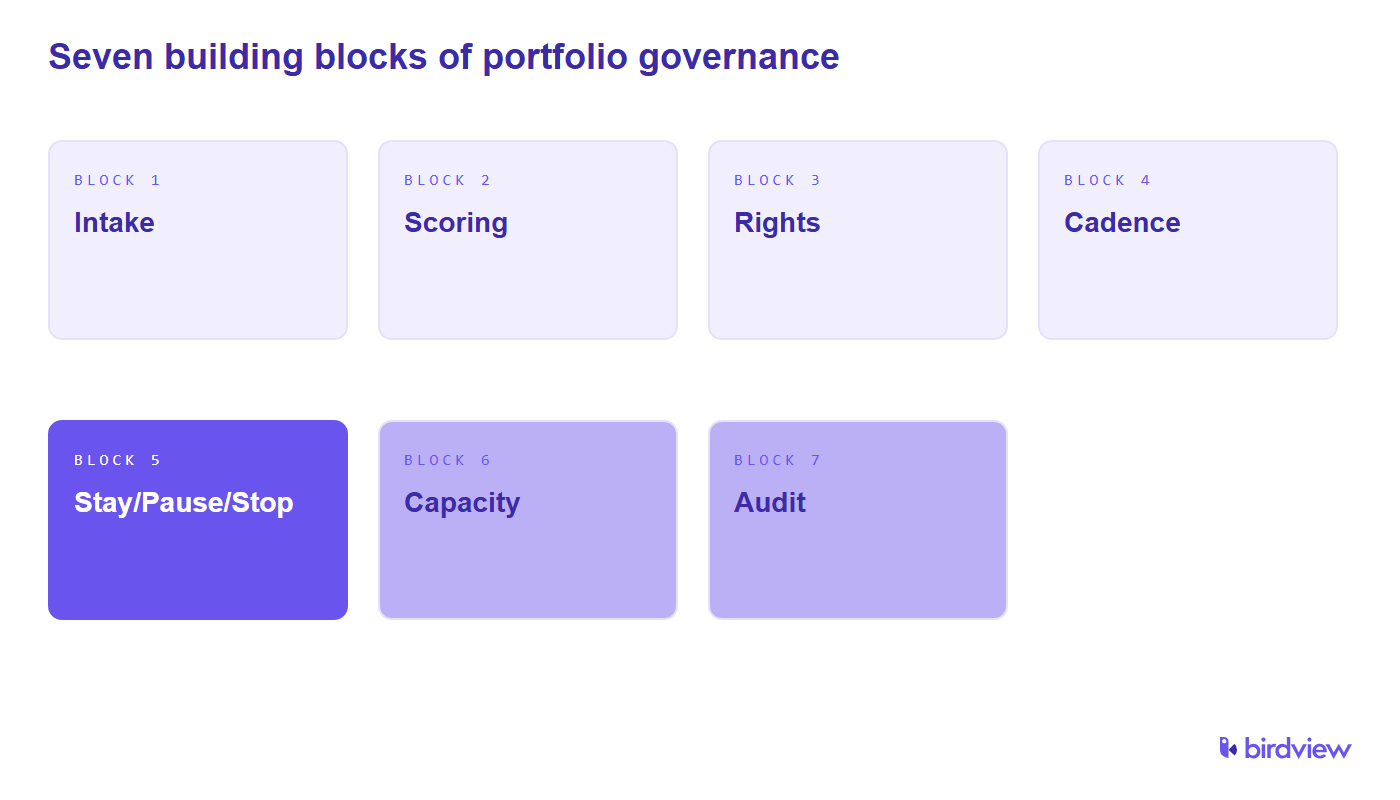
A usable portfolio governance framework for project portfolios usually includes seven building blocks.
| Block | What it answers |
|---|---|
| Intake standard | Which fields every proposal must carry before review |
| Scoring model | How value, risk, effort, and timing are weighted |
| Decision rights | Who approves below and above thresholds |
| Cadence | How often leadership runs portfolio reviews |
| Stay / pause / stop rules | What evidence forces each outcome |
| Capacity check | How staffing conflicts block or delay start |
| Audit trail | Where decisions and reasons are stored |
Keep the framework short enough that PMs and partners can recite it. Long policy decks that nobody opens during crunch weeks are not governance, they are shelfware.
Who decides which projects stay, pause, or stop in portfolio governance
Who decides which projects stay, pause, or stop depends on threshold and risk, not on who shouted last in Slack.
Typical pattern for a mid-size services firm
- Practice lead / engagement sponsor: recommend pause or stop with written reason.
- Portfolio board (PMO + delivery + finance): decide for work above a cost, margin, or risk threshold.
- Executive sponsor: escalate when client relationship or firm strategy is at stake.
Stay means continue with the current plan. Pause means freeze new spend or staffing until a named condition clears. Stop means close or hand off with a recorded decision date.
The framework fails when only sales can start work and only delivery can beg for help later. Put both seats on the same board and use the same project record.
How often should leadership run portfolio governance reviews
Leadership should run portfolio governance reviews on a fixed cadence that matches how fast your mix changes.
| Firm pace | Suggested cadence | Focus |
|---|---|---|
| Stable mid-market | Monthly board + weekly PMO triage | Starts, capacity conflicts, aging risks |
| High growth / many short engagements | Biweekly board + weekly triage | New yeses vs scarce skills |
| Large programs | Monthly board + stage-gate reviews | Benefits, margin, client commitments |
Do not wait for a crisis to invent a review. Put the next date on the calendar with a fixed agenda: new intakes, score changes, capacity exceptions, pause/stop candidates. Between boards, PMs update status in PSA so the meeting reads live data, not a Friday slide rebuild. Related metrics framing: project portfolio KPIs.
What criteria should a portfolio governance framework use to prioritize work
Prioritization criteria should be published, scored the same way every time, and visible in the portfolio view.
Core criteria most mid-size firms need
- Strategic fit to this year’s offers and accounts
- Expected margin or contribution after known costs
- Delivery risk (scope clarity, client readiness, dependency count)
- Effort and scarce-skill demand
- Timing / contractual commitment
- Capacity reality for the proposed start window
Weight the scores so two partners cannot invent a private scale. MoSCoW and value-vs-risk maps still help, as long as they feed the same board packet. When scores disagree with politics, the framework wins only if leadership backs the recorded model.
How portfolio governance connects to resource capacity in PSA
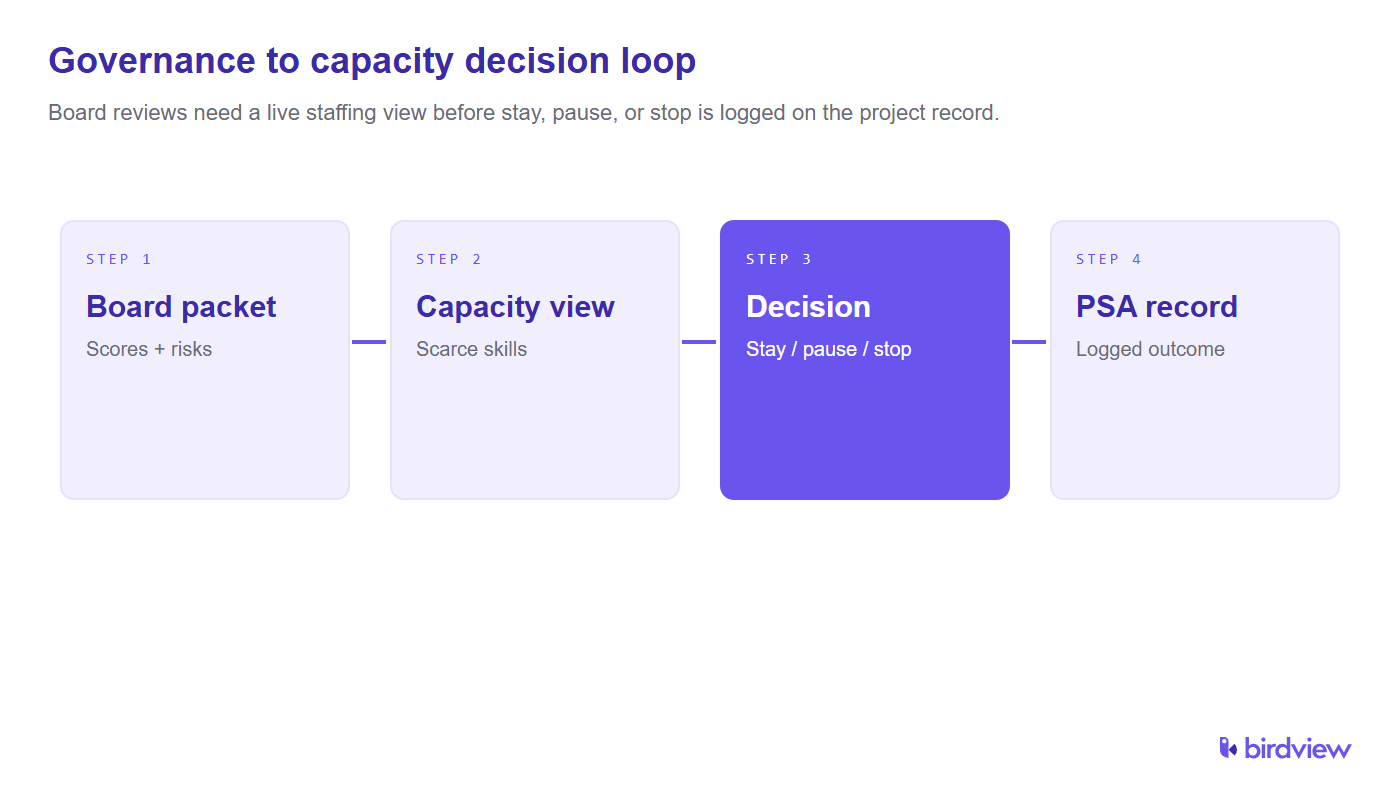
Portfolio governance connects to resource capacity in PSA when the approval vote cannot finish without a staffing view.
Practical link
- Proposal carries role demand and start window.
- Capacity planning shows conflicts on scarce skills before the board date.
- Board chooses delay, re-scope, hire/contractor, or stop, not a silent “yes” into overload.
- After start, monitoring compares hours consumed vs plan so pause triggers are early.
Without that link, governance is a meeting about ambition. With it, governance is a meeting about what the firm can staff. For staffing horizon detail, see capacity planning for consulting firms.
How a portfolio governance framework protects margin and delivery risk
A portfolio governance framework protects margin and delivery risk by forcing early decisions on weak work.
Margin protection
- Reject or re-price low-contribution requests before kickoff.
- Pause when forecast margin drops below a published floor.
- Stop when write-offs or scope creep erase the sold case.
Delivery-risk protection
- Block starts when scarce skills are already overcommitted.
- Escalate aging approvals and unsigned change orders.
- Rebalance when status health turns red across multiple accounts for the same practice.
SPI’s maturity gap is the industry hint [1]: higher-maturity firms convert the same demand into more billable utilization when allocation discipline is real. Governance turns that into weekly action, not a year-end surprise.
How to build a simple portfolio governance framework for a mid-size services firm
Build a simple portfolio governance framework for a mid-size services firm in six moves, then stop adding policy.
- Publish one intake form with impact, cost, timing, and role demand.
- Adopt one scoring sheet (value, risk, effort, timing) used by every practice.
- Name the board and thresholds for who decides stay / pause / stop.
- Set cadence (monthly board + weekly triage is enough for most 50 to 150 person firms).
- Wire capacity into the vote via PSA staffing views before start dates lock.
- Log every decision on the project record, no private “we agreed in the hallway.”
Pilot on one practice for 60 days. Expand only when PMs and partners use the same packet without rebuilding it in Excel.
Can PSA support a portfolio governance framework with live project data?
Yes, PSA can support a portfolio governance framework with live project data when intake, scores, approvals, staffing, time, and status share one engagement record.
What to require from the stack
- Intake forms that land in the portfolio pipeline
- Fields for scores and decision outcomes
- Approval history you can audit
- Capacity and workload views at skill level
- Dashboards for margin, timeline, and health without a shadow export
Spreadsheets break the framework because the board packet ages overnight. Live PSA data keeps the same numbers for PMs, PMO, and finance in the review. Sister ops framing: the professional services operations complete guide.
Common challenges in the PPM process
Even with a strong framework in place, managing a portfolio isn’t always smooth. Teams often run into roadblocks caused by gaps in data, unclear processes, or a lack of coordination. Recognizing these early helps keep the system on track.
- Inconsistent intake details: If proposals vary in quality or miss key info, it’s tough to compare or evaluate them properly.
- Misaligned project choices: Sometimes projects get approved for the wrong reasons, like internal politics, rather than real business value.
- Resource shortages: Great projects can still stall if the right people aren’t available or are already overloaded.
- Data silos: When teams use different systems, it’s hard to get a full picture of what’s happening.
- Weak governance: Without clear approval steps or decision-makers, things slow down or become inconsistent.
- Limited executive support: Without leadership backing, teams struggle to secure resources or resolve conflicts.
- Too many projects, not enough capacity: Trying to do it all leads to delays, burnout, and lower-quality work.
When those challenges show up, treat them as framework gaps: missing intake fields, missing decision rights, or capacity votes that happen after the start date.
Tools that support the PPM process
Trying to manage this entire process manually or in spreadsheets can quickly become overwhelming. Purpose-built tools like Birdview PSA provide structure, automation, and visibility across all six stages.
Project intake forms and workflows
- Standard forms make it easier to collect the right details upfront.
- Automated workflows help move requests through review steps efficiently.
Project prioritization tools
- Scoring tools apply consistent criteria to all potential projects.
- Teams can focus on high-value work instead of reacting to noise.
Resource capacity planning tools
- These tools show who’s available, who’s overloaded, and where there’s slack.
- That helps avoid overscheduling and improves forecasting.
Portfolio dashboards and analytics
- Real-time dashboards show what’s working and what’s not.
- Metrics help track alignment, budget, timelines, and more.
Together, these tools support a more streamlined, reliable portfolio management process, cutting down on manual effort, improving transparency, and helping teams stay focused on delivering long-term value.
Optimize your PPM process with Birdview PSA
Birdview gives PMO teams and enterprise project groups the structure and visibility they need to manage the full portfolio lifecycle. From collecting project ideas to setting priorities and tracking delivery, Birdview supports every step with flexible tools built to scale.
Whether you’re starting from scratch or improving an existing process, Birdview helps teams stay aligned with strategy, make decisions faster, and respond to change with confidence.
Streamline portfolio workflows using Birdview’s PPM management platform. Use the stages above as the operating spine, then lock governance on top: decision rights, cadence, criteria, and capacity-backed stay / pause / stop.
FAQ
Why do consulting firms need a portfolio governance framework?
Because sold work outruns capacity and margin without named decision rights, capacity checks, and pause-or-stop rules. Stages alone do not stop a silent yes into overload.
What belongs in a portfolio governance framework for project portfolios?
Intake standard, scoring model, decision rights, review cadence, stay/pause/stop rules, capacity check, and an audit trail on the project record.
Who decides which projects stay, pause, or stop in portfolio governance?
Practice leads recommend; a portfolio board (PMO, delivery, finance) decides above thresholds; executives escalate when strategy or key accounts are at stake.
How often should leadership run portfolio governance reviews?
Monthly board plus weekly PMO triage fits most mid-size firms; biweekly boards fit high-change portfolios. Put the next date on the calendar with a fixed agenda.
What criteria should a portfolio governance framework use to prioritize work?
Strategic fit, margin contribution, delivery risk, effort and scarce-skill demand, timing, and capacity for the proposed start window, scored the same way every time.
How does portfolio governance connect to resource capacity in PSA?
The board vote should require a staffing view before start dates lock, then monitor hours vs plan so pause triggers fire early.
How does a portfolio governance framework protect margin and delivery risk?
By rejecting or re-pricing weak work early, pausing when forecast margin or staffing breaks floors, and stopping when write-offs erase the sold case.
How do you build a simple portfolio governance framework for a mid-size services firm?
One intake form, one scoring sheet, named board and thresholds, fixed cadence, capacity wired into the vote, decisions logged on the project record, pilot one practice for 60 days.
Can PSA support a portfolio governance framework with live project data?
Yes, when intake, scores, approvals, staffing, time, and status share one engagement record the board reads in the meeting.
Sources
- SPI Research, 2026 Professional Services Maturity Benchmark (509 organizations; Level 5 vs Level 2 billable utilization gap): https://spiresearch.com/reports/2026-ps-maturity-benchmark/
- Project Management Institute, Governance of Innovation in Portfolios, Programs, and Projects (Knapp, Killen, Stevens, Sankaran, 2019): https://www.pmi.org/learning/library/governance-innovation-projects-programs-portfolios-11796

