Blog
Blog

Setting utilization targets without burnout means setting billable work expectations at a level teams can sustain without constant overtime, declining delivery quality, or long-term exhaustion. In practice, this starts with understanding what utilization actually measures, recognizing its limitations, and building operational processes that support realistic capacity planning.
Service firms often use utilization targets to track how much of their team‘s time is spent on billable work. Problems start to appear when utilization becomes the dominant performance metric and teams are pushed toward unrealistic targets. Over time, this leads to stress, hidden overtime, lower delivery quality, and eventually higher employee turnover.
Organizations that manage utilization well treat it as one signal among several indicators of operational health. They monitor utilization trends alongside role-based targets, delivery quality, and overall workload sustainability. Taking this broader view helps teams stay productive without pushing them toward burnout or resignation.
Why utilization targets often backfire
Resource utilization plays a central role in how professional services firms measure performance. Because billable work drives revenue, the metric influences profitability and staffing decisions across many organizations. But when utilization targets are pushed too aggressively, they can start harming both employee well-being and project outcomes.
Why service firms rely on utilization as a core performance metric
Most service organizations generate revenue through billable work delivered by specialists, consultants, or engineers. Utilization reflects how much of a person‘s available time is spent on revenue-generating work.
When utilization is high, teams are usually spending most of their time on client engagements. For that reason, many organizations treat utilization as a key performance indicator for delivery teams.
The common mistake: treating utilization as a productivity score
One common mistake is assuming that utilization reflects individual productivity. In reality, utilization simply tracks how much of someone‘s time is billable.
Employees who spend time mentoring colleagues, improving internal processes, or helping with project planning may appear less utilized, even though these activities strengthen long-term performance.
The difference between healthy utilization and maximum utilization
Maximum utilization aims to fill nearly every available hour with billable work.
Healthy utilization recognizes that teams need time for coordination, training, and recovery between project phases.
Organizations that pursue sustainable utilization build flexibility into capacity planning and allow utilization to rise and fall naturally during project cycles.
What utilization actually measures
Utilization measures how much of a person‘s available working time is spent on billable project activities.
Most organizations calculate utilization using a straightforward formula:
Utilization = Billable hours ÷ Total available hours
For instance, if a consultant records 32 billable hours during a 40-hour week, their utilization rate would be 80 percent.
The metric is useful because it links staffing levels directly to revenue generation. When utilization is high, it usually reflects strong demand for services. Lower utilization can indicate that capacity is underused.
At the same time, utilization alone cannot fully describe team health, delivery quality, or long-term productivity.
For this reason, many organizations review utilization alongside other operational indicators, including project margins, client satisfaction, and employee workload signals. Looking at these metrics together helps leadership determine whether high utilization reflects healthy demand or mounting pressure on delivery teams.
📚 Read more: Capacity utilization: Formula, types, & tools
The hidden costs of chasing “perfect utilization”
When organizations aim for perfect utilization, hidden operational costs often begin to appear. Over time, these costs can reduce long-term performance.
Burnout and turnover
When teams operate close to full capacity for long periods, employees have little time to recover between projects. The pressure often results in burnout and higher employee turnover.
Replacing experienced specialists is expensive and can slow delivery across the organization.
Lower delivery quality
When teams become overloaded, time for planning, documentation, and quality assurance quickly disappears. As a result, errors increase, timelines begin to slip, and client satisfaction often declines.
Reduced innovation and internal improvement work
Internal initiatives, such as automation, process improvement, or knowledge sharing, often disappear once utilization targets start dominating day-to-day decisions.
Although these initiatives are critical for long-term efficiency, they are often pushed aside when billable work fills every available hour.
Over-reliance on top performers
In high-utilization environments, organizations often depend heavily on a small group of experienced specialists. Over time, they become bottlenecks and end up carrying a disproportionate share of the workload.
When those top performers eventually leave, the organization can lose both critical expertise and delivery stability.
📚 Read more: Resource underutilization: how to identify skills underutilized or overutilized?
Practical guide: how to design healthy utilization targets
Designing sustainable utilization targets is less about maximizing billable hours and more about balancing financial performance with workloads teams can realistically sustain.
Step 1: Define realistic utilization ranges
Very few professional services teams can operate close to 100 percent utilization for long periods. Employees need time for coordination, internal meetings, training, and administrative work. These activities are not billable, but they still support successful project delivery.
Because of this, healthy utilization targets usually fall within a range rather than a single fixed number. The appropriate range depends on the role and the type of work being delivered.
| Role | Typical healthy utilization range |
| Consultants / engineers | 70–85% |
| Technical specialists | 65–80% |
| Project managers | 55–70% |
| Leadership roles | 30–50% |
These ranges are illustrative rather than universal. Utilization targets vary by business model, seniority, and service mix.
Maintaining some buffer capacity is important. It allows teams to absorb urgent client requests, unexpected work, or scope changes without immediately overloading schedules.
Utilization will naturally fluctuate during different phases of project work. Delivery periods may push utilization higher, while planning, onboarding, or transition periods usually bring it down. Trying to maintain a constant utilization level across every phase often creates unnecessary pressure on teams.
Step 2: Set role-based utilization targets
Different roles contribute to project delivery in different ways, so applying the same utilization target across the entire organization rarely works in practice.
- Delivery specialists such as consultants or engineers usually maintain higher utilization because most of their work directly generates billable revenue.
- Project managers, however, spend significant time coordinating work, managing risks, and communicating with stakeholders. Moderate utilization gives them enough space to perform these responsibilities effectively.
- Senior leaders and experienced specialists often divide their time between delivery, mentoring, recruitment, strategy, and business development. Their utilization rates are naturally lower, but their work still contributes significantly to long-term organizational performance.
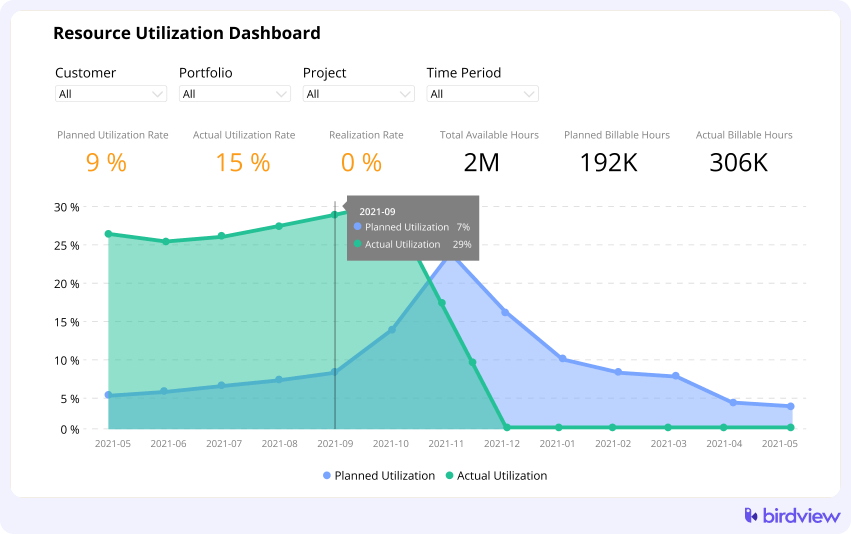
For example, utilization dashboards can help managers compare utilization patterns across teams and roles. Instead of enforcing a single global target, organizations can evaluate whether each role is operating within a reasonable range.
Step 3: Build buffer capacity into planning
Teams that are fully booked leave very little room for change. Even small shifts in project scope or client priorities can create scheduling conflicts.
When every available hour is allocated to billable work, unexpected tasks quickly push teams toward overtime. This creates short-term pressure and makes delivery schedules fragile.
Small capacity buffers improve stability. They allow teams to handle urgent requests, internal work, or temporary workload spikes without disrupting active projects.
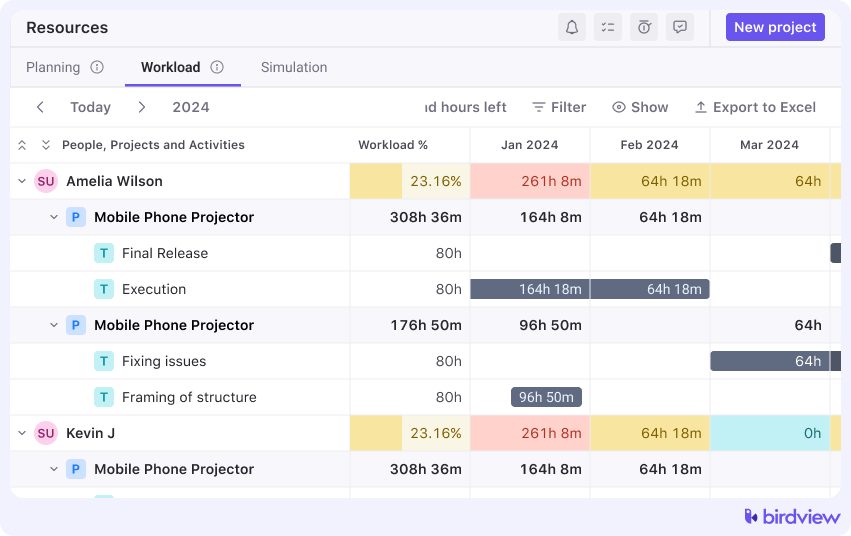
Example: Resource planning views can make these patterns visible early. Managers can spot workload spikes, demand-capacity gaps, or uneven assignments and adjust plans before teams become overloaded.
Step 4: Monitor utilization trends, not single numbers
Utilization becomes much more useful when it is analyzed over time rather than treated as a single weekly number.
Managers should watch for patterns such as:
- long periods of over-utilization across delivery teams
- uneven workload distribution between groups or departments
- recurring spikes during particular project phases
Looking at trends helps leaders identify structural capacity issues instead of reacting to short-term fluctuations.
Step 5: Introduce anti-metrics to balance utilization
Organizations that manage utilization well rarely rely on it as their only performance metric.
Other indicators help provide a more complete picture of delivery health, including:
- employee workload sustainability
- delivery quality indicators
- margin trends across projects
- client satisfaction feedback
Tracking these signals alongside utilization helps ensure that teams are not optimizing for billable hours at the expense of delivery quality or employee well-being.
Step 6: Connect utilization to forecasting and staffing decisions
Utilization becomes most valuable when it informs operational decisions rather than serving only as a performance score.
Teams often use utilization signals to support decisions such as:
- hiring additional specialists
- adjusting project timelines
- redistributing work across teams
- limiting the number of new projects accepted
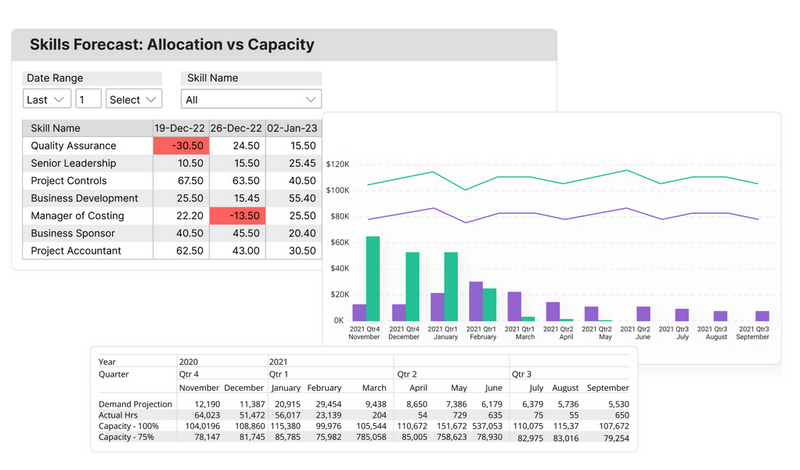
Example: Capacity planning dashboards in systems such as Birdview combine utilization data with upcoming project demand. This visibility allows leadership teams to anticipate when hiring, reprioritization, or schedule adjustments may be necessary before delivery pressure escalates.
Warning signs your utilization model is unhealthy
When utilization targets are set too aggressively, the problems usually show up in daily operations long before they appear in formal reports.
A few signals tend to appear repeatedly in overloaded delivery environments:
- delivery teams working consistent overtime
- rising employee turnover or increasing retention concerns
- internal initiatives such as training or process improvement constantly postponed
- quality issues beginning to surface in active projects
These warning signs often emerge months before teams openly discuss burnout, which is why early detection is important. Monitoring them regularly helps organizations adjust utilization expectations before delivery quality and employee morale begin to decline.
How Birdview supports balanced utilization management
Balanced utilization management requires visibility into workloads, capacity, and project demand. Managers need to see how much of the team‘s time is billable, how work is distributed across people, and whether upcoming projects will push teams beyond sustainable limits.
Birdview supports this by connecting several operational signals in one place:
Time tracking data feeds utilization dashboards, allowing managers to see billable vs. non-billable time and review utilization across individuals, roles, and teams. This helps identify sustained over-utilization or uneven workload distribution early.
Resource planning and workload views also show how assignments affect capacity. Managers can compare planned work against available hours, detect overloaded specialists, and rebalance assignments when demand spikes.
Because utilization data is connected to project schedules and forecasting dashboards, leaders can also see how upcoming projects may affect team capacity. This visibility helps organizations maintain healthy utilization levels while avoiding the overload that often leads to burnout.
Final thoughts: utilization should guide decisions, not dominate them
Utilization is a useful operational signal, but it should not dominate management decisions. The purpose of utilization is to help leaders understand how delivery capacity is being used, not to force teams into constant maximum output.
Sustainable service delivery requires realistic utilization targets, capacity buffers, and a broader set of performance indicators. When organizations rely on utilization alone, they risk creating hidden overtime, declining quality, and long-term delivery instability.
FAQ: utilization targets in service organizations
What is a healthy utilization target for consulting teams?
Most consulting teams operate sustainably with utilization between 70% and 85%. This range leaves space for coordination, learning, and internal improvement work while maintaining strong billable delivery.
Why is 100 percent utilization unrealistic?
No professional services team can spend every hour on billable work. Meetings, planning, documentation, and knowledge sharing are necessary for successful project delivery but are typically non-billable.
What happens when utilization targets are too high?
Excessively high utilization targets often lead to hidden overtime, declining delivery quality, and employee burnout. Over time, this increases staff turnover and reduces long-term delivery capacity.
How often should utilization be reviewed?
Utilization should be reviewed regularly using weekly and monthly trends. Analyzing patterns over time provides more accurate insight than reacting to a single week‘s utilization number.
How does utilization relate to capacity planning?
Utilization shows how much of the team‘s current capacity is used. Capacity planning combines utilization data with future project demand to forecast hiring needs, rebalance workloads, and prevent delivery bottlenecks.
Can utilization vary by role?
Yes. Different roles contribute to value creation in different ways. Delivery specialists typically have higher utilization targets, while project managers and leadership roles have lower targets due to coordination, strategy, and mentoring responsibilities.
Further reading: